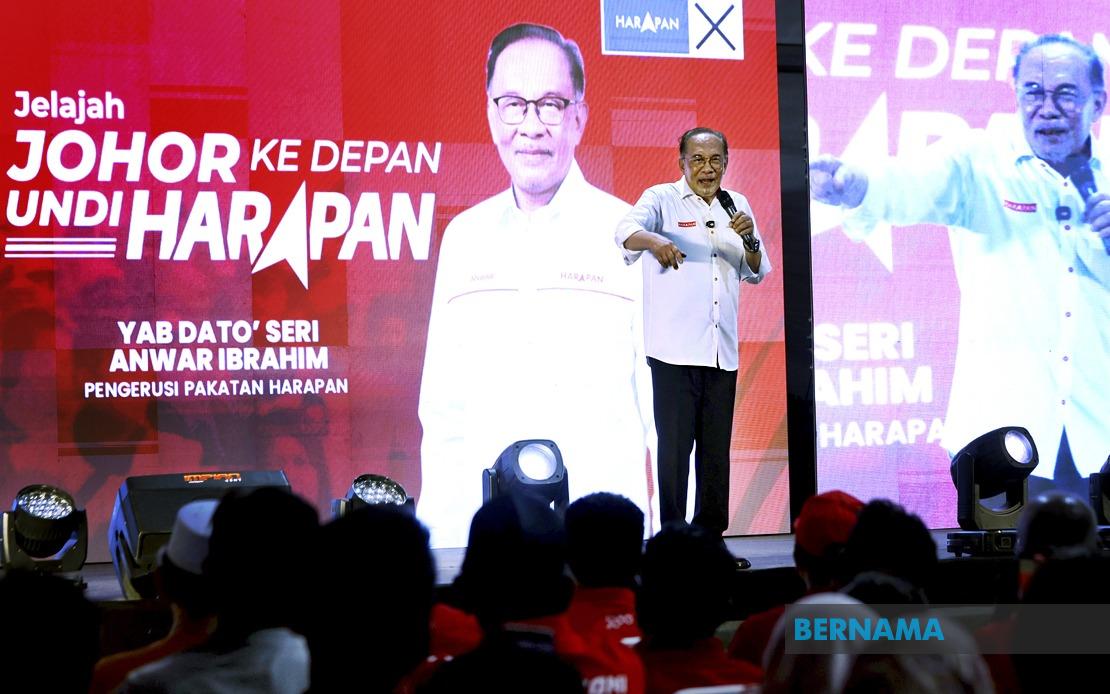
Prime Minister Datuk Seri Anwar Ibrahim has delivered an unequivocal message that the days of using public office for personal enrichment and favouring connected elites are finished, cementing the MADANI Government's positioning as fundamentally opposed to the corruption that characterised previous administrations. Speaking at a campaign event in Sungai Mati within the Serom state constituency in Muar on July 5, Anwar framed anti-corruption not merely as a policy objective but as a defining moral commitment that transcends party lines and political calculation.
The Prime Minister's remarks represent a direct repudiation of what he characterised as the "culture of plunder"—the systemic abuse of state power by government officials and their favoured business associates. Anwar articulated a vision of governance in which administrative systems are fundamentally cleansed of corrupt practices, ensuring that Malaysia's national wealth circulates transparently through legitimate channels for genuine public benefit rather than being diverted through networks of patronage. This framing positions anti-corruption efforts as prerequisite to Malaysia's continued economic development and international standing, linking governance integrity directly to national competitiveness and prestige.
Central to Anwar's message was a challenge to voters to evaluate leaders primarily on the basis of character and ethical standards rather than allowing themselves to be swayed by appeals to narrow sectarian identities or political theatrics designed to obscure personal misconduct. The Prime Minister explicitly rejected any notion that leadership quality should be assessed through communal or racial filters, instead emphasising that communities across Malaysia deserve honest administrators regardless of their own ethnic or religious background. By stating his openness to supporting competent, incorruptible Malays, Chinese, and other communities as leaders, Anwar attempted to reframe the anti-corruption agenda as inherently inclusive rather than targeting any particular group.
Anwar elaborated on the specific abuses that characterised the previous political model, identifying the practice of leveraging governmental authority to enrich immediate family members and business associates through preferential contract awards as particularly egregious. He placed this behaviour squarely within a discredited system now being actively dismantled by the current administration. The characterisation serves both as historical critique and as a stake in the ground regarding standards the MADANI Government claims to uphold, suggesting that discovery of such conduct within the present administration would trigger immediate accountability rather than tolerance.
Significantly, the Prime Minister extended a categorical assurance that no individual would receive protective coverage from government structures on grounds of political affiliation, historical contribution, or personal connection if investigations established involvement in corrupt conduct. This pledge carries particular weight given Malaysia's history of selective prosecution and the perception that certain well-connected figures have escaped accountability despite credible allegations. The commitment essentially invites scrutiny and represents a deliberate distancing from patronage-based approaches to enforcement that have historically compromised anti-corruption efforts.
Anwar characterised opposition attempts to mobilise political pressure at the time of his remarks as fundamentally driven by factional agendas centred on regaining federal executive authority rather than genuine concern for governance standards. This framing seeks to immunise the government against criticism by portraying opposition pressure as motivated by power-seeking rather than principle. It also implicitly suggests that anti-corruption initiatives undertaken by the current administration should be assessed on their merits rather than through the lens of opposition claims, which Anwar implies are inherently coloured by partisan motivation.
The campaign event itself occurred within the context of the Johor State Election campaign, with voting scheduled for July 11 following early voting on July 7. The election would involve 172 candidates competing for 56 state assembly seats, making it a significant electoral test for the MADANI coalition. Anwar's intensive campaign presence—completing 15 engagements over two days and eight stops on the particular day of his Sungai Mati address—demonstrates the priority the federal administration assigned to Johor outcomes and the personal investment of the Prime Minister in mobilising coalition support at state level.
The event was attended by Penang Chief Minister Chow Kon Yeow and Ledang Member of Parliament Syed Ibrahim Syed Noh, reflecting broader coalition participation in Johor campaign efforts. Anwar's role as chairman of Pakatan Harapan (PH) positioned his remarks not simply as expressions of federal government policy but as foundational principles guiding the coalition's approach to governance across all administered territories. This cross-level reinforcement of anti-corruption messaging aims to create consistency in the public perception of coalition governance standards.
For Malaysian and Southeast Asian observers, Anwar's statements acquire particular significance within a regional context in which corruption continues to undermine institutional legitimacy and economic performance across the bloc. Malaysia's repeated ranking in international corruption indices as performing below potential creates domestic and external pressure for demonstrable reform. The Prime Minister's unqualified rhetorical commitments establish benchmarks against which subsequent government performance will inevitably be measured, creating accountability mechanisms beyond formal prosecution systems.
The emphasis on administrative system cleansing rather than simply pursuing individual prosecution suggests a governance philosophy recognising that isolated prosecutions without structural reform prove insufficient to interrupt systemic corruption. This approach acknowledges that corrupt practices become embedded within institutional cultures and incentive structures, requiring comprehensive redesign of processes and accountability mechanisms rather than merely removing individual bad actors. Such an orientation, if matched by concrete institutional changes, could represent a meaningful departure from previous anti-corruption initiatives that often focused narrowly on high-profile individual cases.
For Johor voters specifically, Anwar's message presented anti-corruption commitment as a principal determinant of electoral choice, effectively arguing that state-level leadership should be evaluated fundamentally on integrity grounds. This appeals to a conception of electoral accountability in which voters exercise their franchise to demand governance standards rather than distributing support on basis of patronage networks or communal identification. The framing implicitly suggests that voters selecting leaders lacking integrity would bear responsibility for compromising their communities' futures, positioning integrity as prerequisite to protecting generational interests.
The evident intensity of the federal Prime Minister's personal campaign involvement in state-level elections underscores the interconnection between federal and state governance within Malaysia's federal system and the significance the administration attaches to Johor outcomes. Success or failure in translating anti-corruption rhetoric into electoral support would test both the salience of governance quality as an electoral consideration and the credibility of the MADANI administration's reform agenda among voters. Subsequent developments in both Johor governance and federal-level anti-corruption implementation will reveal whether these commitments translate into institutional transformation or remain primarily rhetorical positioning.

