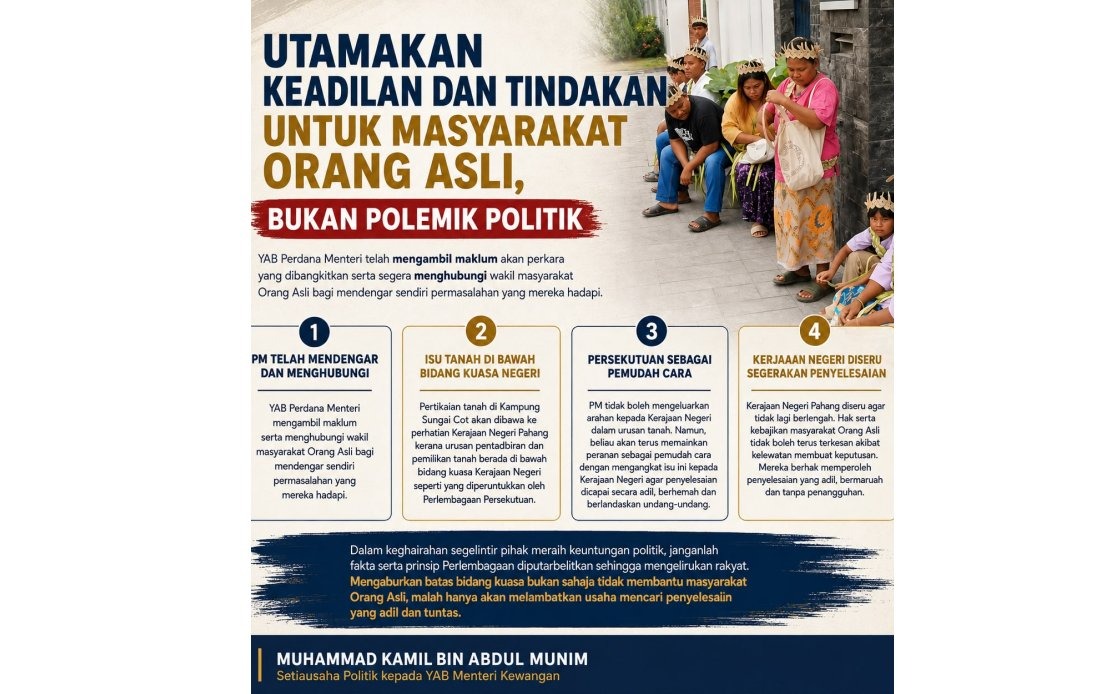
Prime Minister Datuk Seri Anwar Ibrahim has committed himself to playing an active intermediary role in resolving a contested land matter affecting the indigenous Orang Asli community in Kampung Sungai Cot, located in Maran, Pahang. According to Muhammad Kamil Abdul Munim, the political secretary to the Finance Minister, the Premier intends to escalate the issue to state-level authorities to expedite a resolution that balances fairness with legal compliance. The statement came as part of efforts to clarify the federal government's position on a dispute that has drawn public attention and raised questions about constitutional responsibilities.
Anwar has already taken preliminary steps to engage directly with the affected community, having personally reached out to representatives to understand the precise nature of their grievances and the practical obstacles they encounter. This hands-on approach signals the government's recognition that indigenous land rights remain a priority policy concern, particularly given Malaysia's federal structure and the historical complexities surrounding Orang Asli tenure. The Prime Minister's intervention, though framed within constitutional limits, reflects growing pressure from civil society and grassroots movements for higher-level political engagement on indigenous matters.
However, Muhammad Kamil's statement also drew a clear line regarding the boundaries of federal authority in land administration. Under Malaysia's constitutional framework, matters pertaining to land ownership and property administration fall squarely within state jurisdiction. The Pahang State Government, not the federal administration, holds the legal power to adjudicate disputes, formulate policy, and implement resolutions affecting land within its territory. This demarcation is not merely procedural; it reflects the foundational division of powers that underpins Malaysia's federal system and governs the relationship between Kuala Lumpur and the states.
The political secretary emphasized that despite these constitutional constraints, Anwar would not remain passive on the matter. Instead, the government would leverage its facilitating capacity by formally bringing the issue to Pahang's attention and advocating for swift action. This distinction between directing and facilitating is important for understanding how the federal government operates when addressing state-level concerns. By framing the Prime Minister's role as one of advocacy rather than direct intervention, the statement manages expectations while simultaneously demonstrating responsiveness to community concerns.
Muhammad Kamil also levelled criticism at what he characterized as opportunistic political posturing around the dispute. He cautioned that certain quarters were distorting constitutional facts to create misleading impressions among the public, potentially driven by electoral calculations or factional interests. This observation suggests that the Kampung Sungai Cot matter has become entangled in broader political competition, with various actors seeking to mobilize the issue for partisan advantage. Such politicization can complicate resolution efforts by injecting competing agendas into what should primarily be a matter of securing rights and welfare for an already-vulnerable community.
The political secretary stressed that continued delays in decision-making carry real human costs for the Orang Asli families affected. He urged the Pahang State Government to prioritize the matter and fulfill its constitutional obligations without further postponement. This plea underscores an implicit tension within the federal system: while states retain authority over land matters, there is an expectation that they exercise that authority responsibly and with appropriate urgency. The statement carries an implicit message to Pahang that federal scrutiny will accompany any perception of foot-dragging or inadequate attention.
Orang Asli communities across Malaysia have long struggled with land security and recognition of customary tenure rights. Kampung Sungai Cot represents one node in a broader national pattern of indigenous land disputes that intersect with economic development pressures, environmental concerns, and competing claims of ownership. The involvement of the Prime Minister at this level reflects how indigenous issues have graduated from peripheral status to become matters commanding attention from the highest echelons of government. This shift, while welcome, also raises questions about why such basic issues of community rights require prime ministerial intervention rather than being routinely and systematically addressed through normal administrative channels.
On Friday, Anwar had already signalled his intention to engage Pahang on the matter through a Facebook post, demonstrating the government's use of social media to communicate directly with citizens on sensitive issues. This direct communication approach can serve multiple functions: it reassures affected communities that their concerns are heard at the apex of power, it signals to state governments that federal attention is focused on their performance, and it manages public expectations about what can realistically be achieved within constitutional bounds. However, such communications also create pressure for visible outcomes within politically meaningful timeframes.
The government's emphasis on both facilitation and constitutional propriety reflects a broader challenge facing the Anwar administration: how to be responsive to marginalized communities while respecting federalism principles and not overreaching executive authority. This balancing act is particularly delicate in matters involving indigenous rights, where historical injustices and ongoing vulnerabilities create legitimate demands for stronger intervention, yet where institutional architecture constrains unilateral federal action. The resolution of the Kampung Sungai Cot dispute will therefore serve as a test case for how effectively the current government can navigate these competing pressures and deliver tangible improvements in indigenous welfare within its constitutional remit.

