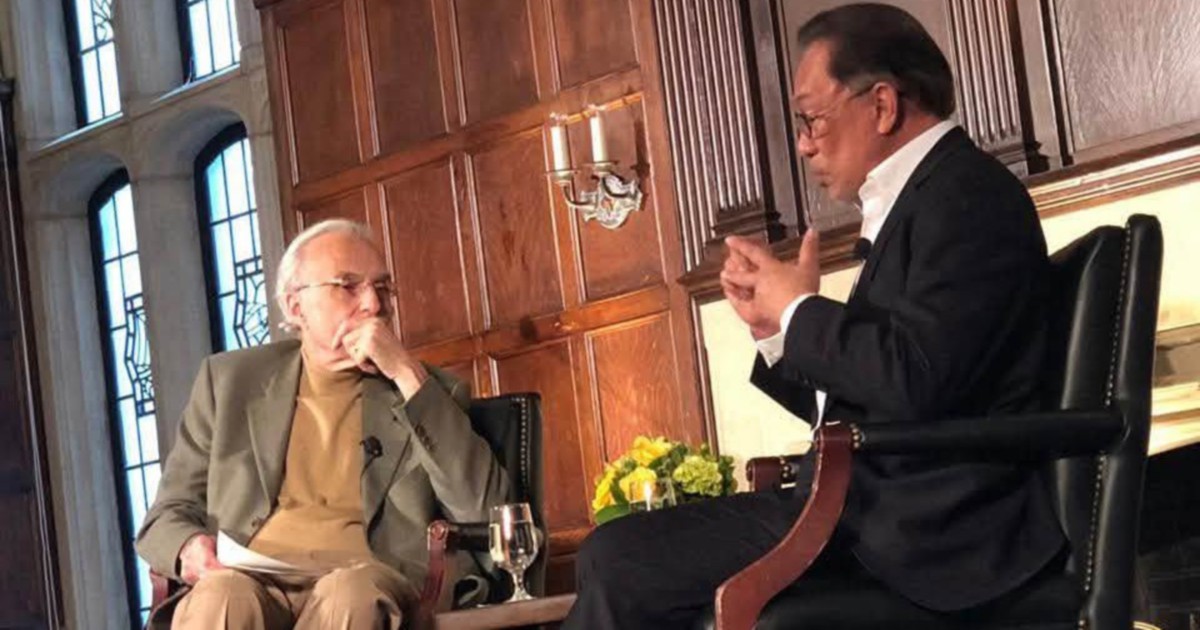
Malaysia's Prime Minister Datuk Seri Anwar Ibrahim issued a formal condolence statement today following the death of Professor John L. Esposito, a towering intellectual figure in Islamic scholarship whose decades of academic work shaped global understanding of Islam and Muslim societies.
Esposito's passing marks the loss of one of the most influential voices in comparative religion and international relations. Throughout a prolific career spanning multiple decades, he established himself as a leading authority on Islam's role in contemporary geopolitics, interfaith dialogue, and the complex relationship between Islamic civilisation and the modern world. His scholarly contributions earned him widespread recognition across academic institutions, policy circles, and international organisations.
The significance of Esposito's death resonates particularly across Southeast Asia, a region home to the world's largest Muslim population and increasingly influential in shaping global Islamic discourse. Malaysian scholars and policymakers have long engaged with Esposito's analytical frameworks, which examined how Islamic values interact with democracy, governance, and social development. His work provided intellectual foundations for serious discussions about modernisation within Islamic contexts, moving beyond simplistic or reductive interpretations.
Throughout his career, Esposito produced numerous seminal works that became standard references in universities worldwide. His scholarly approach emphasised nuance and contextualisation, rejecting stereotypical portrayals of Islam and Muslims. This academic rigour earned him credibility across different ideological spectrums, making him a trusted voice for policymakers seeking informed perspectives on Middle Eastern affairs, terrorism and counter-terrorism strategies, and the integration of Muslim minorities in Western societies.
Esposito's institutional affiliations were distinguished, and his networks extended across continents. He collaborated with scholars, government officials, and religious leaders globally, facilitating cross-cultural exchanges that promoted mutual understanding. For Malaysia, which positions itself as a moderate Muslim-majority nation engaged in interfaith initiatives, Esposito's scholarly work provided valuable intellectual reference points for articulating its own approach to Islam in the contemporary world.
The timing of his death comes amid heightened international attention to Islamic affairs, geopolitical tensions in Muslim-majority regions, and ongoing debates about integration and religious identity in pluralistic societies. The loss of such a respected, evidence-based voice leaves a gap in serious academic discourse on these critical issues. Many of the policy challenges that occupied Esposito's research—from counterterrorism to religious freedom to economic development in Islamic societies—remain pressing concerns for nations across Southeast Asia and beyond.
Anwar Ibrahim's personal condolence reflects both Malaysia's respect for international scholarship and his government's commitment to engaging with serious intellectual discourse on Islam. The Prime Minister has previously emphasised the importance of evidence-based, scholarly approaches to understanding Islamic civilisation, positioning Malaysia as a bridge between the Islamic world and international community. Esposito's work aligned well with this stated vision of promoting Islam as compatible with modernity, democracy, and pluralism.
Esposito's influence extended beyond academia into practical policy formulation. His advice was sought by governments and international bodies grappling with questions of religious extremism, interfaith coexistence, and the role of Islam in shaping national identities. His insistence that Islam, like other major religions, encompasses diverse interpretations and practices—rather than monolithic ideology—provided essential correctives to oversimplified public discourse.
For Malaysian universities and think-tanks, Esposito's passing underscores the importance of building regional expertise in Islamic studies and international relations. Southeast Asia's growing strategic importance means that rigorous scholarship examining Islam's political, economic, and social dimensions becomes increasingly valuable. Esposito modelled how scholars could maintain intellectual integrity while engaging substantively with policymaking and public affairs.
The academic community in Malaysia and throughout Southeast Asia now faces the challenge of maintaining the standards of scholarly rigor that Esposito exemplified. His commitment to empirical research, theoretical sophistication, and balanced analysis set benchmarks for Islamic studies as a discipline. Emerging scholars will need to build upon his foundations while addressing new challenges arising from technological change, regional conflicts, and evolving expressions of Islamic identity.
Anwar's condolence statement, while brief in its formal expression, represents recognition of Esposito's outsized contribution to global knowledge production about Islam. In an era characterised by political polarisation and ideological contestation around religious identity, losing such a measured, authoritative voice represents a genuine intellectual loss for policymakers seeking guidance grounded in evidence rather than ideology.

