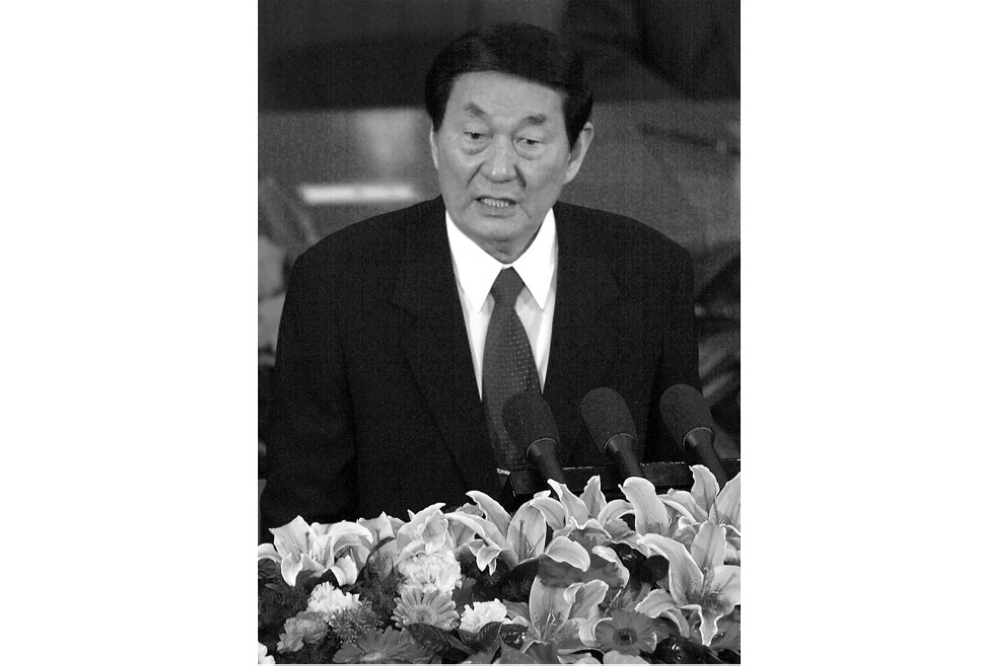
Prime Minister Datuk Seri Anwar Ibrahim has mourned the passing of Zhu Rongji, the former Premier of China who served during a transformative period of economic reform and international engagement. In a statement reflecting on the veteran statesman's legacy, Anwar characterised him as a trusted ally whose vision and diplomatic acumen significantly advanced the relationship between Malaysia and China across multiple dimensions of cooperation.
Zhu Rongji's tenure as Premier from 1998 to 2003 coincided with a critical juncture in China's development trajectory, a period when the nation was navigating its entry into the World Trade Organization whilst managing profound domestic economic restructuring. During these years, the former leader championed an outward-looking foreign policy that prioritised strengthening ties with neighbouring nations in Southeast Asia, understanding that regional stability and prosperity were essential to China's own advancement. His approach contrasted with a more inward-focused posture, instead emphasising mutual benefit and long-term institutional cooperation.
Anwar's tribute underscores the personal dimension of international relations, particularly in the Southeast Asian context where informal networks and individual relationships frequently shape the substance of bilateral engagement. The Malaysian Prime Minister's emphasis on describing Zhu as a "good friend" suggests a bond that transcended the formal protocols of state interaction, reflecting the kind of personal chemistry that often facilitates difficult negotiations and enables leaders to move beyond narrow national interests toward shared regional objectives. Such relationships have historically proved invaluable when bridging differing political systems and cultural perspectives.
The timing of Zhu Rongji's leadership coincided with Malaysia's own strategic reorientation following the 1997-1998 Asian financial crisis, a turbulent period that prompted regional governments to reassess their international partnerships and economic dependencies. China's relatively stable performance during this crisis, combined with Zhu's pragmatic economic management domestically, positioned Beijing as an increasingly important partner for Malaysia. The former Chinese Premier's willingness to engage seriously with smaller Asian economies helped establish frameworks for cooperation that would prove durable across successive administrations.
Bilateral ties between Malaysia and China have expanded substantially across investment, trade, infrastructure development, and cultural exchange during the two decades following Zhu's premiership. Major projects including the construction of port facilities, manufacturing joint ventures, and technology partnerships have their conceptual origins in the groundwork laid during the late 1990s and early 2000s. Zhu's emphasis on pragmatic economic cooperation without heavy ideological baggage created space for Malaysian policymakers to pursue commercial relationships that benefited domestic constituencies whilst maintaining strategic autonomy.
Anwar's tribute also carries significance within contemporary geopolitical context, where Malaysia balances relationships among major powers with careful attention to maintaining its non-aligned positioning. By publicly acknowledging a Chinese leader's contributions to bilateral relations, Anwar reinforces Malaysia's commitment to practical engagement with China whilst avoiding positions that might be interpreted as alignment with either Beijing or any competing power bloc. This calibrated approach reflects the delicate diplomatic dance that smaller nations must perform in an increasingly multipolar environment.
The former Premier's influence extended beyond economic matters into the realm of regional institution-building. During Zhu's years in office, frameworks for dialogue between China and ASEAN began taking more concrete institutional form, with annual meetings becoming routine and mechanisms for addressing disputes through negotiation rather than confrontation becoming embedded in diplomatic practice. These structural developments, though initiated at the highest levels, required the kind of sustained political commitment and flexibility that Zhu demonstrated.
Zhu Rongji was also known for his technical expertise in economic and financial matters, an orientation that made him particularly effective in discussions with Malaysian counterparts who similarly valued evidence-based policymaking and practical solutions to shared challenges. His background as an urban planner and economist before ascending to national leadership gave him credibility when discussing complex matters of infrastructure investment and industrial policy—domains central to Malaysia-China cooperation.
The passing of senior statesmen like Zhu Rongji often prompts reassessment of their era's achievements and their influence on subsequent developments. In Malaysia's case, the infrastructure of institutional cooperation, the normalisation of high-level exchanges, and the accumulation of economic interdependencies all bear the imprint of decisions made during Zhu's leadership. While personalities matter less as institutions mature, the foundation he helped establish has proven sufficiently robust to accommodate changes in both nations' leadership and evolving regional circumstances.
Anwar's public mourning also reflects broader recognition within Malaysia's political establishment of Zhu's constructive role during a period when China was emerging as a major global economic actor. Rather than viewing this emergence as inherently threatening, pragmatic leaders like those in Malaysia sought to engage China on mutually beneficial terms, an approach that Zhu's own philosophy of international relations actively supported. The success of this engagement model continues to inform how Malaysia calibrates its China relations today, even as the bilateral relationship has deepened and become more complex across numerous economic and strategic dimensions.

