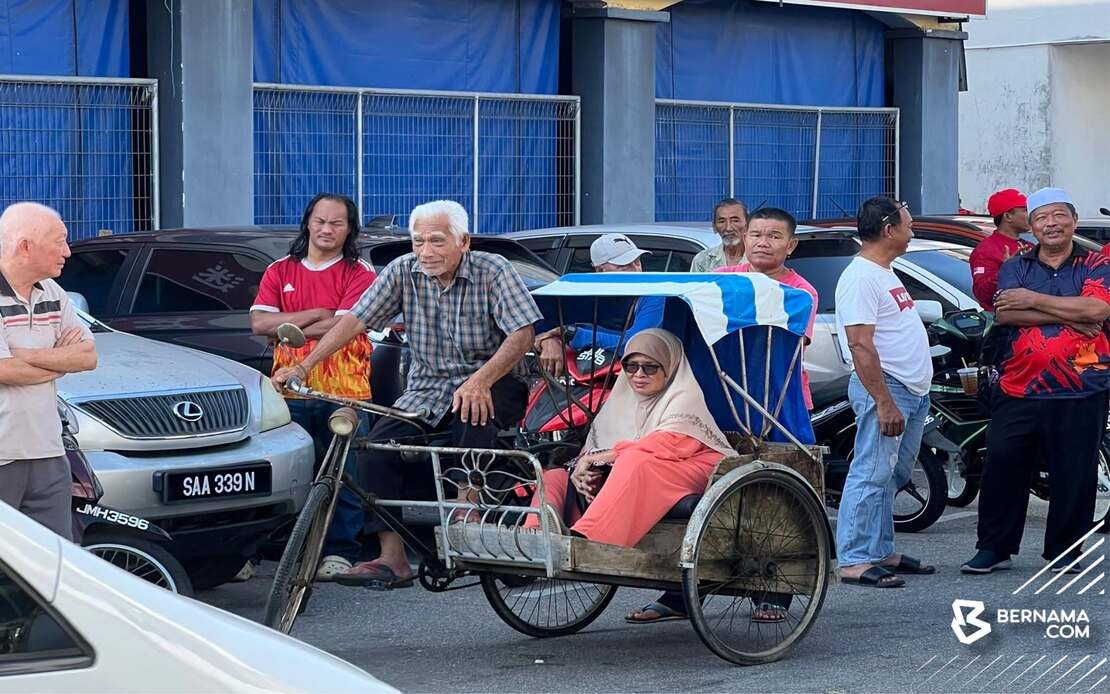
Prime Minister Datuk Seri Anwar Ibrahim has publicly acknowledged the dedication of an elderly couple from Batu Pahat, Johor, who made an unconventional journey to see him during a campaign stop in the state. Abdul Razak Pelangga, 86, and his wife Jamilah Samsudin, 64, travelled by trishaw from their home in Kampung Parit Bugis to a local coffee shop where Anwar was scheduled to have breakfast, a distance of nearly one kilometre. The couple's determination to be present at the encounter moved the Prime Minister, who took to social media to express his appreciation for their gesture and the values it represented.
Anwar's visit to Kedai Kopi Hailam Sri Medan in Senggarang, Batu Pahat, was part of broader campaign activities in the Senggarang state constituency aligned with the Johor State Election. The Prime Minister spent approximately 50 minutes at the venue, engaging with local residents in a structured meet-and-greet programme designed to strengthen connections with constituents. Such grassroots visits have become increasingly important for Malaysian political leaders seeking to demonstrate accessibility and commitment to communities beyond urban centres.
What made Abdul Razak's choice particularly noteworthy was the deliberation behind it. The imam of Masjid Raudhatul Jannah Parit Bugis explained that despite having access to more convenient transportation options—including a private car or motorcycle—Abdul Razak specifically selected the trishaw to navigate the practical challenges of the visit. His primary concern was avoiding the complications of locating adequate parking in the congested area around the coffee shop, a consideration that speaks to the everyday realities facing residents in smaller towns and villages throughout Malaysia. This practical wisdom, combined with his determination to fulfil his wife's wish, created a compelling narrative of devotion and purpose.
In his Facebook response, Anwar expressed genuine remorse at the missed opportunity to meet the couple in person, acknowledging that his schedule during the breakfast visit did not align with their arrival. He extended an invitation for a future meeting, framing the encounter as something that would be rearranged through divine will. The Prime Minister's message invoked Islamic teachings, offering prayers for the couple's wellbeing and requesting blessings upon them. Such personal acknowledgements from senior political figures are relatively uncommon in Malaysian public discourse, and the post generated considerable attention across social media platforms.
The incident reflects broader themes within Malaysia's democratic engagement model, where leaders at all levels are expected to maintain accessibility to ordinary citizens. Campaign visits to small towns and village establishments serve multiple purposes: they allow politicians to demonstrate commitment to constituencies that might otherwise feel marginalised in national discourse, they provide opportunities for informal dialogue beyond formal political messaging, and they create moments of human connection that can enhance public perception of leadership. For a Prime Minister to acknowledge such gestures publicly underscores the value placed on grassroots support and community engagement.
The couple's choice of transportation also carries symbolic weight in the Malaysian context. Trishaws, while increasingly rare in urban areas, remain culturally significant and are associated with traditional Malaysian life and heritage. The image of an elderly couple boarding a trishaw to travel several hundred metres to see the nation's leader creates a poignant contrast between modern political campaigning and traditional community values. This juxtaposition has resonated with many Malaysians who see in the story a reflection of their own experiences navigating the balance between modernisation and cultural preservation.
Anwar's public response demonstrated political awareness of how such moments can be leveraged for broader messaging about unity and national values. By highlighting the couple's sacrifice and determination, the Prime Minister implicitly communicated respect for elders, appreciation for civic participation, and recognition of the importance of every citizen regardless of their socioeconomic status. These messages are particularly valuable during election campaigns, when leaders seek to build comprehensive coalitions across diverse demographic groups.
For residents of Johor and Malaysia more broadly, the incident serves as a reminder that political leadership can intersect with personal human moments. The Senggarang state constituency visit was undertaken in the context of state-level electoral competition, where every interaction and gesture carries potential significance for voting behaviour. However, the apparent sincerity of Anwar's response suggested that the moment transcended mere political calculation, reflecting genuine appreciation for the couple's gesture.
The missed meeting, while disappointing for Abdul Razak and Jamilah Samsudin in the immediate term, ultimately generated more extensive media coverage and public attention than a brief personal encounter would have achieved. Their story was amplified through the Prime Minister's social media platform, reaching audiences far beyond Batu Pahat. This amplification transformed a personal journey into a wider conversation about respect, determination, and the bonds between leaders and citizens in a democratic society. The couple's quiet dignity in their gesture—undertaking a modest trishaw journey without expectation of public recognition—has become emblematic of the kind of grassroots engagement that Malaysian politicians frequently invoke when discussing national unity and social cohesion.

