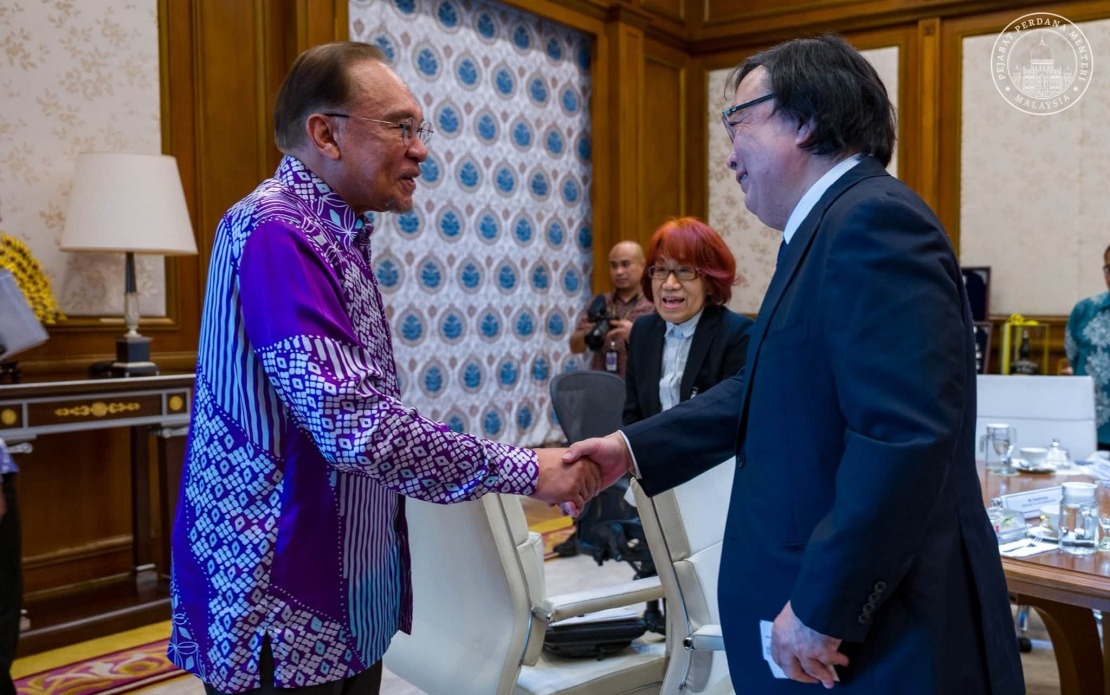
Prime Minister Datuk Seri Anwar Ibrahim received a courtesy visit from The Genron NPO President Yasushi Kudo on July 23, marking another step in deepening bilateral engagement between Malaysia and Japan on matters of strategic importance to the Asia-Pacific region. The meeting, held in Kuala Lumpur, centred on expanding the Asia Leaders Roundtable as a vital forum where policymakers and thinkers can tackle pressing regional and international issues through sustained dialogue and collaborative problem-solving.
The Genron NPO, headquartered in Japan, functions as an independent non-profit research institution that has gained recognition across Asia for convening high-level discussions on geopolitical trends, economic cooperation, and shared security challenges. Its Asia Leaders Roundtable initiative has emerged as a significant platform where senior government officials, business executives, and intellectual leaders can exchange views on the strategic direction of the region without the constraints of formal diplomatic protocols. This informal yet substantive approach has proven valuable in building consensus on contentious issues and identifying common ground among diverse stakeholders.
Anwar seized the opportunity to underscore Malaysia's commitment to its Comprehensive Strategic Partnership with Japan, positioning the relationship as one of the nation's foremost strategic anchors. The Malaysian Prime Minister emphasised that this partnership extends beyond traditional trade and investment flows, encompassing defence cooperation, technological collaboration, and people-to-people exchanges. Japan remains among Malaysia's most significant economic partners, with bilateral trade relationships spanning automotive manufacturing, electronics, energy projects, and financial services. The depth of this engagement reflects decades of mutual interest in regional stability and economic prosperity.
During the meeting, Anwar expressed gratitude for Japan's reception during his official visit in June, highlighting the warm welcome and hospitality extended by the Japanese government. Such reciprocal gestures at the highest political levels signal healthy bilateral relations and provide momentum for advancing shared objectives. The timing of Kudo's visit to Kuala Lumpur demonstrates Japan's continued investment in maintaining close working relationships with key Southeast Asian partners, particularly as regional dynamics shift and new challenges emerge from geopolitical competition and climate-related threats.
A significant element of the discussions involved Anwar's participation in The Genron NPO's Tokyo Conference series. The Prime Minister expressed appreciation for an invitation to address the 2027 iteration of this flagship event, while also acknowledging his contribution through a video message delivered at the 2026 conference. These speaking engagements reflect Malaysia's growing voice in elite international forums and provide a platform for articulating the nation's perspectives on regional governance, economic integration, and security architecture. Anwar's involvement in such conferences enhances Malaysia's diplomatic visibility and allows the Prime Minister to influence discussions on issues directly affecting the country's interests.
The Asia Leaders Roundtable, which Kudo and Anwar discussed at length, represents an evolving mechanism for regional cooperation that complements formal multilateral institutions such as ASEAN and the East Asia Summit. Unlike these established structures, the roundtable offers flexibility in participation and agenda-setting, enabling candid exchanges on topics that governments might hesitate to address in official venues. For Malaysia, participation in such forums provides valuable insights into the thinking of regional counterparts and opportunities to shape emerging consensus on critical issues ranging from maritime security to digital governance.
Anwar's emphasis on strengthening ties with Japan occurs against a backdrop of intensifying strategic competition in Southeast Asia, where major powers vie for influence. Japan's approach to the region emphasises quality of partnerships, substantial investment in infrastructure and human capital development, and respect for ASEAN centrality in regional architecture. Malaysia, as a significant ASEAN member and a country with substantial Japanese investment, benefits considerably from this philosophy. The bilateral relationship has weathered various regional tensions without fundamental strain, demonstrating its underlying resilience.
The meeting also reflected broader Malaysian interest in leveraging intellectual and policy networks to address transnational challenges. The Genron NPO's work on issues including climate change, technological disruption, and regional governance resonates with Anwar's stated priorities for national development and regional cooperation. By engaging with such think tanks, Malaysia positions itself as a serious participant in shaping ideas and policies that will determine the region's trajectory in coming decades. This intellectual engagement complements Malaysia's traditional diplomatic efforts and provides additional channels for advancing national interests.
Looking ahead, the continued collaboration between Malaysia and Japan through platforms such as the Asia Leaders Roundtable will likely deepen as both nations navigate an increasingly complex regional environment. Anwar's expressed hope that ties between the two countries and cooperation with The Genron NPO will be strengthened underscores Malaysia's commitment to institutionalising high-level engagement and ensuring that bilateral relations remain dynamic and forward-looking. As Southeast Asia confronts evolving security challenges, economic restructuring, and the rise of new powers, forums that enable candid strategic dialogue become ever more valuable for preserving regional stability and advancing shared prosperity.

