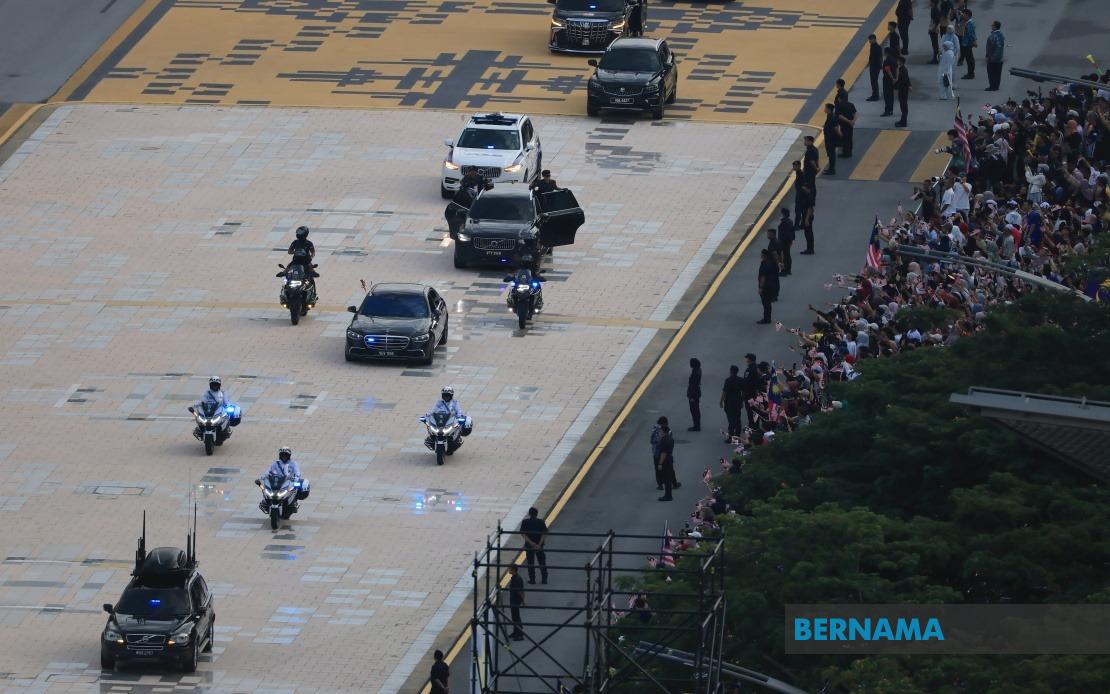
Malaysia's 69th National Day unfolded at Dataran Putrajaya on August 31 with Prime Minister Datuk Seri Anwar Ibrahim leading the nation's top officials in commemorating the annual patriotic milestone. The ceremony, held under the thematic banner of "Malaysia MADANI: Kesejahteraan Dinikmati", brought together tens of thousands of Malaysians alongside government dignitaries and foreign representatives to mark the occasion with pomp and pageantry befitting the nation's founding principles.
Anwar, who shoulders the dual responsibility of Prime Minister and Finance Minister, arrived at the royal viewing stand at 7.53 am in the company of his wife Datuk Seri Dr Wan Azizah Wan Ismail, entering as the ceremonial Hormat Perdana anthem played in the pre-dawn hours. The timing underscored the formality of the state occasion, with key leaders positioning themselves early to oversee the elaborate proceedings that would unfold across the Putrajaya administrative capital.
Deputy Prime Minister Datuk Seri Dr Ahmad Zahid Hamidi reached the venue eight minutes earlier, setting the stage for the high-level attendance that followed. A roster of senior Cabinet figures attended, including Communications Minister Datuk Seri Fahmi Fadzil, who holds the additional distinction of chairing the steering committee responsible for orchestrating the 2026 National Day and Malaysia Day celebrations. Home Minister Datuk Seri Saifuddin Nasution Ismail and Defence Minister Datuk Seri Mohamed Khaled Nordin were among those present, reflecting the comprehensive representation across security, administrative, and development portfolios.
The spectacle itself demonstrated Malaysia's capacity for large-scale coordinated ceremonial displays. The parade brought together 10,819 participants distributed across 76 distinct contingents, representing government agencies, military units, youth organizations, and civilian groups from across the federation. The marching component alone comprised 22 coordinated bands, providing synchronized musical accompaniment to the procession.
The visual and material scale of the event extended well beyond human participation. Organizers deployed 328 vehicles spanning land, sea, and air domains, showcasing Malaysia's defence and civil capabilities. The contingent included 112 working animals, traditionally a focal point of National Day pageantry, alongside 22 electric vehicles, reflecting the government's commitment to sustainable technology integration in public ceremonies. These 11 decorated cars added architectural and artistic elements to the visual narrative.
For Malaysian observers and international visitors, the parade served multiple functions beyond ceremonial commemoration. The prominence of electric vehicles signaled the administration's policy priorities around environmental sustainability and technological modernization, embedding these development themes within the traditional architecture of national celebration. The inclusion of foreign diplomatic representatives reinforced Malaysia's regional and international standing, with the invitation to witness the festivities constituting a form of soft power projection.
The theme "Malaysia MADANI: Kesejahteraan Dinikmati" — translating to shared prosperity and wellbeing — represented the government's aspirational messaging around inclusive development. By choosing this particular emphasis for the 69th commemoration, the administration framed national identity around economic and social benefits reaching across the population, a rhetorical choice carrying significance for domestic political positioning.
For Southeast Asian observers, Malaysia's continued investment in elaborate National Day ceremonialism reflects the enduring symbolic importance these occasions maintain in the region's political cultures. While some nations have scaled back such displays, Malaysia's commitment to large-scale coordination suggests sustained belief in the capacity of state pageantry to reinforce national cohesion and project stability. The comprehensive participation across government levels — from Prime Minister through deputy ministers to local representatives — demonstrated institutional buy-in to the occasion's importance.
The scale of 2024's celebrations also served as preliminary testing ground for the 2026 dual commemoration, with Fahmi's dual role as communications minister and 2026 celebrations chairman ensuring institutional learning transfer from the current event to future planning. This forward-looking dimension suggests Malaysia's celebrations serve as platforms for refining administrative coordination capacity, with each successful iteration building institutional muscle for larger undertakings.
The gathering at Putrajaya carried particular resonance as a display of government unity, with Anwar's leadership prominence reinforced through his central positioning and the turnout of senior colleagues. In the context of Malaysia's often-fractious coalition politics, such moments of comprehensive Cabinet presence carry meaning beyond the ceremonial surface, signifying operational cohesion among competing political interests within the ruling alliance.

