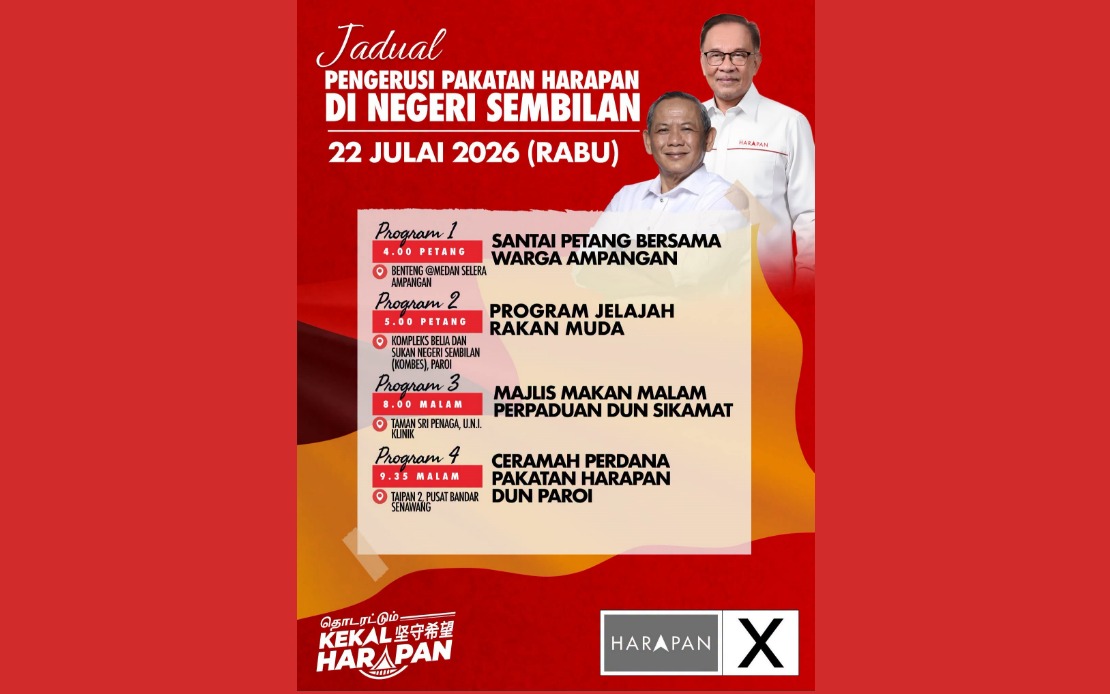
Prime Minister Datuk Seri Anwar Ibrahim is throwing his political weight behind Pakatan Harapan's efforts to maintain control of Negeri Sembilan, embarking on an intensive campaign schedule across multiple constituencies on the fifth day of the state election campaign. The show of high-level political support underscores PH's determination to fend off challenges from rival coalitions and cement its grip on the state administration led by Menteri Besar Datuk Seri Aminuddin Harun.
As chairman of Pakatan Harapan and president of the People's Justice Party (PKR), Anwar's personal involvement carries significant symbolic and practical weight. His presence on the campaign trail sends a clear message to voters about the coalition's commitment to the state, whilst simultaneously energising party machinery and grassroots supporters who draw momentum from the visible backing of the nation's top political leader. The timing is strategically significant as campaigns enter their crucial middle phase, when voter sentiment can still shift meaningfully before polling day.
The prime minister's schedule is deliberately constructed to reach different voter demographics and geographic areas. Beginning at 4 pm with an informal "Santai Petang Bersama Warga Ampangan" (Evening Gathering with Ampangan Residents) at Benteng @ Medan Selera Ampangan, Anwar will engage directly with constituents in a relaxed community setting. This format allows for genuine interaction with ordinary citizens rather than formal party faithful, a crucial approach in Malaysian electoral politics where swing voters and undecided voters often determine outcomes.
Following the Ampangan engagement, Anwar is scheduled to address the youth demographic at the Negeri Sembilan Youth and Sports Complex in Paroi at 5 pm. The "Jelajah Rakan Muda" (Young Friends Journey) programme specifically targets younger voters, a demographic that has become increasingly influential in recent Malaysian elections. Young voters have demonstrated greater willingness to support alternative candidates and fresh political messaging, making youth engagement a priority for coalitions seeking growth or consolidation.
The evening's programme extends to a unity dinner in the Sikamat constituency, emphasising coalition cohesion during the election period. These dinners serve multiple functions beyond symbolic unity—they provide opportunities for party leaders to address constituency-specific concerns, meet local candidate teams, and demonstrate that the national leadership is invested in local electoral success. The Sikamat engagement is particularly notable as it reinforces the message that Pakatan Harapan functions as an integrated political force rather than separate component parties.
The day culminates in a major ceramah, or political rally, at Pusat Bandar Senawang in Paroi. These large public events remain central to Malaysian election campaigns, allowing leaders to deliver manifesto messages directly to assembled crowds and generate media coverage. The decision to hold this significant event in Paroi suggests the constituency may be considered competitive or strategically important for PH's overall performance in the state.
Anwar's campaign activities are explicitly linked to reinforcing Pakatan Harapan's election manifesto, which was unveiled on Monday. The coalition has presented ten key commitments framed around developing Negeri Sembilan into a more prosperous and inclusive state. By repeatedly referencing this manifesto throughout his campaign appearances, Anwar aims to establish a consistent narrative that distinguishes PH's vision from competing political offers. The manifesto's emphasis on inclusive development addresses growing concerns among Malaysian voters about economic opportunities and social cohesion.
The electoral contest itself involves 36 state assembly seats, with Pakatan Harapan fielding 16 PKR candidates, 11 from the Democratic Action Party (DAP), and nine from the National Trust Party (Amanah). This distribution reflects the negotiated coalition agreement and suggests that DAP and PKR are considered the coalition's stronger components in Negeri Sembilan's electoral context. The broad coverage of all 36 seats demonstrates PH's confidence in contesting across the state rather than selectively focusing on winnable constituencies.
The Election Commission has established a clear electoral timeline, with early voting scheduled for July 28 and general polling day on August 1. This framework means campaigns must compress their activities into a relatively short period, making high-profile appearances by national leaders particularly valuable for generating media coverage and maintaining campaign momentum. Anwar's presence helps counteract any perception of low-profile or disorganised campaigning.
Negeri Sembilan represents an important electoral proving ground for Pakatan Harapan's continued political dominance at the state level. Whilst the coalition currently governs the state, elections are rarely guaranteed outcomes in Malaysian politics. Opposition coalitions have clearly invested resources in contesting the state, recognising that capturing Negeri Sembilan could provide momentum and psychological boost for challenges in other electoral arenas. PH's determination to retain the state government is reflected in deploying the prime minister himself to the campaign trail.
The concentration of Anwar's campaign activities in the evening hours suggests careful scheduling to avoid disrupting his responsibilities as prime minister during business hours. This approach reflects the delicate balance Malaysian political leaders must maintain between national governance duties and electoral campaign participation. The scheduling also ensures maximum media coverage during evening news cycles when political stories often receive prominent placement.
From a broader Southeast Asian perspective, Malaysia's ongoing state elections demonstrate the region's commitment to regular electoral processes and competitive politics. Unlike some neighbouring democracies, Malaysia maintains consistent election schedules and respects institutional frameworks despite significant political competition and occasional institutional tensions. Negeri Sembilan's election showcases how Malaysian political coalitions mobilise resources, craft manifestos addressing voter concerns, and deploy leadership across multiple campaign venues within compressed timeframes.

