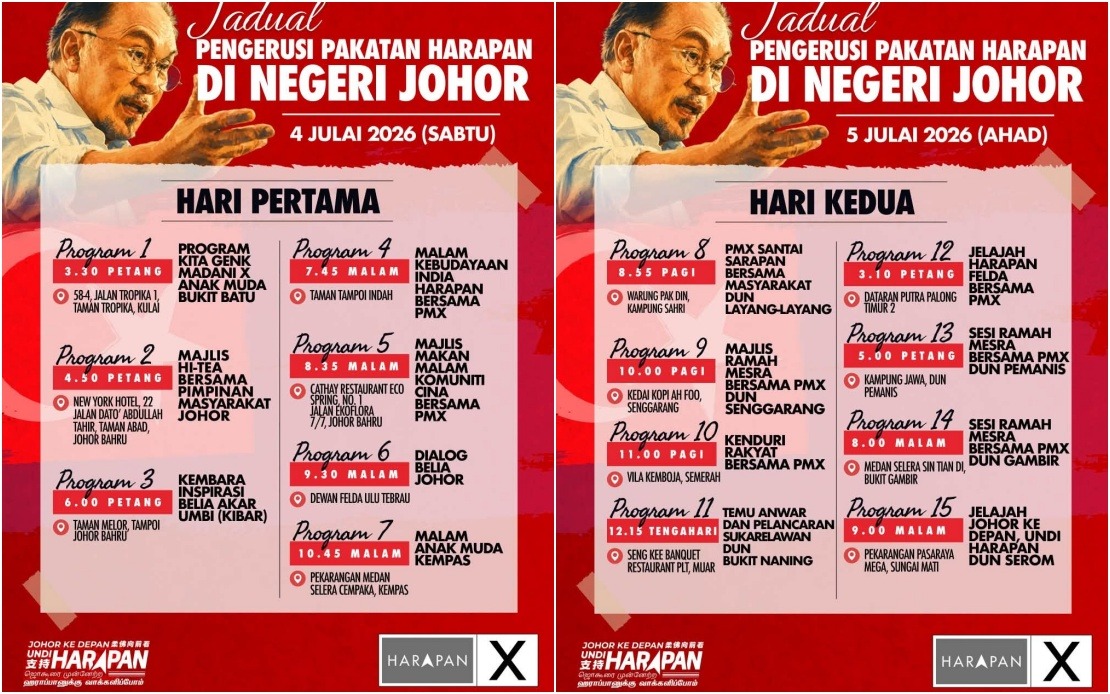
Pakatan Harapan chairman Datuk Seri Anwar Ibrahim is mounting an intensive campaign push through Johor this weekend, committing to attend 15 separate programmes as the coalition mobilises its machinery in support of 56 candidates contesting the 16th Johor state election. The comprehensive schedule reflects the opposition coalition's determination to maintain its political foothold in a state where it secured significant gains in recent electoral cycles, with the party leadership positioning itself as the central draw for voters across multiple constituencies and demographic groups.
Through a Facebook announcement, Anwar extended a public invitation to all Johor voters to participate in the weekend activities, signalling PH's strategy of maximum grassroots engagement rather than reliance on traditional party structures alone. His message emphasised the coalition's commitment to mobilising its broader support network, framing the campaign as a collective endeavour between party leadership, candidate machinery, and community stakeholders. This approach reflects evolving campaign dynamics in Malaysian politics, where coalition leaders increasingly seek to build momentum through direct voter interaction rather than top-down party directives.
The Saturday itinerary commences at 3.30 pm with the Kita Genk MADANI x Anak Muda Bukit Batu programme in Kulai, immediately followed by a high-tea gathering with Johor community leaders at 4.50 pm. Anwar then transitions to the Kembara Inspirasi Belia Akar Umbi programme in Tampoi at 6 pm, establishing a progression from youth-focused initiatives to community engagement activities. This scheduling pattern deliberately connects different voter segments—young voters, community influencers, and grassroots organisers—within a compact geographical area, maximising the coalition leader's presence across multiple constituencies while maintaining operational efficiency.
The evening programming reveals PH's deliberate cultivation of support among Malaysia's diverse communities. The Harapan Indian Cultural Night scheduled for 7.45 pm at Taman Tampoi Indah demonstrates targeted outreach to the Indian Malaysian electorate, a demographic group that has demonstrated fluid voting patterns in recent elections. This is followed by a Chinese community dinner at 8.35 pm, indicating systematic engagement with the Chinese Malaysian voter base. The sequencing of these cultural and community events underscores PH's strategy of presenting itself as an inclusive coalition capable of addressing the interests and concerns of Malaysia's multicultural society.
The late evening youth dialogue at Dewan Felda Ulu Tebrau at 9.30 pm and the Anak Muda Kempas Night in Kempas at 10.45 pm extend the campaign well into the night, reflecting the traditional Malaysian political culture of evening and late-night campaign events when voters are more likely to gather after work commitments. This scheduling also demonstrates organisers' willingness to maintain high-intensity activity levels, potentially signalling internal confidence about campaign momentum and volunteer enthusiasm.
Sunday's programming extends the campaign across different geographical zones and voter categories. Beginning with a breakfast gathering at Warung Pak Din in Kampung Sahri at 8.55 am, the schedule transitions to a meet-and-greet at Dewan Undangan Negeri Senggarang in Senggarang at 10 am, followed by the Kenduri Rakyat Bersama PMX in Semerah at 11 am. The deployment of the term "Kenduri Rakyat"—a traditional communal feast—reflects PH's efforts to anchor its campaign messaging within familiar Malaysian cultural frameworks while projecting an image of accessibility and community integration.
The launch of Bukit Naning Volunteers at 12.15 pm suggests PH's emphasis on volunteer mobilisation and grassroots organisation, acknowledging that sustained electoral success depends upon developing robust volunteer networks capable of ongoing voter engagement beyond the campaign period. This focus on volunteer infrastructure indicates the coalition's longer-term strategic thinking regarding political sustainability in Johor, a state where electoral margins have proven competitive in recent contests.
Afternoon activities include the Jelajah Harapan Felda programme at Dataran Putra Palong Timur 2, meeting sessions at Pemanis and Gambir constituencies, and a concluding event at Sungai Mati at 9 pm. The inclusion of Felda constituencies reflects recognition of rural constituencies' continued electoral significance, while the progression through multiple parliamentary and state constituency meeting sessions indicates systematic coverage of all major population centres within Johor's electoral geography.
Voting for the 16th Johor state election is scheduled for July 11, with early voting set for July 7. This timeline places Anwar's weekend campaign activities approximately one week before polling day, a critical period when voter sentiment remains malleable and campaign messaging potentially carries heightened impact. The concentration of senior coalition leadership visibility at this juncture represents standard Malaysian electoral practice, wherein final campaign weeks typically witness intensified activity by senior political figures seeking to generate momentum and shape late-deciding voters' preferences.
The breadth of Anwar's programme schedule—encompassing youth engagement, cultural community outreach, rural constituency mobilisation, and volunteer network development—illustrates PH's comprehensive approach to electoral competition in Johor. Rather than concentrating resources on a limited number of priority constituencies, the coalition demonstrates confidence in its candidate slate across the full spectrum of 56 contested seats. This represents a significant commitment of the chairman's personal time and political capital, with implications for national coalition dynamics and internal perceptions regarding Johor's strategic importance within broader Malaysian electoral calculations.
The intensive weekend campaign also signals PH's recognition that Johor remains pivotal to national political outcomes. As a state with substantial parliamentary seat allocations and historical significance within Malaysian politics, Johor's electoral results influence both state-level governance arrangements and broader federal political configurations. Anwar's personal campaign presence, therefore, transcends purely state-level significance, serving instead as a barometer of coalition momentum and leadership commitment to constituencies that determine Malaysia's overall political trajectory.

