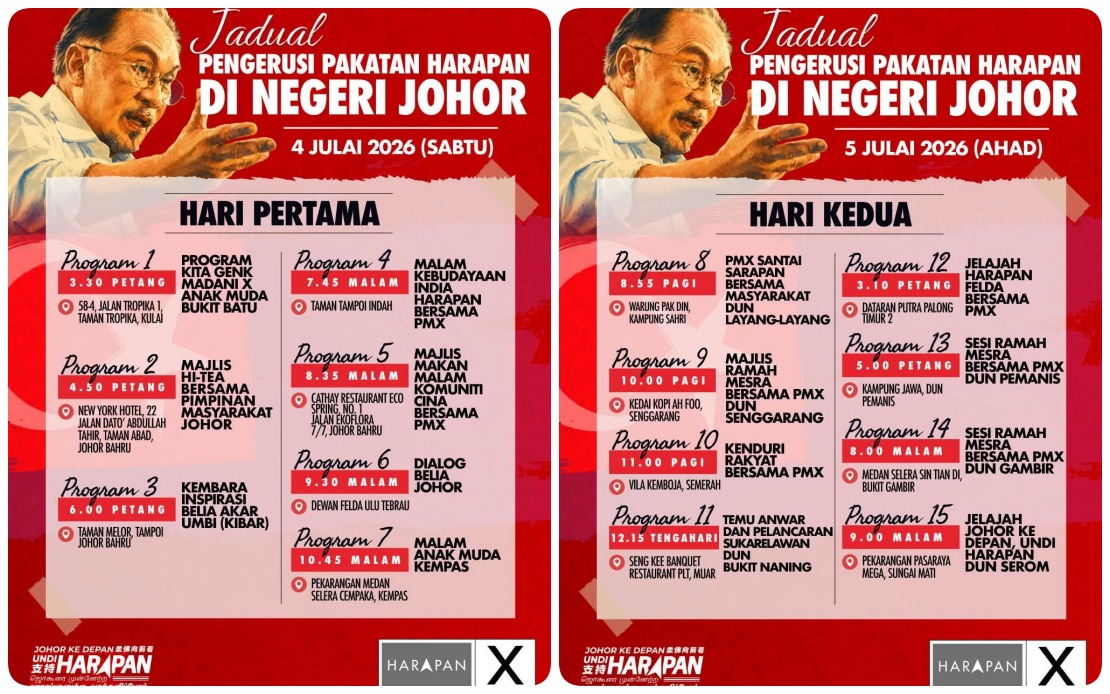
Prime Minister Anwar Ibrahim is throwing his full weight behind Pakatan Harapan's bid to retain control of Johor, with a gruelling campaign schedule of seven separate events lined up for July 4 alone. The Pakatan Harapan chairman is deploying a comprehensive strategy to energise the coalition's grassroots machinery and reach voters across different demographic segments in Malaysia's second-largest state, signalling the importance party leadership places on the outcome of the 16th Johor state election.
The campaign day will begin with direct engagement with voters in a morning rally format, setting the tone for what promises to be an exhausting but symbolically important show of party unity and organisational strength. Such frontline appearances by the Prime Minister typically serve multiple purposes: they boost morale among party workers, attract media coverage that amplifies campaign messaging, and provide a high-profile endorsement of local candidates who may otherwise struggle for visibility in a crowded electoral landscape.
By late afternoon, Anwar will shift focus to community engagement when he attends a high tea with local leaders at a Johor Bahru hotel at 4:50 pm. This type of intimate gathering with business people, civil society figures, and opinion leaders reflects a deliberate strategy to move beyond mass rallies and address concerns from middle-class and establishment constituencies that increasingly represent swing voters in Malaysia's urban and semi-urban areas. Such forums allow the Prime Minister to project statesmanship and accessibility while gathering feedback on local grievances that may inform policy priorities.
The evening schedule demonstrates Pakatan Harapan's recognition that younger voters require dedicated outreach tailored to their interests and communication preferences. A youth dialogue session scheduled for 9:30 pm at the Felda Ulu Tebrau Hall indicates the coalition is attempting to counter perceptions that it appeals primarily to older, urban voters. Youth engagement has become increasingly critical in Malaysian elections, as demographic trends show younger citizens making up an expanding share of the electorate, yet historically demonstrating lower voting participation rates and sometimes gravitating toward protest votes or alternative political movements.
Anwar's campaign momentum will not pause after July 4. Plans are already in place for eight additional programmes on July 5, maintaining relentless pressure on the ground as voting day approaches. This extended schedule suggests the coalition views the Johor race as highly competitive and potentially within reach of opposition parties, necessitating an all-hands-on-deck approach from party leadership.
Pakatan Harapan is contesting all 56 state assembly constituencies, distributing candidacies strategically among its three component parties: PKR is fielding 20 candidates, Amanah 19, and DAP 17. This allocation reflects ongoing internal negotiations within the coalition about seat distribution and power-sharing arrangements, highlighting the complex dynamics of managing a multi-party alliance where each constituent party must secure sufficient representation to maintain credibility with its own support base.
The broader electoral context adds weight to these campaign efforts. The July 11 election will feature a total field of 172 candidates competing across the 56 seats, indicating that whilst Pakatan Harapan contests all seats, opposition parties including Perikatan Nasional, independent candidates, and smaller political movements are also fielding substantial numbers of aspirants. Early voting is scheduled for July 7, allowing voters unable to participate on election day to cast ballots in advance, a mechanism that typically benefits better-organised campaigns with robust mobilisation infrastructure.
Johor holds significant symbolic and practical importance for Malaysian politics. As a large state with considerable economic output and population, electoral performance here carries implications beyond the state level, influencing narratives about which coalition is in genuine ascendancy and which is in decline. For Pakatan Harapan, maintaining or expanding its representation in Johor is crucial for demonstrating that the political realignment that brought the coalition to federal power in 2018 and 2022 retains traction with ordinary voters. A strong showing would reinforce the legitimacy of the current government, whilst a disappointing result could embolden opposition parties and create internal strains within the ruling coalition.
For Southeast Asian observers and Malaysian business communities, state elections like Johor's serve as reliable barometers of public sentiment and political stability. The performance of the Prime Minister's party and coalition in these contests provides early warning signals about whether government policies are resonating with voters, whether internal coalition tensions are manageable, and whether opposition movements are gaining momentum. In Malaysia's context, where coalition politics regularly involves complex negotiations and occasional defections, electoral momentum in a major state can sometimes trigger shifts in intra-party dynamics or political alignments at the federal level.
Anwar's intensive personal involvement in the campaign underscores the stakes involved. Prime ministers typically reserve such energy expenditure for truly critical contests, and the scale of his scheduled appearances suggests Pakatan Harapan views this election as a test of its ability to consolidate power and demonstrate effective governance. Whether measured against internal party benchmarks or public expectations, the July 11 results will shape political momentum heading into the final years of the current parliamentary term and potentially influence calculations about the timing of the next federal election.

