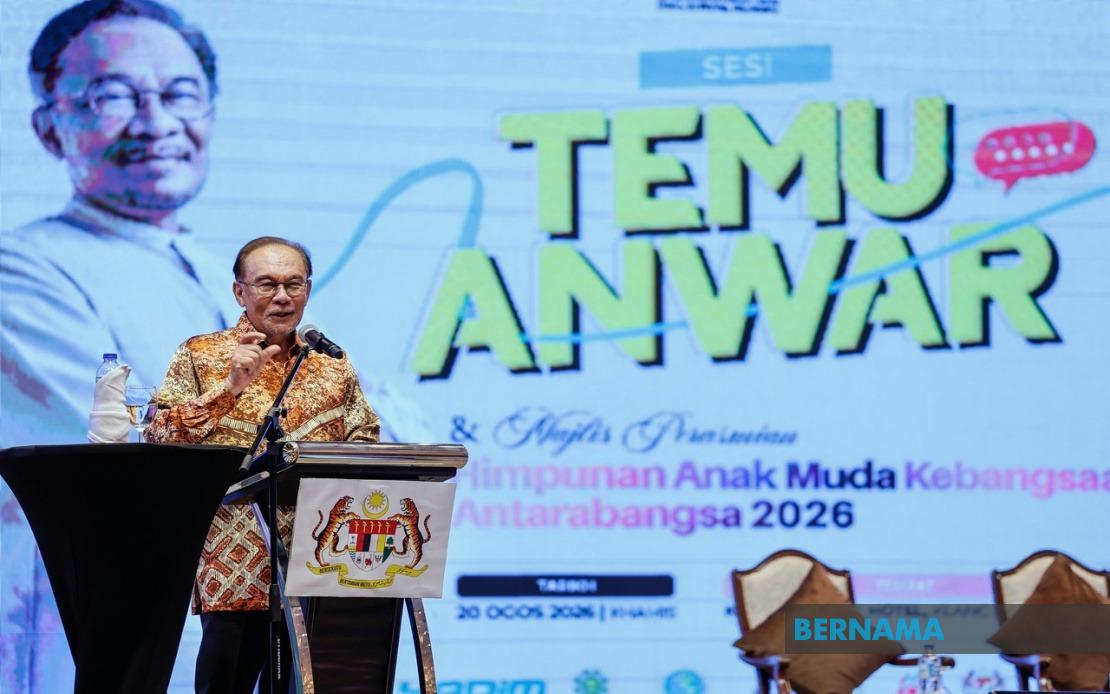
Prime Minister Datuk Seri Anwar Ibrahim has indicated that a series of consequential policy declarations will be rolled out across three key national occasions over the coming weeks, beginning with the eve of National Day on August 30 and extending through Malaysia Day celebrations on September 16, with a third announcement anticipated in early October during the Budget tabling. The Prime Minister provided limited specifics during remarks made at a youth engagement session in Klang, declining to elaborate on the substance of these forthcoming announcements, though his timing suggests deliberate coordination with moments of heightened national significance and public attention.
The three-pronged announcement schedule reflects a strategic approach to policy communication. Anwar made his remarks during the opening ceremony of Himpunan Anak Muda Antarabangsa (HAMKA) 2026, a significant international youth gathering, where he emphasised his administration's commitment to consulting widely before finalising major decisions. The staggered timeline—spanning late August through early October—allows the government to build momentum around its policy agenda while maintaining public anticipation and ensuring consistent media coverage around nationally significant dates. This sequencing is particularly important for an administration navigating multiple policy fronts simultaneously.
The immediate trigger for the Prime Minister's remarks centred on youth concerns regarding financial security within the gig economy, an increasingly critical employment segment across Malaysia and the broader Southeast Asian region. The question from a student participant highlighted growing anxiety among young workers about protection and support systems within non-traditional employment arrangements. This concern reflects a genuine gap in social safety nets that have traditionally been designed around conventional employer-employee relationships, a problem that has intensified as platform-based and freelance work has become a primary income source for millions of young Malaysians.
In response, Anwar articulated the government's ongoing efforts to strengthen protections for gig workers through the Malaysian Gig Economy Commission, known locally as SEGiM. This institutional framework represents an acknowledgment that the sector requires dedicated regulatory attention and policy development distinct from conventional labour frameworks. The establishment of SEGiM signals governmental recognition that gig economy workers face unique vulnerabilities—including absence of formal contracts, inconsistent income streams, and limited access to conventional employee benefits—that demand tailored interventions rather than applicating existing labour protections wholesale.
Complementing the commission's establishment, the government is advancing a new legislative framework targeting small businesses, which constitute the backbone of the gig economy ecosystem in Malaysia. Many gig platform operators and individual service providers operate as small business entities, making this legislation essential for creating coherent policy architecture. The bill's introduction indicates movement toward comprehensive regulation that addresses both platform governance and worker protections simultaneously, though the Prime Minister acknowledged that segments of the youth population perceive current assistance measures as inadequate relative to actual needs and costs.
Anwar signalled the government's willingness to reconsider existing financing requirements that currently demand business track records before entrepreneurs can access capital through major schemes such as TEKUN, the National Entrepreneurial Group Economic Fund. This represents a potentially significant shift in policy orientation, as track record requirements have historically functioned as barriers preventing first-time entrepreneurs, particularly younger individuals without established business histories, from accessing formal financing. The Prime Minister framed this flexibility as a necessary response to evolving economic conditions and employment patterns, acknowledging that rigid requirements designed for earlier economic configurations may constrain opportunity in contemporary labour markets.
The emphasis on removing artificial barriers to entrepreneurial financing carries substantial implications for Malaysia's broader economic development strategy. Young Malaysians increasingly view formal employment as unstable or insufficiently rewarding, driving demand for self-employment pathways. However, lack of capital access has traditionally constrained entry into legitimate business formation, forcing many youth toward informal arrangements or overseas migration. By revisiting financing eligibility criteria, the government addresses a genuine market friction that has deterred capital formation within younger demographic cohorts.
The Prime Minister's approach during the HAMKA 2026 session reflected a particular rhetorical strategy: emphasising open listening, consultation, and conditional commitment to action. Anwar repeatedly referenced seeking diverse perspectives and evaluating government capacity before implementing new initiatives, language suggesting deliberation rather than immediate action. This framing may indicate genuine policy uncertainty regarding optimal approaches, resource constraints on implementation, or political calculations regarding the pace of reform. For youth stakeholders, this cautious tone may reinforce impressions that government responsiveness remains incremental despite expressed commitment.
The sequencing of announcements across National Day, Malaysia Day, and Budget tabling connects economic policy development to broader national narratives. National Day on August 30 carries symbolic weight around national cohesion and shared identity, making it an appropriate venue for announcements addressing youth welfare and social inclusion. Malaysia Day on September 16 emphasises regional integration and national diversity, potentially framing announcements around inclusive economic participation. The Budget tabling in early October provides formal legislative context for resource allocation supporting new initiatives, suggesting that at least one announcement may carry budgetary implications requiring parliamentary approval.
For Malaysian policymakers and observers, these forthcoming announcements will reveal the government's priorities regarding youth employment, entrepreneurial opportunity, and social protection in non-traditional work arrangements. The pattern of consultation, deliberation, and staged announcement suggests a government seeking to balance multiple constituencies—youth seeking greater opportunity, businesses requiring regulatory clarity, and fiscal authorities concerned with sustainability. Whether the eventual policy measures will substantially address underlying structural challenges in youth employment and economic security remains a central question for implementation following the announcements.
The broader Southeast Asian context further underscores the significance of Malaysia's approach to gig economy regulation and youth entrepreneurship. Regional peer economies including Indonesia, Thailand, and the Philippines grapple with identical challenges regarding gig worker protections and youth unemployment, making Malaysian policy developments potentially instructive across the region. A coherent, effective framework combining worker protections with entrepreneurial financing could establish a model with applicability across ASEAN, while conversely, inadequate measures might signal continued policy uncertainty affecting investor and worker confidence region-wide.
As the announcements approach, Malaysian stakeholders across government, business, and civil society will monitor whether policy content matches the significance implied by strategic timing and high-profile announcement venues. The three-phase rollout provides opportunity for iterative policy development and public engagement, though it simultaneously risks diffusing attention and limiting comprehensive understanding of interconnected initiatives. Success will ultimately depend not on announcement spectacle but on substantive implementation capacity and sustained commitment to supporting Malaysia's youth through genuine economic security and opportunity expansion.

