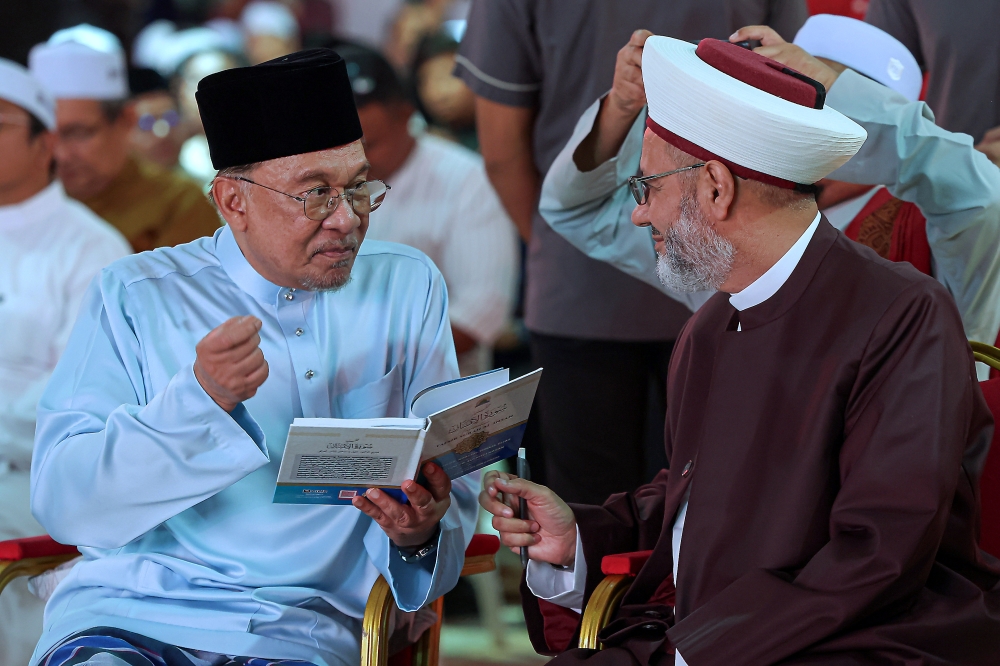
Prime Minister Datuk Seri Anwar Ibrahim has publicly commended Grand Imam Ahmad Al-Tayyeb of Al-Azhar as a leading international voice for moderate Islamic principles and values. The recognition reflects Malaysia's strategic alignment with institutional approaches to promoting tolerance and interfaith cooperation in the Muslim-majority region and beyond.
Anwar's remarks underscore the significance of Al-Azhar's role as one of the world's most influential Islamic educational and theological institutions. Established in 970 CE, Al-Azhar has long served as a scholarly beacon influencing Islamic thought across the Middle East, North Africa, and Asia. As its Grand Imam since 2010, Ahmad Al-Tayyeb has shaped the institution's contemporary direction, positioning it as a counterweight to extremist ideologies that claim Islamic legitimacy.
The Prime Minister's commendation carries particular weight in Southeast Asia, where Malaysia has positioned itself as a proponent of moderate Islam in a region increasingly scrutinised for its religious harmony. By publicly endorsing Al-Tayyeb's approach, Anwar reinforces Malaysia's commitment to a centrist Islamic philosophy that accommodates pluralism, rejects fundamentalism, and emphasises coexistence with other faith communities. This alignment reflects broader diplomatic objectives within the region's Muslim-majority nations.
Al-Tayyeb's international prominence stems from his activism in several critical domains. He has been instrumental in organising interfaith conferences, authored numerous theological works addressing contemporary Islamic challenges, and engaged with world leaders on matters spanning religious tolerance, counterterrorism, and educational reform. His 2019 visit to the Vatican, where he met Pope Francis, symbolised Al-Azhar's commitment to transcend sectarian boundaries and build bridges between major world religions.
For Malaysian policymakers and analysts, Al-Tayyeb's model of institutional moderate Islam offers a template for navigating the complex relationship between religious governance and pluralistic society. Malaysia's own experience with Islamic administration through the state mufti system and Islamic courts demonstrates longstanding engagement with balancing Sharia principles alongside secular constitutional frameworks. Anwar's endorsement suggests continuity in Malaysia's diplomatic strategy of promoting scholarly, institutionalised approaches to Islamic governance as alternatives to politicised religious movements.
The timing of this recognition also carries geopolitical nuance. The Middle East continues experiencing profound instability, with sectarian tensions, regional conflicts, and the aftermath of extremist insurgencies destabilising multiple nations. Within this context, moderate Islamic voices like Al-Tayyeb's carry increased diplomatic currency. For Malaysia, a nation navigating complex relationships with Gulf states, Iran, and broader regional powers, alignment with mainstream institutional Islam serves strategic interests beyond purely religious domains.
Al-Tayyeb's theological contributions have emphasised reinterpreting classical Islamic jurisprudence to address modern challenges including women's rights, scientific advancement, and democratic governance. His position that Islamic law need not conflict with contemporary human rights standards resonates with Malaysian reformist Islamic thought, particularly among younger generations seeking religious authenticity without abandoning progressive values. This intellectual bridge-building distinguishes his approach from both rigid traditionalism and wholesale modernism.
The institutional framework Al-Tayyeb represents also contrasts sharply with decentralised religious authority structures that have enabled extremist recruitment in various Muslim societies. By demonstrating that major Islamic institutions can champion both scriptural fidelity and global moderation, Al-Tayyeb provides counternarrative to claims that authentic Islam necessarily aligns with fundamentalist positions. For Malaysian authorities concerned with deradicalisation and preventing local youth recruitment by extremist groups, such institutional models offer practical legitimacy.
Anwar's public appreciation likely signals Malaysian interest in deepening cooperation with Al-Azhar on educational, theological, and interfaith initiatives. Malaysia's International Islamic University and other local institutions have historically engaged with Al-Azhar scholars and curricula. Strengthened partnerships could facilitate knowledge exchange on Islamic studies pedagogy, counterterrorism theology, and pluralism-compatible Islamic interpretations, benefiting regional stability and intellectual development.
The commendation also reflects broader Southeast Asian diplomatic positioning. Indonesia, the world's largest Muslim-majority nation, has similarly emphasised institutional moderate Islam through its Nahdlatul Ulama and Muhammadiyah organisations. By recognising Al-Tayyeb's contributions, Malaysia aligns itself with a regional consensus that sustainable interfaith peace and security require engagement with mainstream Islamic institutions rather than marginalisation of religious discourse to secular governance alone.
Moving forward, such recognition may catalyse formal collaborative frameworks between Malaysian Islamic institutions and Al-Azhar on research initiatives addressing contemporary religious challenges. Training programmes for Islamic scholars, joint theological publications, and coordinated interfaith platforms could strengthen institutional capacities across both regions. This practical dimension transforms diplomatic appreciation into tangible institutional relationships supporting long-term regional stability and religious coexistence.

