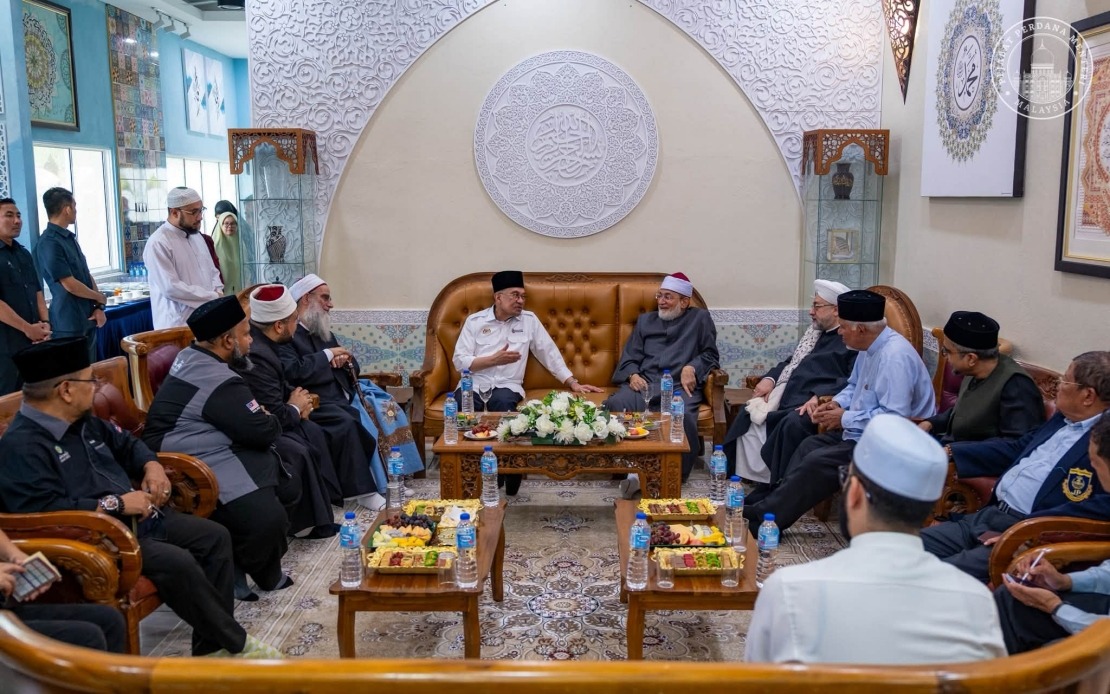
Prime Minister Datuk Seri Anwar Ibrahim has received three internationally recognised Islamic scholars who are visiting Malaysia, marking a significant moment of engagement between the nation's political leadership and respected figures in Islamic scholarship and religious studies. The visits underscore Malaysia's continuing commitment to positioning itself as a hub for Islamic knowledge and interfaith dialogue within the broader Southeast Asian region.
The three scholars receiving audiences with the Prime Minister represent diverse but complementary fields within Islamic learning. Al-Fadhil Al-Allamah Al-Muhaddith Syeikh Dr Mustafa al-Nadwi Al-Hasani brings decades of expertise in hadith scholarship from Egypt, a discipline that forms the foundational basis for Islamic jurisprudence and practice. His specialisation in authentic prophetic traditions carries particular weight in academic and religious circles across the Muslim world. Joining him is Al-Fadhil Al-Allamah Al-Muqri' Syeikh Dr Ahmad Isa Al-Ma'sarawy, whose international standing as a Quran reciter has made him a respected voice in preserving the proper recitation and memorisation of the Quranic text. The third visitor, Al-Fadhil Al-Syeikh Maulana Al-Sayyid Afeefuddin Al-Jailani, serves as custodian of the waqf, mosque and maqam associated with Syeikh Abdul Qadir Al-Jailani, a revered figure in Islamic spirituality whose influence extends across multiple cultures and generations.
Through his social media announcement, Anwar conveyed the multifaceted purpose behind these meetings. Beyond the ceremonial aspects of receiving distinguished guests, the Prime Minister explicitly stated his intention to seek their counsel and prayers—a gesture reflecting both personal piety and a deliberate signal about his administration's engagement with theological authority and spiritual guidance. By visiting the scholars at Nasyrul Quran, a venue dedicated to Quranic studies and dissemination, Anwar also highlighted his government's investment in institutions devoted to Islamic education and knowledge promotion.
The timing and nature of these visits carry broader implications for Malaysia's positioning within the Islamic world. By hosting and meeting with internationally prominent Islamic scholars, the country reinforces its aspiration to be recognised not merely as a Muslim-majority nation, but as an active participant in global Islamic intellectual discourse. This is particularly significant given Malaysia's diverse religious landscape and its constitutional framework that recognises multiple faiths while designating Islam as the federation's religion. Such engagements demonstrate how political leadership can balance these dual roles whilst maintaining credibility within both the Islamic scholarly community and the country's pluralistic society.
Anwar's emphasis on the scholars' contribution to promoting Islamic teachings in Malaysia reflects a broader agenda within his administration regarding religious education and social cohesion. The Prime Minister framed the visit explicitly within the context of building a society that is virtuous, knowledgeable, and harmonious—aspirations that resonate across demographic lines in Malaysia. By connecting Islamic scholarship to practical societal outcomes rather than treating religious engagement as purely devotional or ceremonial, Anwar presented a vision where theological and intellectual rigour directly serves the nation's social stability and moral development.
The venue of Nasyrul Quran itself warrants attention. As an institutional space dedicated to Quranic knowledge, its selection as the meeting point was not incidental. It demonstrated the Prime Minister's willingness to engage with the infrastructure of Islamic learning that exists within Malaysia's civil society, rather than confining such interactions to purely governmental settings. This approach signals openness to non-state actors who contribute substantially to the nation's intellectual and spiritual life.
For Southeast Asia more broadly, Malaysia's hosting of these scholars and the Prime Minister's direct engagement carries significance. The region has increasingly sought to establish itself as a centre for moderate, knowledge-based Islamic practice, distinguishing itself from extremist interpretations that have periodically threatened regional stability. By facilitating scholarly exchange and demonstrating governmental respect for legitimate Islamic intellectual authority, Malaysia contributes to a regional narrative that emphasises education, inter-community dialogue, and spiritual depth over doctrinal rigidity or political instrumentalisation of religion.
Anwar's reference to his "busy daily schedule" whilst still making time for these meetings suggests a hierarchy of priorities that places religious and intellectual engagement near the apex of governmental concerns. This messaging may resonate particularly with constituencies that view Islamic knowledge and spiritual guidance as essential components of responsible governance, reflecting a growing global trend where political leaders across diverse nations seek explicit endorsement and counsel from religious authorities.
The scholars' willingness to visit Malaysia and participate in such public engagements also reflects the country's reputation as a relatively welcoming environment for international Islamic academic exchange. Many Muslim-majority nations face restrictions or constraints on hosting foreign religious figures, making Malaysia's openness on this front a distinguishing characteristic that enhances its soft power within Islamic circles.
Looking forward, these interactions between political leadership and Islamic scholarship may influence how Malaysia approaches policy questions with religious dimensions—from education curricula to social welfare frameworks to international relations. When scholars of this calibre receive direct access to prime ministerial attention, their perspectives inevitably carry amplified weight in policy deliberations and public discourse. The outcomes of any counsel these scholars provide, whether explicitly or implicitly, could thus shape Malaysia's trajectory across multiple governance domains for months or years ahead.

