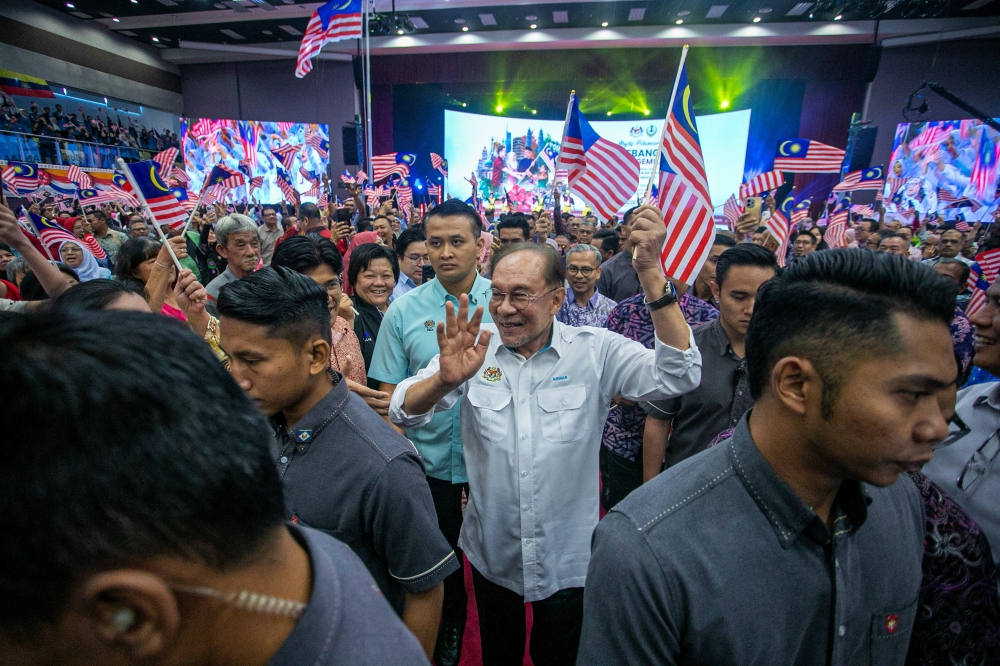
Prime Minister Datuk Seri Anwar Ibrahim has drawn a clear distinction between legitimate political campaigning and the improper use of government authority, cautioning ministers and government leaders to remain within acceptable ethical boundaries in their electoral activities. Speaking at an event in Ipoh, Anwar emphasised that holding public office does not prohibit individuals from engaging in political promotion, but it does require them to exercise such activities with integrity and respect for institutional norms.
The prime minister's remarks reflect growing concerns within Malaysia's political establishment about the potential blurring of lines between official duties and partisan electioneering. As the nation approaches various electoral contests at federal and state levels, clarity on such matters becomes increasingly important for maintaining public confidence in governmental institutions. Anwar's intervention suggests that his administration is committed to establishing ground rules that protect the integrity of both the political process and the civil service machinery.
Anwar's position acknowledges a practical reality of modern governance: elected officials and appointed government leaders maintain legitimate political interests and affiliations, and complete separation from political activity is neither feasible nor necessarily desirable in a functioning democracy. However, the prime minister's emphasis on boundaries reflects international best practices where democracies maintain systems of accountability to prevent those holding public power from converting that power into electoral advantage. The distinction matters particularly in Malaysia's context, where questions about the misuse of government machinery have periodically surfaced in public discourse.
The warning carries implicit consequences, suggesting that violations of these unspoken rules may trigger administrative or political repercussions. In the Malaysian system, the prime minister wields considerable influence over ministerial appointments and portfolio assignments, giving his admonitions practical weight beyond mere rhetorical persuasion. Ministers and government leaders who ignore such guidance risk their political standing and career prospects, making Anwar's cautionary words a serious institutional signal.
For Southeast Asian observers, Malaysia's approach to managing this tension illustrates broader regional challenges in consolidating democratic institutions. Many countries in the region struggle with questions of how to maintain checks on executive power while allowing elected officials meaningful political participation. Anwar's framework—permitting campaigning while prohibiting resource misuse—represents a middle-ground approach that seeks to preserve both democratic participation and institutional integrity.
The timing of Anwar's statement carries additional significance given Malaysia's recent political volatility. The country has experienced multiple changes of government, realignment of coalitions, and questions about political stability. By establishing clear parameters for acceptable behaviour, the prime minister may be attempting to stabilise expectations and reduce the likelihood of escalating conflicts over resource allocation and procedural fairness. Such clarity can help prevent the kind of political friction that has previously destabilised Malaysian governments.
Implementing such guidelines presents practical challenges for enforcement. Unlike formal laws that can be adjudicated in courts, ethical boundaries depend largely on institutional culture and peer pressure within government. The absence of explicit written rules means that determination of violations often depends on subjective assessment and political judgment. This ambiguity could create space for differing interpretations, though Anwar's public pronouncement establishes at least a clear statement of intent from the highest level of government.
For Malaysian civil servants and government officials, Anwar's remarks provide important guidance about maintaining professional boundaries during election periods. Public sector employees, though generally constrained from overt political campaigning, may face pressure from political superiors to advance partisan interests through ostensibly official channels—such as by channeling development projects, government contracts, or administrative resources toward certain constituencies or groups. The prime minister's statement reinforces the principle that such conduct violates acceptable norms.
The statement also sends a message to Malaysia's opposition parties and civil society organisations, potentially raising expectations that the government will police its own conduct rather than expect external critics to serve as sole monitors of propriety. If government leaders are publicly committed to respecting boundaries, they become vulnerable to criticism and loss of moral authority when violations occur. This creates stronger incentives for internal compliance than reliance on external oversight alone.
Looking forward, the effectiveness of Anwar's approach will depend on consistent application across all levels of government and all political factions within the ruling coalition. Malaysia's government comprises multiple parties with distinct bases, organisational structures, and campaign strategies. Ensuring uniform adherence to ethical guidelines across this diverse political landscape presents considerable complexity. Differential enforcement—where violations by certain groups face consequences while others escape sanctions—would undermine the credibility of the entire framework.
Anwar's intervention also reflects his broader political positioning as a leader committed to institutional reform and democratic strengthening. By emphasising rules and boundaries, he seeks to establish himself as a serious custodian of governance standards, distinguishing his administration from previous periods when such concerns received less prominent attention. This positioning may enhance his standing with moderate voters and international observers who value democratic institutions, though it requires consistent follow-through.
The prime minister's remarks ultimately represent an attempt to navigate a perpetual tension in democratic systems: how to prevent those holding official power from converting that power into electoral advantage, while acknowledging that elected officials necessarily maintain political interests and affiliations. Malaysia's approach through informal guidelines and institutional norms, rather than formal legal restrictions, reflects the constraints and opportunities of its particular constitutional framework and political culture.

