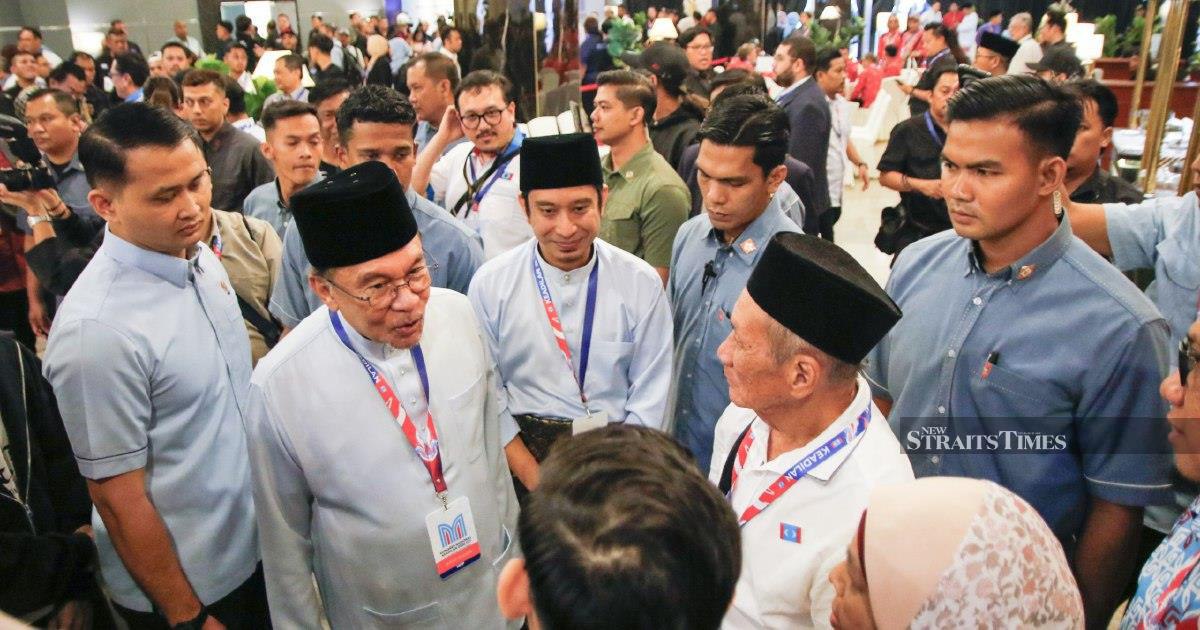
Prime Minister Datuk Seri Anwar Ibrahim has moved to quash growing speculation about friction within Malaysia's top political leadership, declaring at Ayer Keroh that his relationship with Deputy Prime Minister Datuk Seri Dr Ahmad Zahid Hamidi remains fundamentally sound and productive. The categorical denial comes amid persistent reports of strains between the two figures, who represent different factions within the ruling Pakatan Harapan coalition and command support from distinct regional constituencies.
The timing of Anwar's statement underscores the delicate balancing act required to maintain cohesion across Malaysia's fragmented political landscape. With the government relying on support from multiple parties encompassing diverse ideological positions and competing interests, any perceived disharmony at the apex risks signalling instability to both domestic stakeholders and international observers. Zahid's Umno-led faction controls substantial parliamentary votes and retains significant grassroots machinery, making the partnership between the two leaders essential for governance and policy implementation.
Malaysia's political configuration has repeatedly demonstrated vulnerability to sudden shifts in coalition alignments. The rejection of public narratives portraying leadership division thus carries practical significance beyond mere optics. Coalition partners continuously monitor signals from the top echelon, interpreting statements and actions for clues about the government's durability and the likely distribution of future ministerial portfolios and state-level influence. Anwar's intervention attempts to reset expectations and prevent cascading doubt among coalition members.
The Prime Minister's comments reflect a broader Malaysian political reality where multiple parties occupy government simultaneously despite maintaining separate organisational structures and competing agendas. This arrangement, while representing the democratic expression of voter preference, creates inherent pressures requiring careful management. The 2022 merger that brought Umno and Parti Pribumi Bersatu Malaysia under a broader coalition framework was presented as a unifying move, yet underlying tensions between different power centres remain evident.
Zahid's position as Deputy Prime Minister carries symbolic weight extending beyond his administrative portfolio. His presence at the upper tier of government represents the inclusion of Umno, historically Malaysia's dominant ruling party, and signals to its members and supporters that their concerns retain sufficient influence over national direction. Anwar's emphasis on maintaining good working relations speaks to an understanding that perceived marginalisation of coalition partners invites defection and internal sabotage.
From a Southeast Asian perspective, Malaysia's coalition governance model differs markedly from single-party or two-coalition systems dominating the region's other major economies. The requirement to accommodate multiple parties and competing factions simultaneously creates particular vulnerabilities but also distributes power more widely than systems with decisive single-party majorities. Foreign governments and investors monitoring Malaysian stability therefore pay close attention to statements clarifying the functionality of internal political mechanisms.
The relationship between Anwar and Zahid specifically carries historical dimensions shaping current dynamics. Both have navigated Malaysia's complex political terrain across decades marked by significant institutional shifts. Their ability to work collaboratively signals maturity within the political system and demonstrates that past rivalries and disputes need not permanently foreclose cooperation. This narrative carries importance for how younger political actors and emerging factions perceive the viability of power-sharing arrangements.
Dismissals of rift reports also serve to reorient media and public discourse away from personality-driven conflict narratives toward substantive policy discussions. Extensive media coverage of alleged tensions between leaders can crowd out coverage of government initiatives and can fatigue public confidence in institutions. By actively contradicting such narratives, political leaders attempt to reset information environments and redirect attention toward areas where they can showcase competence and policy achievements.
The practical effectiveness of Anwar's denial depends partly on subsequent observable behaviour. Coalition coherence ultimately depends less on official statements and more on whether major decisions proceed smoothly, whether coalition members receive anticipated patronage and influence, and whether public disputes remain contained. Senior leaders who repeatedly assert harmony while their subordinates engage in visible conflict generate scepticism that undermines the reassurance they attempt to provide.
For Malaysian business constituencies and international partners, stability in top-level relationships carries direct implications. Sustained political divisions at the leadership level can slow decision-making, prevent bold policy initiatives, and create unpredictability in regulatory environments. Conversely, functional working relationships between different coalition factions enable governments to implement comprehensive programmes and signal investor confidence to external markets.
Zahid's Umno faction has particular interest in maintaining the coalition arrangement despite frustrations about ministerial distribution and policy influence. As Malaysia's largest Malay-Muslim political organisation, Umno retains substantial electoral strength but currently operates within a coalition rather than leading government independently. Whether the party leadership views the current arrangement as a transitional phase toward future solo governance, or as an acceptable long-term positioning, influences how responsive they remain to central government cohesion efforts.
Anwar's statement also implicitly addresses concerns among other coalition partners about potential recalignment between the two largest political forces. Should Anwar and Zahid move toward deeper conflict, speculation about coalition restructuring would intensify, potentially encouraging other members to revisit their positioning. The preventive reassurance thus extends beyond these two individuals toward stabilising broader coalition architecture and reducing transaction costs for other members considering their continued participation.
As Malaysia navigates contemporary economic challenges and positions itself within evolving regional dynamics, sustained political functionality at the top remains prerequisite for effective governance. Whether Anwar's characterisation of stable working relationships accurately reflects underlying reality will become evident through observed government performance and coalition stability over coming months.

