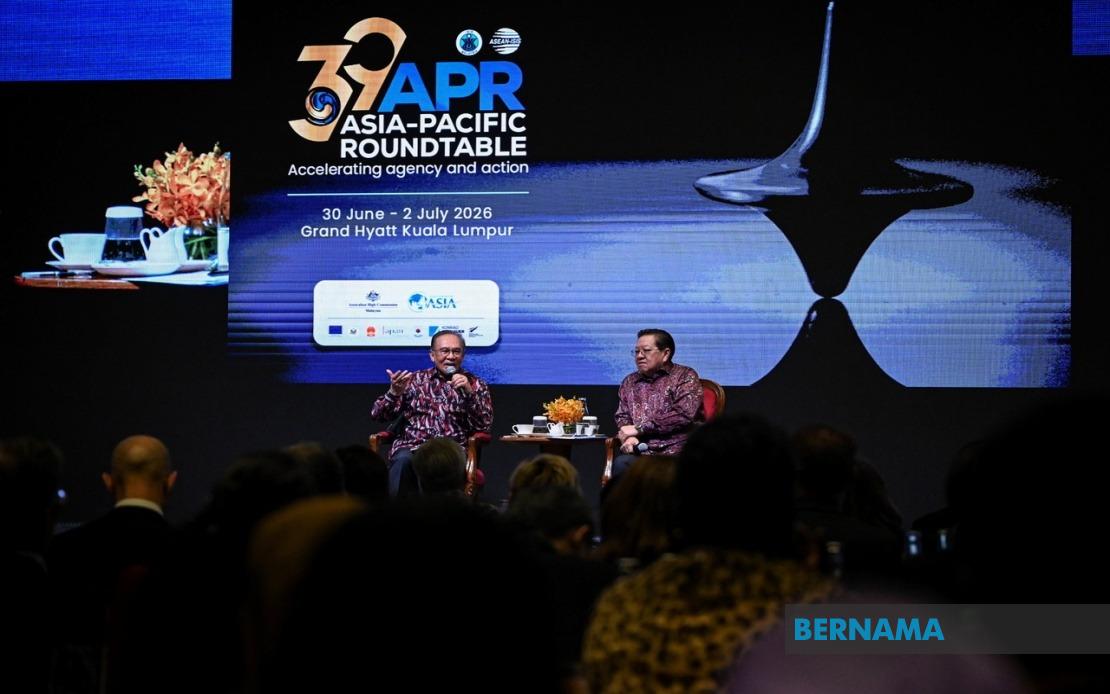
Prime Minister Datuk Seri Anwar Ibrahim has dismissed widespread anxieties about military confrontation in the South China Sea, arguing instead that the region's stability rests on sustained diplomatic channels, mutual confidence, and commitment to established international frameworks. Speaking during a question-and-answer session at the 39th Asia-Pacific Roundtable in Kuala Lumpur on Thursday, Anwar pushed back against what he characterised as alarmist projections about the contested waterway, insisting that Malaysia's own experience demonstrates the possibility of meaningful coexistence even amid territorial disagreements.
The Prime Minister elaborated that Malaysia has cultivated substantive engagement with China despite longstanding maritime claims in the South China Sea. He highlighted direct conversations with Chinese President Xi Jinping and Premier Li Qiang as evidence that bilateral relations have remained robust and free of the kind of escalatory friction that outside observers often anticipate. His remarks reflect Malaysia's broader strategic positioning as a nation that seeks to balance its ASEAN commitments with pragmatic ties to Beijing, avoiding the polarisation that has marked some regional capitals' approaches to great power competition.
Anwar specifically noted that China has signalled backing for the United Nations Convention on the Law of the Sea, the foundational treaty governing maritime conduct globally. He further referenced the ongoing negotiation of an ASEAN-China Code of Conduct covering the South China Sea as a constructive framework that should anchor collective efforts toward resolving disputes without recourse to force. The code, which has been under discussion for years, represents a middle path between enforcement of competing claims and a return to historical spheres of influence, and Anwar's invocation of it underscores Malaysia's investment in rule-based rather than power-based solutions.
The Prime Minister issued a cautious critique of media and analytical narratives that foreground the possibility of warfare in the region. Rather than engaging in what he framed as unproductive fear-mongering, Anwar argued that ASEAN nations must remain committed to dialogue and sustained engagement. This positioning reflects a deliberate diplomatic choice to resist what Malaysia views as external pressure to take sides in broader geopolitical rivalries, particularly between the United States and China, and instead to maintain the Association's traditional emphasis on non-alignment and consensus-building.
Anwar underscored the instrumental role that personal relationships among ASEAN leaders have played in preserving regional tranquility across recent decades. He pointed to the practice of direct communication and informal problem-solving among heads of state as a stabilising mechanism that has repeatedly prevented local disputes from metastasising into broader conflicts. This emphasis on interpersonal diplomacy reflects a distinctly Southeast Asian approach to statecraft, one that privileges face-to-face engagement and quiet negotiation over public confrontation or institutionalised enforcement mechanisms.
Beyond the South China Sea, the Prime Minister addressed the Cambodia-Thailand border dispute, welcoming both nations' stated commitment to continued negotiations. Anwar contextualised many regional boundary disagreements as historical residue from the colonial period, a framing that shifts responsibility away from current governments and toward external powers' past administrative decisions. His confidence in eventual peaceful resolution through sustained dialogue mirrors his broader message about the sufficiency of diplomatic channels when political will exists.
Anwar also articulated Malaysia's position on reforming global multilateral institutions, including the United Nations and the World Trade Organisation. This advocacy sits within a wider ASEAN campaign to ensure that the Global South maintains meaningful voice in rules-making forums that have historically been dominated by Western powers. For Malaysia specifically, institutional reform represents both a matter of principle and of practical interest, given its stakes in trade governance and maritime law.
The Prime Minister's remarks carry particular significance given Malaysia's own exposure to South China Sea risks. As a claimant state with significant offshore economic interests and a population dependent on marine resources, Malaysia has genuine incentives to prevent militarisation. Anwar's public rejection of conflict inevitability and his emphasis on China's support for existing legal frameworks may be read partly as reassurance to domestic constituencies worried about encroachment, as well as a signal to international partners that Malaysia will not be pushed toward confrontational stances.
Anwar's framing also reflects Malaysia's broader diplomatic strategy of maintaining equidistance between competing powers while deepening engagement across the region. By emphasising constructive bilateral relations with China and ASEAN's collective commitment to peaceful dispute resolution, he attempts to preserve space for Malaysia to pursue national interests without being conscripted into larger power competitions. This balancing act has become increasingly delicate as geopolitical tensions have mounted, but Anwar's language suggests that Malaysia intends to keep pushing back against zero-sum framings of regional politics.

