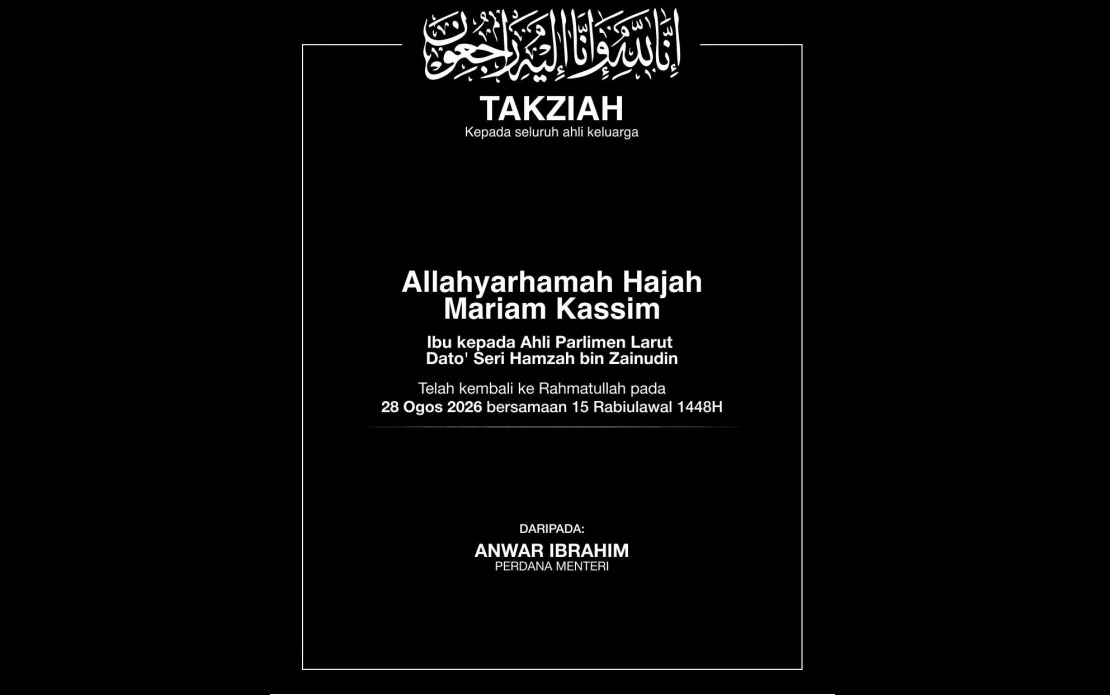
Prime Minister Datuk Seri Anwar Ibrahim has expressed his sympathies to Opposition Leader Datuk Seri Hamzah Zainudin following the passing of his mother, Mariam Kassim, who was 90 years old. The gesture reflects the longstanding parliamentary convention whereby the nation's top political office acknowledges significant personal losses within the political establishment, transcending factional divides. Anwar's outreach underscores the importance of maintaining civility and shared humanity across the political spectrum, particularly during moments of bereavement that touch members of opposing parties.
Through a statement posted on the social media platform X, Anwar conveyed that both he and his wife, Datuk Seri Dr Wan Azizah Wan Ismail, were offering prayers for Hamzah and his extended family during this difficult period. The Prime Minister emphasised his hopes that the Opposition Leader and his relatives would find the emotional reserves necessary to navigate the grief accompanying such a loss. This expression of solidarity carries weight in Malaysian political culture, where acknowledgement from senior government figures can provide comfort to those in mourning, regardless of their political affiliation or public standing.
In his message, Anwar invoked Islamic sentiments appropriate to the Malaysian context, expressing the prayer that Allah SWT would extend His mercy upon the departed soul, absolve her of transgressions, and grant her a place among the righteous. Such religious language reflects the Islamic principles that underpin Malaysia's constitutional framework and resonate deeply within the nation's Muslim-majority society. The use of such phraseology demonstrates respect for both the individual's faith and the customs observed within Malay-Muslim communities, where religious expressions during bereavement form an integral part of the mourning process.
Mariam Kassim was subsequently laid to rest at the USJ 22 Muslim Cemetery located in Subang, following the customary burial practices observed within Islam. The cemetery, situated in the Petaling Jaya area of Selangor, serves as the final resting place for many members of the community. The funeral arrangements concluded the formal period of grieving that typically follows death in Malaysian Islamic tradition, with family members observing the prescribed rituals and prayers. The choice of burial location reflects the family's connection to the Selangor region and their adherence to established customs.
Hamzah Zainudin, who currently leads the parliamentary Opposition following recent electoral developments, has maintained a prominent position in Malaysian politics over several decades. His political career has witnessed numerous shifts in the nation's complex political landscape, during which he has held various ministerial positions and maintained influence across different political coalitions. The loss of his mother represents a significant personal milestone for the seasoned politician, who has navigated one of the country's most demanding political environments. Such moments often provide perspective within the often-contentious realm of parliamentary politics, reminding public figures of priorities beyond factional rivalries.
The incident exemplifies the Malaysian political establishment's capacity to observe protocols of respect and decorum during personal crises, even when political opponents occupy opposite ends of the parliamentary spectrum. While Anwar and Hamzah have frequently sparred over policy matters and governance approaches, their ability to recognise shared humanity during moments of loss reflects the underlying institutional frameworks that guide political conduct in the country. These customs, whether formally codified or informally observed, contribute to the stability and continuity of the democratic process by preventing personal animosities from completely eroding the bonds of professional courtesy.
Within Malaysian society, expressions of condolence from senior government officials carry particular significance, as they signal that political differences need not preclude acknowledgement of personal tragedy. The Prime Minister's gesture would likely resonate positively across various segments of the population, demonstrating that even in a polarised political environment, fundamental human values remain paramount. Such moments provide opportunities for the political establishment to model the civility and mutual respect that citizens might reasonably expect from their leaders, regardless of party affiliation or ideological orientation.
The death of elderly parents often prompts reflection among politicians and public figures regarding mortality, legacy, and the values transmitted across generations. For Hamzah, the loss of his mother at an advanced age, while inevitable in the natural course of life, nevertheless represents the closing of another chapter in his family history. Many Malaysians who have experienced similar losses would recognise the particular poignancy of losing a parent who has witnessed the nation's entire post-independence development, from the early years of nationhood through to contemporary Malaysia.
Anwar's response also reflects contemporary Malaysian political norms, wherein social media platforms have become the primary vehicle for official communications and public expressions. The use of X to disseminate condolences demonstrates how political messaging has evolved in the digital age, allowing for rapid, widespread distribution of sentiments that might previously have required formal press releases or parliamentary statements. This democratisation of political communication has accelerated the pace at which such gestures reach the public domain while simultaneously allowing direct engagement with various constituencies without intermediation by traditional media channels.

