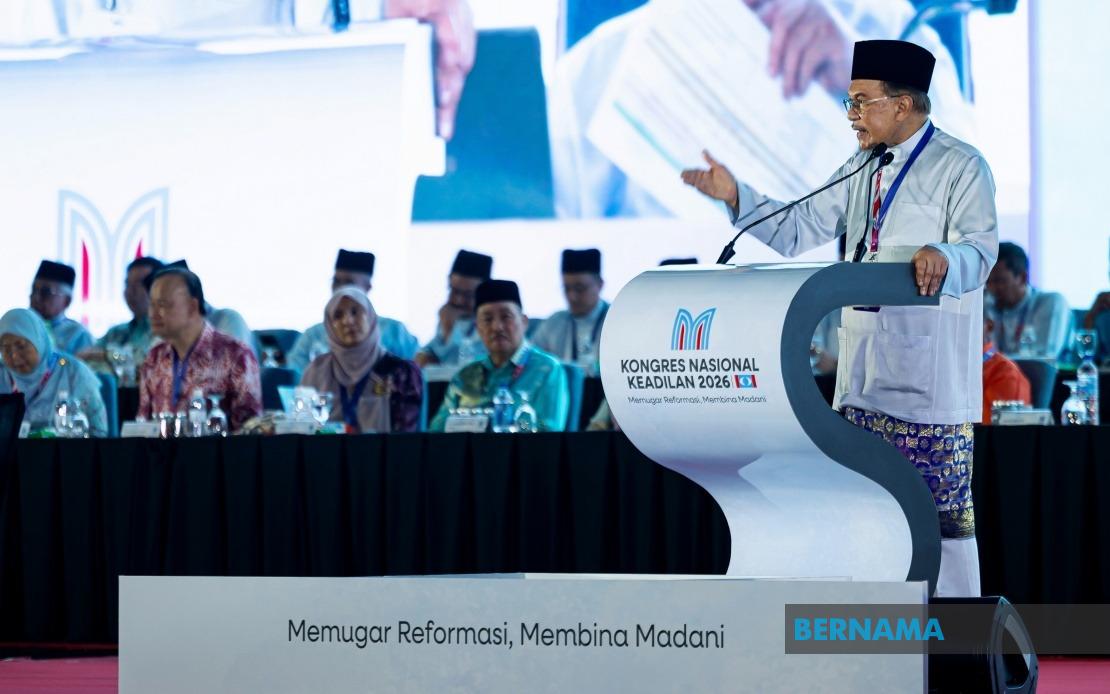
Prime Minister Datuk Seri Anwar Ibrahim moved to quash speculation about a growing divide with his deputy by emphasizing that ties between them remain functional and cordial, speaking before delegates at the 2026 PKR National Congress in Melaka on August 15. The remarks came in direct response to earlier assertions by former UMNO Youth chief Khairy Jamaluddin, who had suggested that trust between the two leaders has eroded significantly since the Unity Government took office following the 15th General Election in 2022.
Anwar characterised Khairy's assessment as merely a personal interpretation rather than an accurate reflection of the current state of affairs. In explaining the distinction between his own approach and that of his critic, the Prime Minister suggested that Khairy habitually interprets political developments through a lens of conflict, whereas he himself prioritises dialogue and reconciliation. This rhetorical framing underscores a broader philosophical divide within Malaysia's fractious political landscape, where the choice between confrontational and consensus-building strategies remains a defining feature of governance.
During his presidential address at the Melaka International Trade Centre, Anwar took the opportunity to publicly acknowledge Ahmad Zahid's contribution to establishing the Unity Government framework. Such recognition signals an attempt to reinforce the appearance of harmony within the coalition, particularly important given the delicate balance required to maintain cross-party cooperation in a parliament where the government's majority remains relatively slim. The gesture carries symbolic weight, suggesting that despite periodic tensions, Anwar views the Barisan Nasional chairman's role as instrumental to the current political settlement.
Khairy's intervention, released publicly on August 14, had painted a more pessimistic picture of the relationship between Malaysia's top two executive positions. The former Rembau Member of Parliament argued that the deterioration of mutual trust had accelerated in recent months, a claim he attributed to mounting friction between Barisan Nasional and Pakatan Harapan. This assessment gained particular credence in the context of the Negeri Sembilan State Election, where BN made the strategic decision to cooperate with Perikatan Nasional rather than maintain the existing coalition arrangement with PH partners.
That decision to work with PN in a state-level contest represents more than a tactical manoeuvre; it signals the fluidity of Malaysia's political alignments and the conditional nature of coalition arrangements that have sustained the Unity Government. For observers tracking the stability of the current administration, such moves raise legitimate questions about whether the underlying consensus that binds together ideologically disparate parties remains robust or is gradually fragmenting under pressure from competing local interests and factional ambitions.
Anwar's response suggests a deliberate effort to downplay such concerns, framing them as matters of perception rather than substance. He argued that disagreements arising either within individual parties or among different components of the ruling coalition are best addressed through transparent discussion and non-adversarial problem-solving. This emphasis on peaceful resolution reflects a consistent messaging theme from the Prime Minister's office, one designed to reassure investors, international observers, and Malaysian voters that the government possesses sufficient internal cohesion to function effectively.
The timing of this exchange carries significance for understanding the current state of Malaysian politics. The Negeri Sembilan situation occurred recently enough that its consequences continue to reverberate through coalition dynamics, while simultaneously the 2026 PKR National Congress provides a platform for Anwar to shape party narratives and demonstrate leadership control. By using the occasion to defend the stability of top-level relationships, Anwar signals to his party base that he maintains command of the political situation and that reports of serious deterioration are exaggerated.
However, the mere fact that such denials became necessary points to underlying vulnerabilities within the coalition structure. The Unity Government, formed in the aftermath of GE15, was never envisioned as a permanent arrangement by most of its constituent parties. UMNO and BN have long viewed their participation as a temporary expedient to prevent Perikatan Nasional from securing executive power, while PH has sought to consolidate Anwar's position and advance its own agenda. These divergent objectives create inherent tension that periodic public reassurances cannot fully resolve.
For Malaysian observers, the exchange between Anwar and Khairy illustrates how political leadership in the country frequently operates at multiple levels simultaneously. Public statements about coalition harmony coexist with documented instances of parties pursuing separate interests, as demonstrated by BN's willingness to cooperate with PN in Negeri Sembilan. This apparent contradiction reflects not necessarily deceit, but rather the pragmatic reality that Malaysia's coalitional politics requires both unity on broad governance questions and flexibility regarding specific electoral contests or state-level arrangements.
The relationship between Anwar and Ahmad Zahid will likely continue to face pressure points, particularly as the next general election approaches and both leaders contemplate their parties' strategic positioning. Ahmad Zahid's management of UMNO, which has shown signs of internal restlessness, adds another layer of complexity to their partnership. Whether the two maintain sufficient alignment to guide the coalition through the next electoral cycle will significantly influence Malaysian political trajectories for years to come.
Anwar's insistence on distinguishing between hostile interpretations of coalition dynamics and actual deterioration in working relationships serves an important tactical function. By characterizing Khairy's assessment as reflecting a confrontational mindset rather than objective reality, the Prime Minister creates rhetorical space for the government to pursue necessary pragmatism—including state-level accommodations with rival parties—without appearing to concede that the broader coalition architecture is destabilizing. Whether this framing ultimately persuades skeptics depends largely on how subsequent weeks and months unfold in the complex terrain of Malaysian governance.

