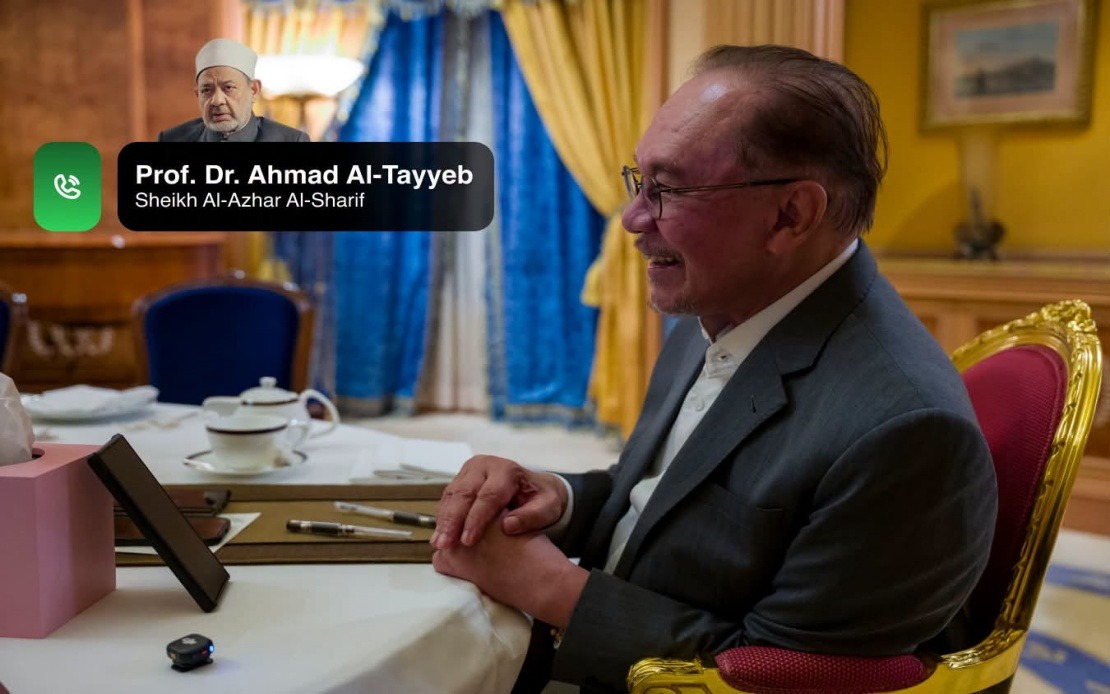
Prime Minister Datuk Seri Anwar Ibrahim has engaged in substantive discussions with two of the Islamic world's most influential figures regarding Malaysia's role in promoting understanding of Islam and advancing religious scholarship. The conversations, initiated by the leaders themselves, centred on collaborative approaches to dakwah activities and the expansion of Islamic studies as a means to deepen knowledge within the broader Muslim community.
Sheikh al-Azhar al-Sharif Prof Dr Ahmad al-Tayyeb, who leads Al-Azhar University—one of Islam's oldest and most respected centres of learning—reached out to the Prime Minister by telephone to inquire about his health following recent surgical treatment. The gesture reflected the esteem in which Anwar is held within the wider Islamic world and signalled a commitment to maintaining dialogue between Malaysian leadership and international Islamic institutions.
During their exchange, Anwar expressed appreciation for al-Tayyeb's prayers and well-wishes, confirming that his surgical procedure proceeded without complications and that his recovery is progressing satisfactorily. Beyond these personal matters, however, the conversation evolved into a broader strategic discussion about how Malaysia and Al-Azhar might work together to advance Islamic education and interpretation. Anwar underscored the importance of continued dakwah efforts—the Islamic concept of inviting others to understand and practise Islam—as a framework for this collaboration.
A particularly significant dimension of their discussion involved al-Tayyeb's previous visit to Malaysia, which Anwar characterised as having left a profound impression on the Malaysian Muslim community. This prior engagement appears to have established a foundation for deeper institutional cooperation, with both leaders expressing interest in furthering their partnership. Anwar indicated that a subsequent meeting—whether in Cairo, where Al-Azhar is headquartered, or in Kuala Lumpur—would provide an opportunity to solidify these collaborative plans and develop more concrete initiatives.
In a parallel development, Anwar also spoke with Mohamed Abdelsalam, Secretary-General of the Council of Muslim Elders (Majlis Hukama Muslimin), an influential platform bringing together senior Islamic scholars from across the Muslim world. This second conversation similarly touched on health matters, with Abdelsalam inquiring about the Prime Minister's condition and extending his prayers. Anwar reciprocated by asking about Abdelsalam's wife, who is currently hospitalised, and offered prayers for her recovery—a gesture that highlights the personal bonds underlying these high-level institutional relationships.
The substance of Anwar's exchange with Abdelsalam reinforced themes introduced in his conversation with al-Tayyeb. Both discussions centred on Sheikh al-Azhar al-Sharif's intention to return to Malaysia for further engagement. More significantly, Anwar and Abdelsalam discussed several emerging initiatives designed to strengthen Malaysia's institutional ties with Al-Azhar and to promote what they characterised as a straightforward, accessible, and authoritative interpretation of Islam. This language—emphasising simplicity and clarity—carries particular resonance in the Malaysian context, where debates about Islamic teaching have sometimes been clouded by competing interpretations and conflicting theological positions.
The Prime Minister publicly articulated his gratitude for both al-Tayyeb and Abdelsalam, expressing appreciation for their friendship, support, and confidence in Malaysia's leadership and vision. This gratitude extends beyond ceremonial courtesy; it reflects genuine recognition of the strategic value these relationships hold for Malaysia's positioning within the global Islamic community and its capacity to shape conversations about contemporary Islamic thought and practice.
Anwar also acknowledged the steadfast support of his wife, Datuk Seri Dr Wan Azizah Wan Ismail, whom he lauded as an exemplary woman for her loyalty and sacrifice throughout his political journey. This personal recognition, shared publicly, underscores the role that family commitment plays in sustaining the Prime Minister's engagement with broader national and international responsibilities, particularly as he navigates both political leadership and health challenges.
These communications hold several layers of significance for Malaysia. At the institutional level, they signal the country's continued commitment to engaging with the broader Islamic world and to positioning itself as a thoughtful contributor to global conversations about Islam's role in contemporary society. The emphasis on dakwah and Islamic education reflects a conscious effort to promote interpretations that are inclusive, intellectually rigorous, and responsive to modern contexts. For the region, Malaysia's cultivation of these relationships with institutions like Al-Azhar potentially strengthens Southeast Asia's voice in broader Islamic forums and provides alternative platforms for discussing Islamic issues beyond the Middle East.
The focus on collaborative educational and scholarly initiatives is particularly noteworthy given contemporary global tensions and polarisation. By anchoring the relationship between Malaysian leadership and international Islamic institutions in concrete work—whether through expanded Islamic studies programmes, scholarly exchanges, or coordinated dakwah efforts—these conversations suggest a pragmatic approach to advancing understanding and building bridges across diverse Muslim communities. The emphasis on simplicity and accessibility in Islamic teaching also addresses a significant contemporary challenge: ensuring that Islamic education remains open to ordinary believers rather than becoming arcane or dominated by narrow theological factions.
Moving forward, the stated intention to arrange in-person meetings in either Cairo or Kuala Lumpur will likely produce tangible outputs. These might include formal academic partnerships, sponsored scholarship programmes, or coordinated publishing initiatives that amplify authoritative Islamic voices and perspectives. Such developments would enhance Malaysia's soft power within the Islamic world while contributing to more moderate and intellectually grounded discourse on Islam globally—outcomes that align with Malaysia's stated national interests and its aspirations to be a moderate, progressive Muslim-majority nation.

