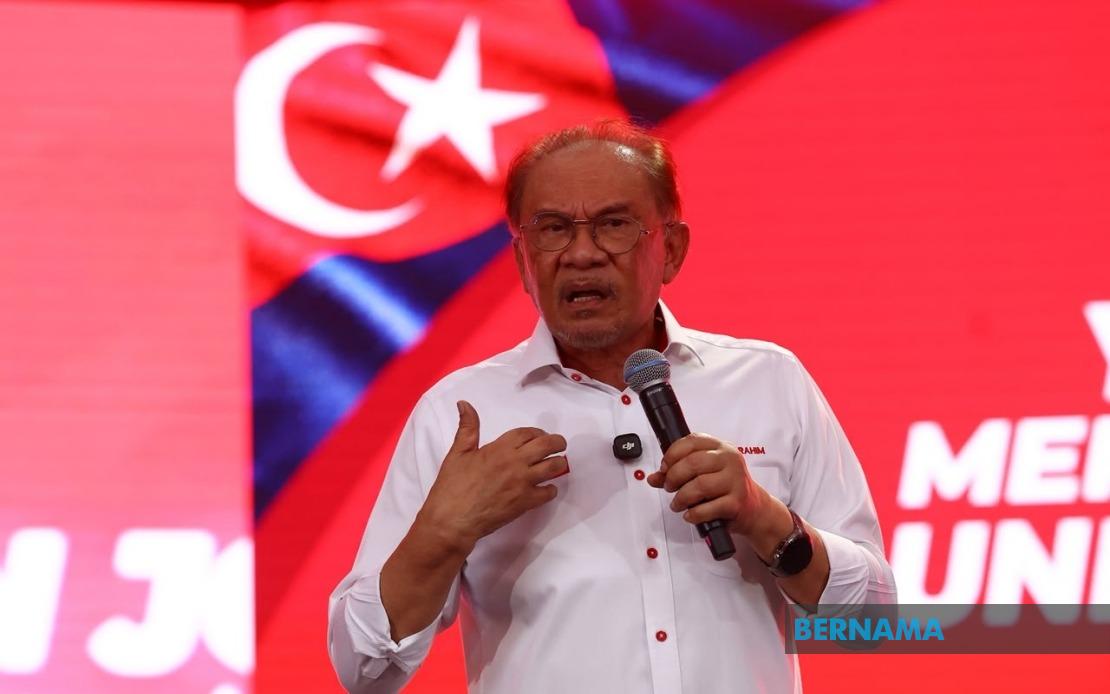
Prime Minister Datuk Seri Anwar Ibrahim has firmly rejected claims circulating on social media that he recently acquired a luxury BMW vehicle for his personal use, dismissing the allegations as misinformation during a campaign event in Johor. Speaking at the 'Yok! Meriahkan Johor! Undi Harapan' programme in Senggarang on July 9, Anwar characterised the allegation as part of a pattern of falsehoods designed to undermine his public image, particularly given his administration's stated focus on assisting lower-income Malaysians.
The Prime Minister emphasised that the BMW in question is not a newly purchased vehicle but rather an existing government asset that has long been part of the Prime Minister's Department's fleet. This clarification came after the Prime Minister's Department and the Ceremonial and International Conference Secretariat Division issued a statement two days prior confirming that the vehicle was an existing government asset designated for official logistics purposes, rather than a newly acquired acquisition. The distinction between an old vehicle already in government custody and a fresh purchase is significant in the context of public accountability, as it addresses concerns about potential misuse of state resources during a period when the government is emphasising fiscal responsibility.
Apart from addressing the BMW matter, Anwar also took the opportunity to explain the provenance of the Mercedes-Benz he currently uses as his official vehicle. He disclosed that the vehicle was bestowed upon him by His Majesty Sultan Ibrahim, King of Malaysia, as a royal gift. Rather than registering the Mercedes under his personal name, Anwar stated that he ensured the vehicle was registered under the Prime Minister's Department, a decision he characterised as maintaining proper governance standards and preventing any confusion about asset ownership.
The Prime Minister's decision to register the royal gift under the department rather than in his personal capacity reflects concerns about transparency in high office. By doing so, he sought to demonstrate that he does not view state assets or royal gifts as personal property, a distinction that carries political weight in Malaysia's constitutional monarchy. This approach stands in contrast to what Anwar described as the practices of others who he alleged have misappropriated public funds for personal enrichment, implying a broader critique of governance standards under previous administrations.
The timing of these allegations during the campaign period for Johor's 16th state election adds a political dimension to the controversy. Opposition parties and social media networks have been actively circulating claims about the Prime Minister's vehicle usage as part of the broader electoral competition. For Pakatan Harapan, which is contesting all 56 state seats in Johor, addressing such allegations swiftly is crucial to maintaining voter confidence, particularly among the electorate segments most concerned about government integrity and the equitable distribution of public resources.
The presence of senior Pakatan Harapan figures at the Senggarang event underscored the coalition's commitment to the Johor campaign. Communications Minister Datuk Fahmi Fadzil, who heads PH's communications strategy, attended alongside the coalition's candidates for the Senggarang, Semerah, and Penggaram seats. This high-level participation indicates that PH views the Johor state election as strategically important, particularly given that state-level governance often influences perceptions of federal administration.
Vehicle usage by political leaders has historically been a sensitive issue in Malaysian politics, frequently becoming flashpoints for public debate about the appropriate use of state resources and the distinction between official and personal assets. Previous administrations have faced considerable scrutiny over their treatment of government vehicles, making Anwar's explicit clarification about his Mercedes-Benz registration particularly notable. His emphasis that the vehicle belongs to the Prime Minister's Department rather than himself addresses longstanding concerns about the blurring of lines between official and private property among the country's highest office holders.
The dispute over the BMW vehicle appears to reflect broader anxieties about accountability in government procurement and asset management. In Malaysia's political context, where questions about whether leaders practice what they preach regarding austerity and fair governance frequently arise during election campaigns, Anwar's denial carries implications beyond the specific vehicle involved. His statement that he did not purchase the vehicle and that it represents an older government asset rather than new expenditure attempts to counter the narrative that his government is indulging in luxury spending while advocating for fiscal discipline.
Social media's role in propagating these claims demonstrates how rapidly allegations can spread during election periods, often outpacing official clarifications. The Prime Minister's Department and BIUPA's statement on the vehicle's status had been issued earlier, but Anwar's direct public address of the matter at a campaign event provided a more visible and emotionally resonant response that reaches voters more effectively than official press releases. This approach reflects the evolving nature of political communication in Malaysia, where leaders increasingly must address social media narratives directly rather than relying solely on institutional channels.
The Johor state election, scheduled for Saturday July 10, represents an important test of Pakatan Harapan's electoral fortunes at the state level. For a federal government that has emphasised reform and renewed standards of governance, addressing perceptions of hypocrisy or lavish spending among leadership is essential to maintaining public trust. Anwar's swift and pointed response to the BMW allegations, coupled with his clarification about the Mercedes-Benz gift, reflects an understanding that public confidence in the integrity of government cannot be assumed but must be actively maintained through transparent communication and clear demonstration of proper asset management practices.

