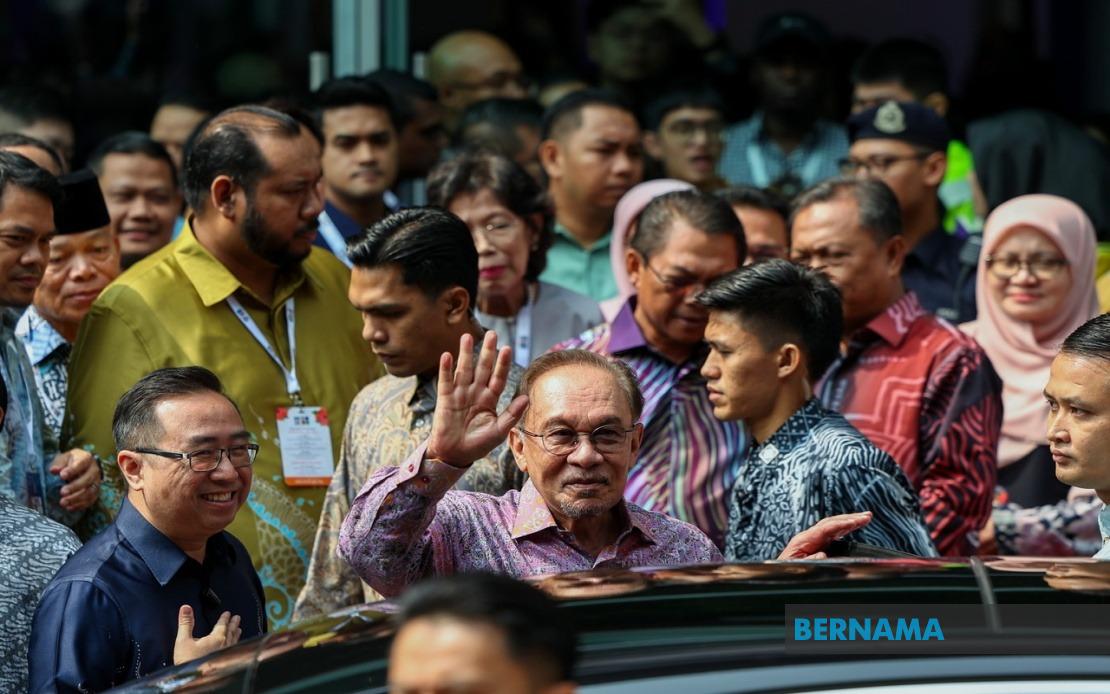
Prime Minister Datuk Seri Anwar Ibrahim has downplayed reports of recruitment efforts within PKR, insisting he was not informed about any overtures made to former deputy president Datuk Seri Mohamed Azmin Ali to rejoin the party. When questioned following his address at the National Innovation and Commercialisation Expo (NICE) 2026 at the Kuala Lumpur Convention Centre (KLCC), Anwar gave a terse response, questioning whether any formal invitation had even been extended to Azmin and reiterating his lack of involvement in such discussions.
The timing of Anwar's comments comes as PKR pursues what appears to be a broader reconciliation and membership expansion strategy. The party has been actively reaching out to former members who departed during various political upheavals, seeking to rebuild its organisational strength ahead of critical political developments. This phase of recruitment represents an attempt to consolidate PKR's position within the broader political landscape, particularly as coalition dynamics continue to shift.
Azmin, who formerly held significant influence within PKR before his controversial departure, now serves as secretary-general of Parti Pribumi Bersatu Malaysia (Bersatu), a position that places him squarely in a rival coalition. On Tuesday, Azmin emphatically rejected any possibility of returning to PKR, stating categorically that he would not rejoin the party regardless of invitations being circulated to reconnect with former members. His stance appeared designed to publicly reinforce his commitment to his current political home and leadership role.
The recruitment campaign extends beyond Azmin, however. Multiple former PKR lawmakers have either confirmed their intention to return or are being considered for readmission into the party fold. Datuk Kamarudin Jaffar, the former Member of Parliament for Bandar Tun Razak, and Datuk Mansor Othman, who previously represented Nibong Tebal, have both been mentioned as candidates to rejoin PKR. These moves signal that party leadership is systematically working to bring back cadres who departed during previous political realignments.
Among those who have already committed to returning is Datuk Dr Xavier Jayakumar, a former PKR vice-president who publicly confirmed his intention to rejoin the party. His readmission carries particular significance given his previous senior position within PKR's organisational hierarchy, suggesting that the party leadership views his return as a meaningful statement about party renewal and internal reconciliation. Such high-profile rejoinders often serve as catalysts for broader membership movements.
Anwar's apparent distance from these recruitment efforts raises intriguing questions about internal party dynamics and decision-making structures within PKR. While the Prime Minister holds the position of party president, his claim of not being informed about invitations to prominent former members suggests either a deliberate delegation of these activities to subordinate party organs, or perhaps a desire to maintain plausible deniability regarding specific recruitment initiatives that might prove politically sensitive. Either interpretation reflects the complex negotiations and internal politics that characterise Malaysian political parties.
The broader context of PKR's recruitment drive reflects structural realities within Malaysia's political ecosystem. Coalition governments require constant maintenance of internal relationships and periodic realignment of party membership to sustain parliamentary support and strengthen organisational capabilities. The departure and return of political figures represents a normal, if sometimes contentious, feature of Malaysian political life, where loyalty to broader coalitional projects often supersedes strict party allegiance.
From a regional perspective, PKR's efforts to strengthen its membership base carry implications for Malaysian government stability and the viability of Anwar's administration. A more cohesive and numerically stronger PKR could provide the Prime Minister with greater leverage within the Pakatan Harapan coalition and potentially reduce dependence on support from other parties or independent lawmakers. The party's ability to reintegrate wayward members while managing relationships with those who have chosen alternative political homes becomes a crucial factor in sustaining the delicate coalitional mathematics that underpin the current government.
Azmin's definitive rejection of PKR overtures, meanwhile, underscores the deeper organisational divides that have characterised Malaysian politics in recent years. His emergence as secretary-general of Bersatu positions him as a significant figure within the rival coalition structure, and his public refusal to return to PKR sends a clear message about the permanence of political realignments and the difficulty of reversing factional divisions once they have solidified. His statement essentially forecloses a potential reconciliation avenue that PKR may have hoped to explore.
The episode also reflects broader patterns of political mobility that characterise Southeast Asian democracies, where individuals frequently navigate between parties in response to leadership changes, factional disputes, or perceived shifts in political viability. Malaysia's experiences with party-hopping have historically generated significant public debate about political ethics and stability, though such movements remain constitutionally protected activities. The current PKR recruitment efforts must be understood within this regional context of fluid political affiliations and pragmatic party switching.
For Malaysian political observers, Anwar's demurral about knowledge of the recruitment drive suggests that party management continues to operate through multiple channels and decision-making forums. Whether this reflects genuine lack of information or strategic positioning remains unclear, but it illustrates the complexity of managing large political organisations within coalition governments where multiple power centres and competing interests must be balanced. The coming weeks will likely reveal whether PKR's broader recruitment strategy succeeds in significantly strengthening the party's parliamentary and organisational position.

