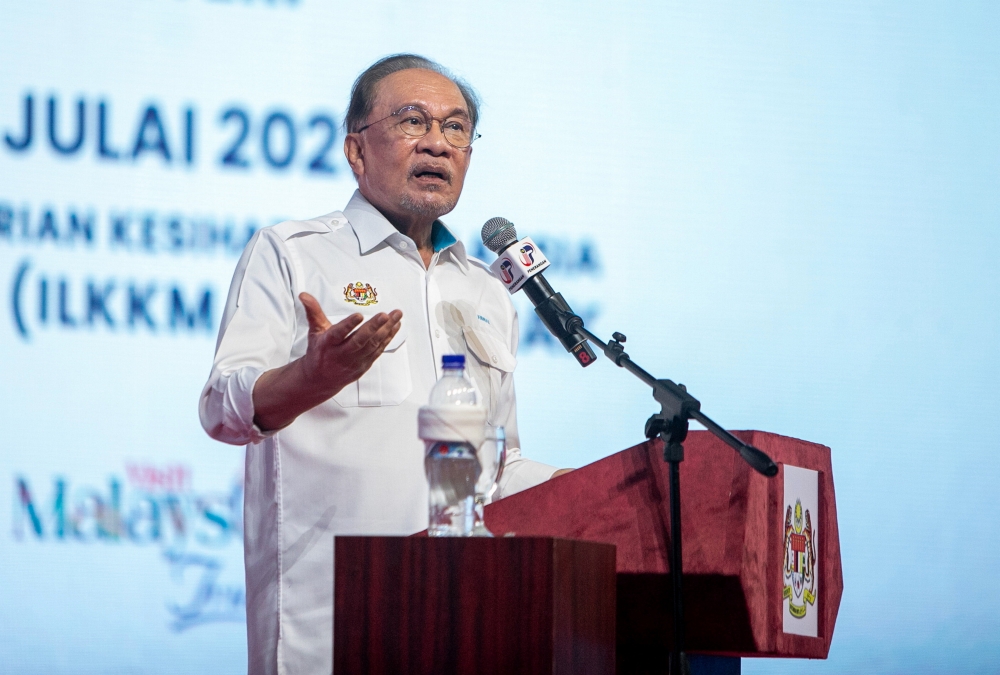
Prime Minister Datuk Seri Anwar Ibrahim has moved to shore up public confidence in the government's approach to fuel pricing, framing the subsidy regime as a necessary social support measure even as he signals deep concern about the nation's long-term debt trajectory. Speaking in Kajang, Anwar articulated a delicate political balancing act that reflects the competing pressures facing his administration: maintaining accessible fuel costs for ordinary Malaysians while grappling with the hard realities of public finances.
The prime minister's intervention underscores growing tension within federal policymaking over how aggressively to roll back fuel subsidies. These programmes represent one of the largest single expenditures in the annual budget and have historically proved politically explosive whenever governments attempt substantive reform. Anwar's comments suggest the cabinet remains divided on the optimal pace and scope of any subsidy rationalisation, with his defence of current policy indicating that those favouring caution have won recent internal debates.
Central to Anwar's argument is the proposition that abrupt subsidy withdrawal would disproportionately burden working-class Malaysians and lower-income households already stretched by rising living costs. Fuel prices serve as a transmission mechanism affecting transport, food, and energy costs throughout the economy, meaning any substantial increase propagates quickly through consumer prices. This reality constrains policymakers' room for manoeuvre, particularly as inflation concerns persist across the region and household budgets face mounting pressure from multiple directions.
Yet the prime minister's simultaneous warnings about debt accumulation reflect genuine fiscal anxiety within government circles. Malaysia's debt-to-GDP ratio has climbed substantially over recent years, driven partly by pandemic-related spending and partly by structural budget deficits that persist even during periods of reasonable economic growth. Each year the government defers difficult fiscal choices, the debt burden grows larger and the eventual adjustment required becomes more wrenching. Anwar appears to be signalling that while current subsidy levels remain defensible on social grounds, the trajectory itself is unsustainable.
The philosophical question underpinning this debate concerns the proper role of government in managing commodity prices. Economists across the political spectrum generally favour allowing prices to find market-clearing levels, arguing that subsidies create inefficiencies, encourage excessive consumption, and distort investment decisions. Yet political economy considerations pull powerfully in the opposite direction. Fuel subsidies function as an implicit social contract in Malaysia, with citizens accepting lower real wages partly in exchange for artificially suppressed energy costs. Breaking that contract requires compensation elsewhere and carries electoral risks.
Anwar's framing of the issue as a matter of "who will pay for it" invites consideration of alternative funding mechanisms. Rather than maintaining blanket subsidies funded through budget deficits or crowding out spending on health, education, and infrastructure, a targeted approach could channel support specifically to lower-income households while allowing prices to rise for others. Such schemes exist across the developing world, though implementation presents considerable administrative challenges and often generates political friction as citizens dispute eligibility criteria.
The regional context adds urgency to Malaysia's fuel policy deliberations. Indonesia and Thailand have both undertaken significant subsidy reforms in recent years, with mixed but broadly instructive results. Thailand's experience particularly demonstrates that careful communication and targeted support programmes can ease the transition, though opposition remains formidable. Singapore, by contrast, has long maintained minimal fuel subsidies and uses road pricing and tax mechanisms to manage transport demand. These neighbours' experiences provide both cautionary tales and potential blueprints for Malaysian policymakers considering reform trajectories.
For Malaysian businesses and investors, the subsidy question carries material consequences extending beyond consumer purchasing power. Artificially suppressed fuel costs distort resource allocation across the economy, potentially propping up inefficient transport and energy-intensive industries that would not survive on market terms. Over time, this misallocation reduces competitiveness and productivity growth. Yet reform undertaken without adequate preparation and transition support could impose substantial costs on affected sectors, particularly logistics and transport companies operating on thin margins.
Anwar's interventions also reflect deeper governance questions about fiscal credibility and medium-term budget planning. A government that allows subsidies to expand unchecked signals to creditors and citizens alike that it lacks will to make difficult choices. Conversely, a government that undertakes subsidy reform transparently, with clear communication about fiscal pressures and public benefit, can build support for change. The prime minister's public acknowledgment of debt dangers represents a step toward the transparency needed for sustainable fiscal adjustment.
The practical implication of Anwar's position appears to be a holding pattern on subsidy reform, at least in the near term. This respite provides opportunity for more sophisticated analysis of alternatives—particularly targeted support schemes and broader revenue-raising measures—that could accompany eventual subsidy rationalisation. It also allows political space for broader economic reforms that might ease the burden of adjustment on vulnerable households.
Ultimately, Malaysia faces the same choice as every developing economy wrestling with expensive subsidy regimes: defer the hard decisions and compound fiscal pressures, or undertake managed reform that distributes adjustment costs more fairly across society. Anwar's comments suggest he recognises both the urgency and the sensitivity of this choice, positioning the government to move cautiously toward a more sustainable model while maintaining necessary social support for the transition period.

