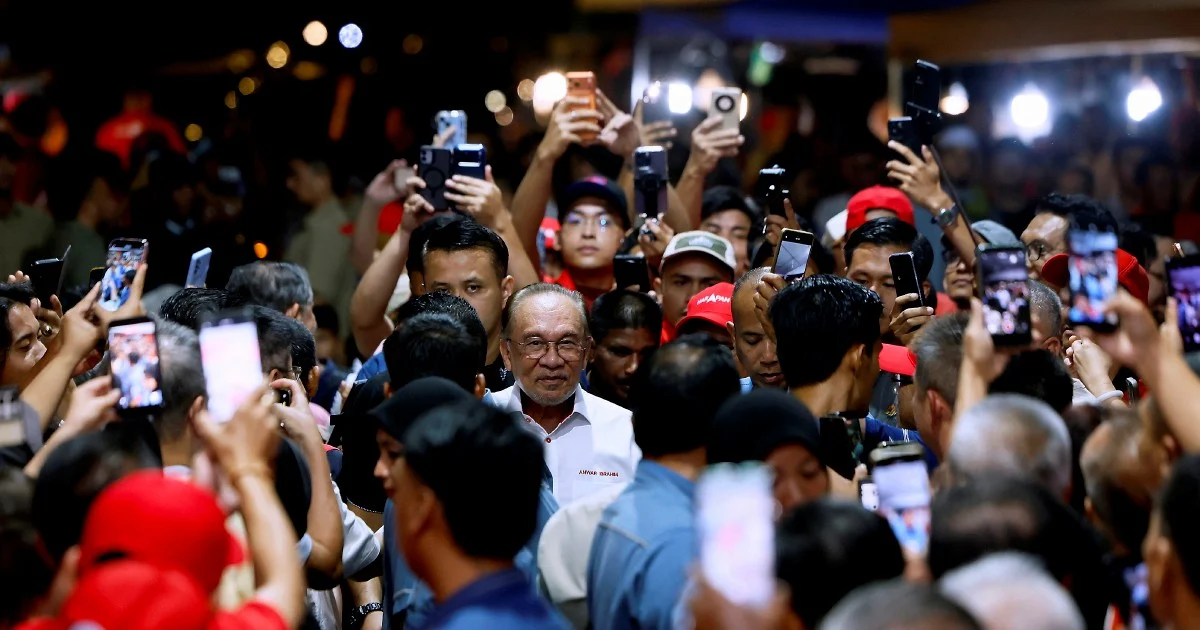
Prime Minister Datuk Seri Anwar Ibrahim delivered a forceful message in Muar that the longstanding patterns of institutional plunder and nepotistic politics will no longer define Malaysia's governance landscape. Speaking with conviction about the trajectory of his administration, Anwar emphasised that the Madani Government has fundamentally rejected the transactional model in which public office served primarily as a vehicle for enriching connected business interests and political allies.
The statement carries significant weight given Malaysia's recent political history. The previous decade witnessed multiple high-profile corruption scandals, procurement irregularities, and allegations of misuse of state resources that eroded public confidence in institutions. Anwar's explicit rejection of this system signals an attempt to rebuild trust through demonstrable commitment to administrative integrity. The declaration effectively draws a line between the previous era of governance and the current administration's stated priorities, positioning clean leadership as a defining characteristic rather than merely an aspirational goal.
For Malaysian citizens and businesses, this pronouncement addresses a persistent concern that has influenced investment decisions and social stability. Systemic corruption creates unpredictable operating environments where success depends on political connections rather than merit or efficiency. By articulating a clear break with crony capitalism, the Prime Minister is signalling to both domestic and international observers that Malaysia intends to operate on more transparent foundations. This philosophical shift, if implemented rigorously, could reshape how government contracts are awarded, how regulatory decisions are made, and how public funds are allocated.
The Madani Government framework itself was constructed around promises of institutional renewal and ethical leadership. Since assuming office, the administration has navigated complex political mathematics while attempting to implement anti-corruption measures and governance reforms. Anwar's Muar statement reinforces those commitments during a period when maintaining political capital around clean governance remains essential for the coalition's legitimacy and electoral prospects.
Implementing such a transformation requires more than rhetorical statements. The challenge lies in converting declarations into institutional mechanisms that systematically prevent the very patterns Anwar is disavowing. This demands strengthened oversight bodies, transparent procurement processes, meaningful consequences for violations, and sustained political will across cabinet levels where competing interests often complicate reform efforts. Regional observers, particularly business communities in Thailand, Indonesia, and Singapore, monitor such developments closely as they assess Malaysia's competitive positioning and reliability as a partner.
The crony capitalism model that the Prime Minister explicitly rejected has historical roots extending back decades, embedded in political structures and patronage networks. Dismantling these systems proves far more complex than announcing their termination. Vested interests, accumulated advantages, and institutional inertia all resist change. Yet Anwar's unambiguous language suggests awareness that incremental messaging about reform risks being perceived as rhetorical cover for marginal adjustments rather than genuine transformation.
Young Malaysians, in particular, have grown increasingly intolerant of corrupt practices and nepotistic advancement. This demographic views institutional integrity as fundamental to fairness and opportunity distribution. Anwar's stark pronouncement addresses this constituency directly, acknowledging that expectations for accountability have shifted irreversibly. The political calculus increasingly favours clean governance advocates, making anti-corruption positioning essential rather than optional for government credibility.
From a Southeast Asian perspective, Malaysia's anti-corruption trajectory influences regional governance standards. As one of the region's larger economies with established institutions and media freedom, Malaysian choices set reference points for neighbouring countries. A genuine commitment to clean leadership strengthens the region's overall governance profile and reinforces professional standards across ASEAN business networks and government-to-government relationships.
The Prime Minister's warning specifically targets the mentality underlying crony politics—the assumption that government access justifies private enrichment and that patronage networks remain legitimate tools for political coalition-building. By naming this system explicitly as obsolete, Anwar positions ethical governance not as a constraint on leadership but as its foundation. This reframing matters symbolically and practically, influencing how officials at all levels interpret expectations for their conduct.
While declarations alone prove insufficient, Anwar's Muar statement establishes a measurable standard against which the Madani Government's performance will be evaluated. Civil society organisations, international observers, and Malaysian citizens increasingly scrutinise whether actions match rhetoric. Sustained anti-corruption performance through investigation, prosecution, and structural reforms will determine whether this statement represents genuine policy direction or aspirational messaging. The months and years ahead will reveal whether the government possesses the institutional capacity and political courage to translate Anwar's warnings into functioning systems that genuinely eliminate the space for plunder and crony enrichment in Malaysian governance.

