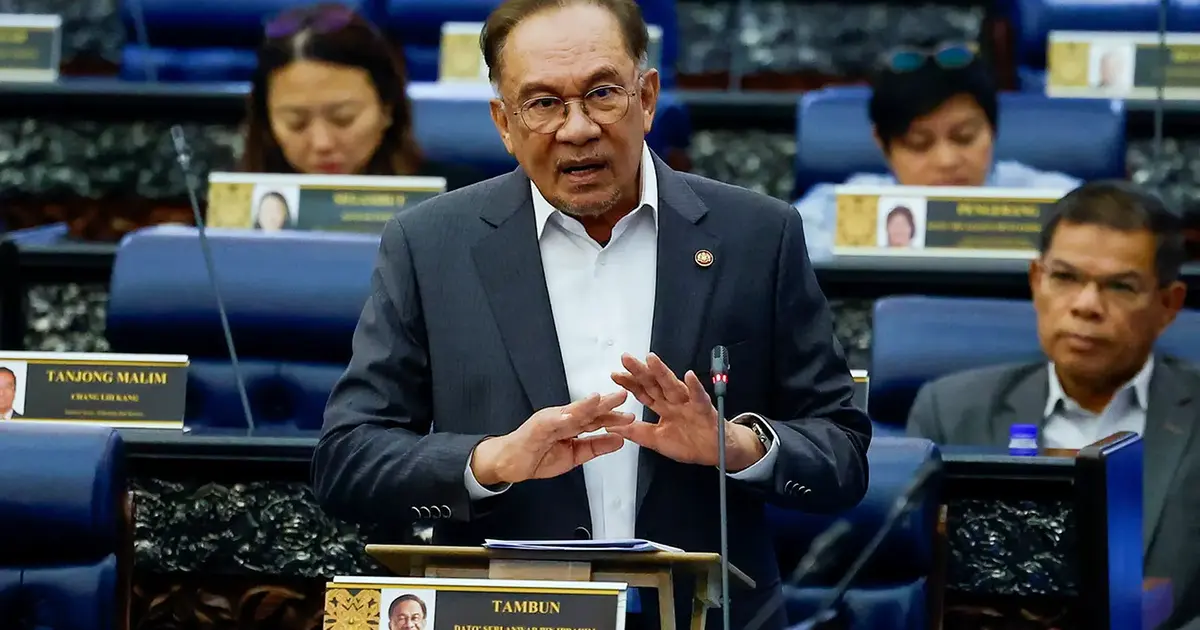
Prime Minister Anwar Ibrahim has defended the special grant allocations flowing to Sabah, pointing out that the previous state government under Warisan had explicitly consented to the escalating payment structure now in effect. The clarification addresses ongoing questions about the financial arrangements between the federal and state authorities, with Anwar emphasising that the current disbursement framework carries the endorsement of the administration that preceded the current state leadership.
The financial trajectory reveals a significant expansion in federal support to the Sabah government over the past four years. The initial allocation stood at RM53.4 million for the 2020 and 2021 financial years, representing the baseline of the agreement reached during the Warisan tenure. By the time the current administration took office and entered its subsequent budgetary cycles, this figure had more than doubled to reach RM106.8 million for 2024, demonstrating a substantial increase in the annual special grant commitment.
The doubling of allocations between the earlier and more recent years carries broader significance for understanding federal-state fiscal relations in Malaysia. Such dramatic increases in special grants typically reflect either increased federal commitment to addressing specific state needs, shifting political alignments that favour particular states, or agreements to absorb costs previously borne by state budgets. In Sabah's case, the expansion suggests a deliberate strategy by the federal government to strengthen its financial footprint in the resource-rich eastern Malaysian state.
Anwar's intervention in this matter underscores the political sensitivity surrounding federal spending in Sabah, a state that has historically occupied an outsized role in national coalition mathematics. The emphasis on Warisan's prior approval appears designed to neutralise potential criticism from opposition quarters that might characterise the grants as politically motivated or fiscally irresponsible. By anchoring the arrangement to decisions made by a predecessor administration, Anwar positions the current government as merely honouring commitments rather than initiating new expenditure.
The timing of Anwar's clarification is noteworthy given the state political dynamics in Sabah. The Warisan party, which governed Sabah until 2020, has since undergone considerable political realignment, with its leadership eventually moving closer to the Pakatan Harapan coalition at the federal level. The acknowledgment that Warisan had agreed to the special grant structure provides historical continuity that spans across different state administrations and reinforces the notion that the arrangement transcends partisan considerations.
Understanding the evolution of these grants requires examining the broader context of federal fiscal policy towards Sabah. The state's unique constitutional status, derived from the Malaysia Agreement 1963, grants it considerable autonomy in certain fiscal matters and justifies special arrangements that might not apply elsewhere in the federation. Consequently, special grants to Sabah operate within a framework distinct from standard federal-state revenue-sharing mechanisms, allowing for more flexible and negotiated arrangements.
The RM106.8 million figure for 2024 represents the current baseline, but the pattern of escalation suggests that further increases may be anticipated in subsequent years. For Malaysian readers across the peninsula, such allocations to Sabah warrant attention because they represent a significant portion of discretionary federal spending and reflect priorities in the government's fiscal strategy. The commitment to Sabah also has implications for federal revenues available for other states and programmes, making it a matter of collective economic interest.
Anwar's statement also reflects the necessity for federal leadership to maintain detailed knowledge of prior commitments made by previous administrations. In Malaysia's system of government, where political transitions at state level can be rapid and unpredictable, documenting and honouring previous agreements serves to stabilise expectations and maintain confidence in federal-state relations. The explicit reference to Warisan's approval demonstrates institutional continuity, even as political personnel change.
The special grant arrangement illustrates how Malaysia's federal system accommodates negotiated fiscal relationships between different levels of government. Rather than relying solely on statutory revenue-sharing formulas, the federal government retains flexibility to provide additional support to states based on specific circumstances or agreements. This discretionary element allows for responses to emergent needs but also introduces an element of political calculation into the distribution of federal resources.
Looking ahead, the sustainability of such escalating grant commitments merits scrutiny from fiscal policy analysts. The doubling of allocations over four years suggests a trend that, if continued, would significantly enlarge Sabah's federal subventions. Understanding the underlying justifications—whether driven by population growth, rising costs of administration, or political commitments—becomes important for assessing the long-term viability of the arrangement and its impact on federal finances.
For the current Sabah administration, which took office following the 2020 political transition, inheriting and maintaining these grant arrangements provides substantial financial resources for state development and operations. The confirmation that these amounts had been previously agreed upon by Warisan provides the current government with a measure of political cover, allowing continuation of arrangements without appearing to have negotiated them under duress or political pressure from the federal centre.
The clarification from Anwar represents a calculated exercise in political communication, simultaneously addressing fiscal transparency concerns while reinforcing federal-state cooperation on matters of financial substance. As Malaysia navigates post-pandemic fiscal recovery and grapples with questions about sustainable spending levels, the treatment of special grants to states like Sabah remains an indicator of how the federal government balances budgetary discipline with political necessity in managing a diverse, multi-state federation.

