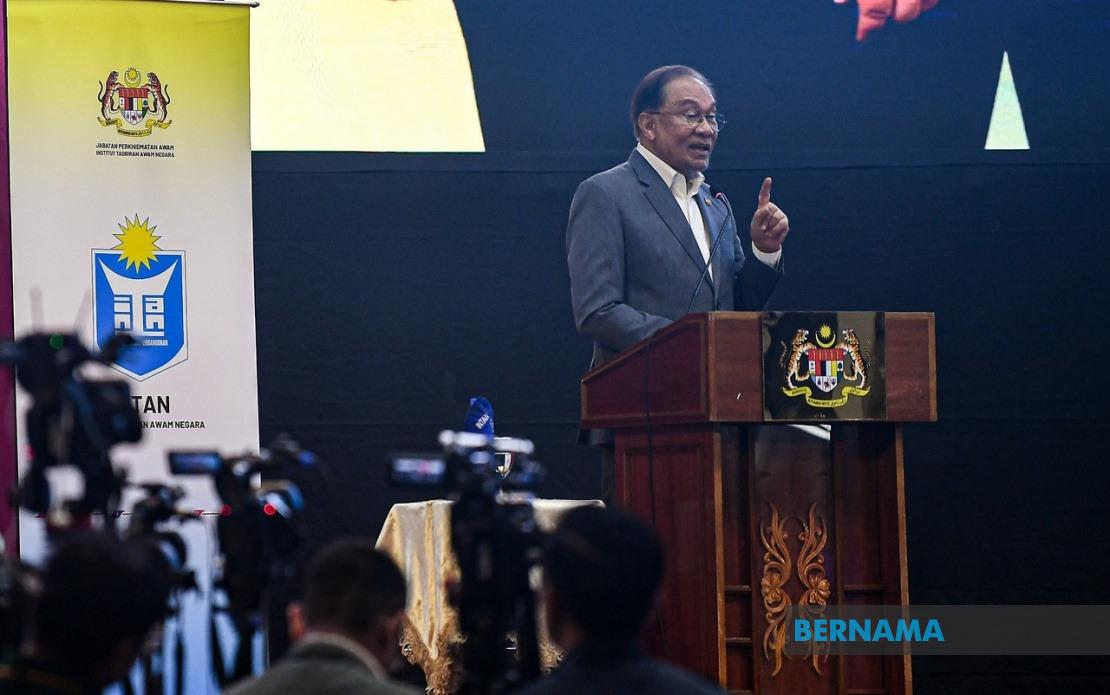
Prime Minister Datuk Seri Anwar Ibrahim has offered a qualified apology regarding perceptions that his communication style with civil servants may have come across as unnecessarily stern, while simultaneously defending the authenticity behind his direct approach to leadership. Speaking at a gathering with Central Zone civil servants at Universiti Islam Selangor on July 20, Anwar acknowledged feedback from various quarters suggesting that the nation's top executive should moderate his tone and project greater equanimity in public forums.
Anwar articulated the tension between adopting the measured demeanour traditionally expected of prime ministers and remaining true to his instinctive responses to matters he considers crucial. He noted that colleagues and observers have counselled him to speak with greater restraint, employ softer language, and cultivate a more conciliatory engagement style befitting his office. Yet the Prime Minister made clear that suppressing authentic emotional reactions runs counter to his nature and approach to governance, presenting a candid portrait of a leader grappling with the gap between personal conviction and institutional expectations.
The remarks came in remarks delivered alongside Chief Secretary to the Government Tan Sri Shamsul Azri Abu Bakar, underscoring that this was not an offhand comment but a deliberate message to Malaysia's administrative establishment. By framing his apology conditionally—apologising only if his tone was perceived negatively—Anwar signalled that he does not view his approach as inherently problematic, but rather as context-dependent and purpose-driven. This distinction matters for understanding how the Prime Minister conceptualises his role and relationship with the bureaucracy.
Anwar argued that his firm tone when communicating with civil servants reflects the profound significance of their institutional role in translating government policy into tangible results. The civil service, as Malaysia's implementing machinery, bears primary responsibility for converting political vision into programmatic reality and driving forward the national development agenda. In this calculus, Anwar's reasoning suggests that a commanding presence and emotional urgency are justified—even necessary—to underscore the weight of expectations placed upon this sector.
The Prime Minister's statement reveals a particular philosophy about leadership communication and accountability within hierarchies. Rather than viewing himself as inappropriately harsh, Anwar positioned his directness as proportionate to the stakes involved and the audiences concerned. He questioned rhetorically who else should receive his unvarnished expression of conviction if not the machinery of state tasked with implementing his government's programmes. This rhetorical move reframes directness not as personal temperament but as functional necessity.
Anwar's framing also touches on the evolution of his public persona since assuming office. The Prime Minister acknowledged receiving consistent counsel to adopt a softer public presentation, suggesting he is aware that his communication style represents a departure from diplomatic convention. Yet he indicated that such counsel, however well-intentioned, asks him to compromise aspects of his authentic leadership approach. This tension between institutional expectation and personal authenticity has become a recurring theme in his administration.
The video shared on Facebook amplified the Prime Minister's message beyond the immediate audience of civil servants, taking his explanation directly to the Malaysian public. This deployment of social media reflected a deliberate strategy to frame the narrative around his leadership approach before critical commentary could crystallise. By getting ahead of potential criticism and offering his own interpretation of recent public engagements, Anwar attempted to shape how Malaysians understand his interactions with the bureaucracy.
For Malaysia's civil service, these comments carry implications for workplace culture and expectations. Anwar's messages could be interpreted as permission for officials to expect and accept more intense engagement from their political leadership, or conversely, they may create uncertainty about what tone and expectations genuinely characterise the Prime Minister's relationship with subordinate officials. The ambiguity embedded in his conditional apology—acknowledging perception without fully validating it—leaves room for multiple interpretations.
Anwar's approach stands in contrast to some international peers who have successfully cultivated carefully modulated public personas aligned with contemporary expectations of executive restraint. His assertion that he cannot entirely suppress his emotional investment in matters touching his convictions suggests he has opted for a different model of leadership authenticity. Whether this resonates with civil servants or creates friction within the bureaucracy remains an open question, though his address suggested he views the administrative establishment as the appropriate venue for candid discourse about national priorities.
The broader context includes Malaysia's ongoing governance challenges and the Prime Minister's stated commitment to administrative efficiency and accountability. Set against this backdrop, Anwar's firmness toward civil servants can be interpreted as reflecting impatience with implementation delays or perceived foot-dragging. His emotional investment in policy outcomes, as he describes it, reflects genuine frustration with barriers to effective governance.
Looking forward, the Prime Minister's remarks establish a baseline for understanding his leadership style going forward. He has essentially told the civil service and the broader public that measured restraint in his communications should not be expected as his governing approach evolves. Instead, Malaysians should anticipate continued moments where his passion for particular policy objectives surfaces in his public statements, especially when addressing the officials charged with implementation.

