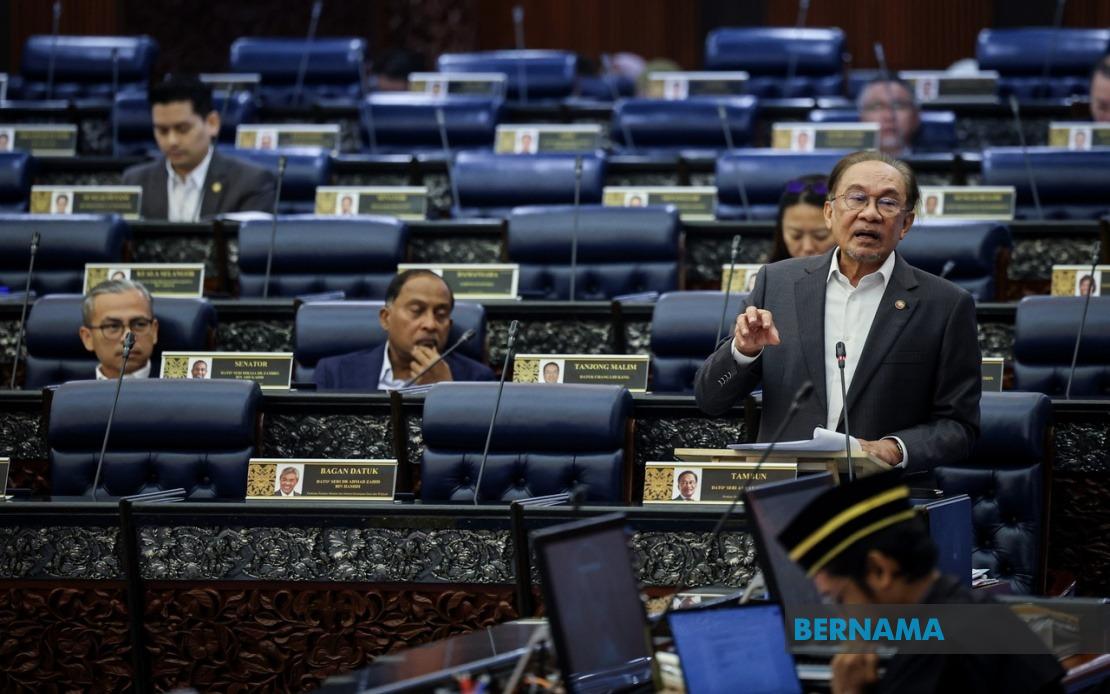
Prime Minister Datuk Seri Anwar Ibrahim moved swiftly on July 7 to clarify that his recent observations about the Johor state election's scheduling represented nothing more than a personal perspective, explicitly denying any suggestion that he had overstepped into interfering with the Election Commission's constitutionally protected autonomy. Speaking during Minister's Question Time in Parliament, Anwar distinguished sharply between voicing an opinion on matters affecting voter convenience and attempting to direct an independent institution's operational decisions, a distinction he considered fundamental to Malaysia's democratic institutions.
The clarification came in response to questions about media coverage of remarks Anwar had made during the Johor election campaign period, when he had suggested that holding polling on a Sunday rather than a Saturday would prove more practical for Malaysian citizens employed across the causeway in Singapore. Anwar reiterated his observation that many Malaysians working in Singapore maintain Saturday schedules that include afternoon commitments, making a Sunday poll date more accommodating for their participation in the electoral process. However, he firmly asserted that this preference represented his thinking as a citizen and observer of practical logistics, not a directive or recommendation intended to shape the Election Commission's actual decision-making.
The Prime Minister's comments carry particular weight given ongoing scrutiny of the relationship between the executive and independent constitutional bodies in Malaysia's governance structure. By explicitly acknowledging the Election Commission's sole statutory authority over polling dates and accepting that the Commission's Saturday decision represented a legitimate exercise of that authority, Anwar appeared to be addressing concerns that might arise when senior government figures publicly express preferences about electoral mechanics. His statement that "if it decides on Saturday, that is its decision" affirmed the Commission's independence in terms that left no ambiguity about respecting institutional boundaries.
Anwar's reference to Singapore's cross-border workforce highlighted a dimension of regional labour mobility that receives limited policy attention despite its significance for bilateral relations and individual Malaysian livelihoods. Tens of thousands of Malaysians commute to or work in Singapore, creating genuine logistical challenges for electoral participation. The Prime Minister's recognition of this reality demonstrated awareness of practical governance concerns that extend beyond standard electoral administration, though he stopped short of suggesting that such practical considerations should override the Election Commission's established procedures and planning.
The parliamentary exchange also touched on a second, more sensitive dimension when opposition parliamentarian Mohd Sany Hamzan suggested that Malaysia might formally engage Singapore in facilitating voter return arrangements. Anwar's response here grew more emphatic, establishing clear boundaries around Malaysia's electoral sovereignty. He stated unambiguously that he harboured no intention of contacting Singapore Prime Minister Lawrence Wong regarding voting or electoral arrangements, positioning Malaysia's elections as an exclusively domestic matter beyond the scope of bilateral negotiation or coordination, regardless of the strength of Malaysia-Singapore relations.
This distinction between informal acknowledgement of practical challenges and formal inter-governmental coordination proved crucial to Anwar's framing. While he acknowledged that companies operating in Singapore had received general guidance to accommodate Malaysian employees seeking to vote during elections, he presented this as routine workplace flexibility rather than as a negotiated arrangement with Singapore authorities. The approach preserved Malaysia's insistence on non-interference in its internal electoral processes while acknowledging operational realities that employers in Singapore might accommodate voluntarily.
Anwar's personal relationship with Singapore's Lawrence Wong, which he referenced in Parliament, underlies the sensitivity surrounding any appearance of cross-border coordination on electoral matters. The warm bilateral relationship and direct communication channels between Malaysian and Singaporean leadership create both opportunity and risk in managing questions about electoral logistics. By explicitly stating he would not involve Singapore in Malaysia's electoral processes, even given his strong personal ties with Wong, Anwar reinforced a principle that transcends individual relationships: electoral integrity and national control over voting procedures remain non-negotiable even among closely aligned neighbouring states.
The broader context involves longstanding constitutional arrangements that position the Election Commission as an independent body insulated from executive direction. Malaysia's constitutional framework, inherited and adapted from Westminster traditions, placed significant emphasis on the Election Commission's autonomy precisely to prevent accusations that sitting governments might manipulate polling procedures for partisan advantage. When a Prime Minister emphasises an institution's independence in response to questions about his own public statements, he simultaneously reinforces the legitimacy of that independence and acknowledges the importance that observers and parliamentarians place on preserving institutional boundaries.
For Malaysian workers in Singapore and their employers, Anwar's comments offer modest reassurance that logistical challenges to exercising voting rights receive some policy consideration, even if formal mechanisms remain limited. However, the clarifications also establish that such considerations will not translate into formal coordination or formal requests for Singapore's assistance. The practical reality likely remains that Malaysians working in Singapore continue to face genuine difficulties voting in state or federal elections, a challenge that parliamentary discussion has highlighted but that existing institutional arrangements struggle to fully resolve.
The parliamentary exchange also signals to the Election Commission itself that the government will respect its decisions even when those decisions diverge from preferences that senior officials might voice publicly. Anwar's acceptance of the Saturday polling date despite his stated preference for Sunday demonstrates adherence to that principle in concrete terms. This approach serves to reinforce the Commission's actual independence and the credibility of its decision-making by showing that expressing preferences does not translate into pressure or interference when those preferences are not adopted.
Looking forward, the distinction Anwar drew between personal observation and institutional interference may guide how future interactions between the executive and the Election Commission are understood and evaluated. By clearly separating his role as a private observer concerned with practical voter convenience from his position as a government leader who must respect institutional autonomy, Anwar established parameters that other officials might reference when discussing electoral matters. The approach suggests that public figures can acknowledge practical challenges and express preferences without crossing into interference, provided they explicitly respect the ultimate decision-making authority of independent bodies.

