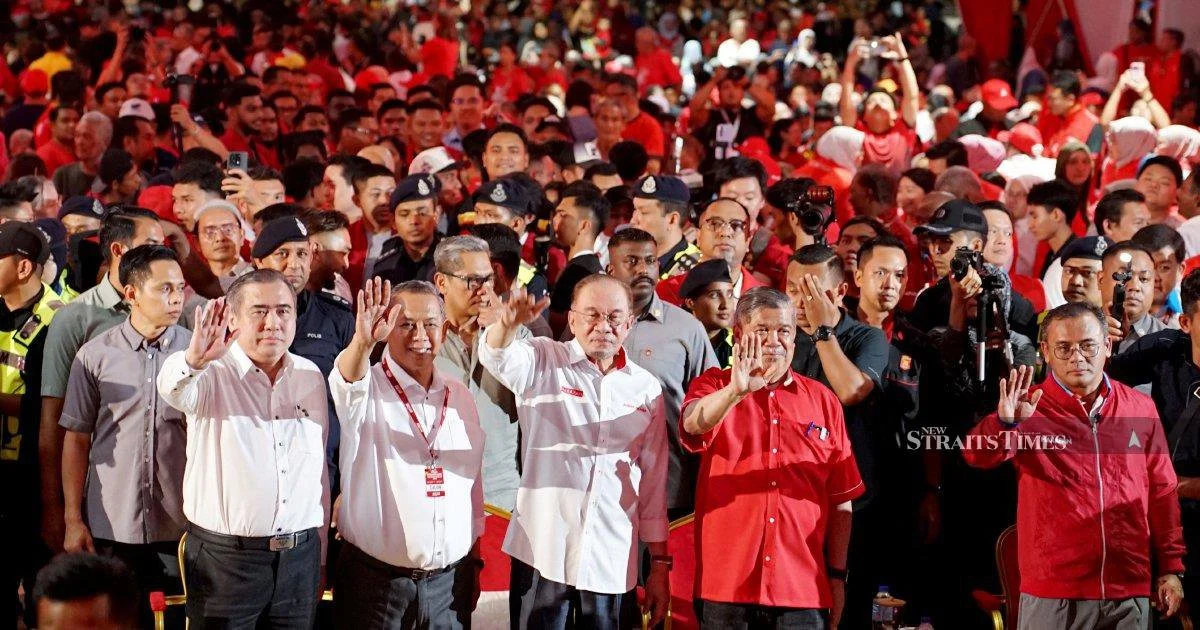
Prime Minister Datuk Seri Anwar Ibrahim has issued a stern reminder to all political factions, particularly senior party figures, to refrain from instrumentalising Malaysia's royal institution during the Negri Sembilan election campaign. Speaking in Kuala Pilah, Anwar stressed the importance of maintaining clear boundaries between electoral competition and constitutional respect for the monarchy, reflecting broader concerns about political conduct in Malaysia's democratic processes.
The warning arrives at a critical juncture in Malaysian politics, where state-level contests increasingly test the maturity of the nation's political discourse. The Negri Sembilan election represents more than a routine regional ballot; it serves as a barometer for whether political parties can wage legitimate campaigns without crossing into territory that threatens institutional dignity. Anwar's intervention suggests that some elements within competing camps may have already ventured into problematic territory, or that he anticipates such moves as the campaign intensifies.
Malaysia's constitutional framework grants the Yang di-Pertuan Agong and state rulers significant formal authority, yet the monarchy's political neutrality remains foundational to the system's stability. Throughout Malaysian history, the royal institution has largely transcended partisan divisions, serving instead as a unifying symbol of national continuity. When political actors attempt to claim special relationship with royal authority or invoke royal support for partisan objectives, they undermine this crucial separation and invite destabilising questions about the institution's impartiality.
Anwar's statement reflects the Prime Minister's broader commitment to institutional strengthening and respect for constitutional limits on political behaviour. As the head of government, Anwar carries responsibility for modelling appropriate political conduct and ensuring that Malaysian democracy operates within established norms. His willingness to address this issue directly demonstrates recognition that left unchecked, such transgressions could erode public confidence in both the electoral process and the monarchy itself.
The Negri Sembilan contest carries particular sensitivity given the state's status as a constitutional monarchy with the Yang di-Pertuan Negeri playing a symbolic but meaningful role in governance. Any attempt by contending parties to leverage royal connection for electoral gain would be especially problematic at state level, where the ruler's ceremonial functions remain more visibly intertwined with government operations. Anwar's warning thus carries heightened significance in this specific context.
From a Southeast Asian perspective, Malaysia's ability to maintain institutional boundaries in electoral competition distinguishes it among regional democracies. Indonesia, Thailand, and other neighbours have experienced serious instability when political forces sought to capitalise on respect for traditional authority. Anwar's proactive stance suggests Malaysia remains committed to learning from such cautionary examples rather than replicating them. The region watches how established democracies manage tension between electoral competitiveness and institutional protection.
The nature of Anwar's warning—public, unambiguous, and directed at multiple parties rather than a single target—indicates the Prime Minister views this as a systemic issue rather than an isolated incident attributable to one camp. This framing is analytically important because it acknowledges that the temptation to exploit royal connection for political advantage may transcend traditional partisan boundaries. Whether ruling coalition members or opposition figures face greater temptation remains unstated but evident to observers of Malaysian politics.
Enforcing such boundaries requires more than rhetorical caution. Malaysian political culture has historically relied heavily on voluntary compliance with institutional conventions, assuming that political actors possess sufficient sophistication and patriotism to honour unwritten rules. Yet as electoral competition intensifies and margins tighten, these assumptions face increasingly stringent testing. Anwar's explicit reminder effectively clarifies that the Prime Minister will not assume compliance but instead holds all parties to a publicly articulated standard.
For ordinary Malaysians, Anwar's statement carries reassuring implications about institutional health. It signals that senior political leadership remains committed to preserving the monarchy's constitutional role as a unifying force above partisan struggle. This commitment matters for social cohesion, particularly in a diverse society where the royal institution functions as one of few genuinely transcendental symbols capable of uniting Malaysians across ethnic and religious lines.
The warning also implicitly addresses younger voters and digital-native Malaysians who may be less familiar with established norms around royal deference. Social media campaigns, memes, and viral content can easily blur boundaries that previous generations understood instinctively. By articulating expectations explicitly, Anwar ensures that modern campaign dynamics cannot hide behind claims of ignorance or evolving standards of political discourse.
Moving forward, the Negri Sembilan campaign will test whether Anwar's caution suffices to deter boundary-crossing or whether more formal sanctions prove necessary. The Prime Minister's statement establishes a clear marker against which observer can measure political conduct. Should candidates or parties violate this principle, they will do so in full knowledge of leadership disapproval and public scrutiny, raising political costs significantly.
Ultimately, Anwar's intervention reflects confidence in Malaysian democracy's underlying strength while acknowledging vulnerabilities that require active protection. By treating the monarchy's institutional integrity as a matter demanding explicit, public reinforcement, the Prime Minister reinforces an essential principle: that competing for power means competing within rules, not competing for dominance over the symbols and structures that make democratic competition itself possible.

