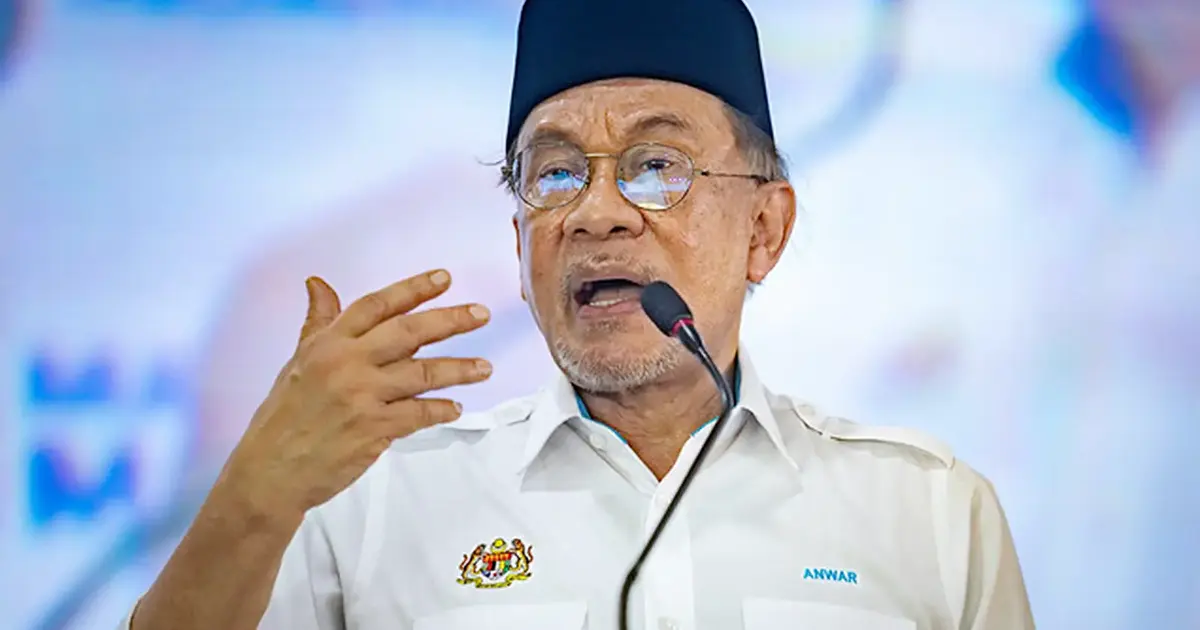
Prime Minister Anwar Ibrahim has issued a stern directive to members of his cabinet, cautioning them against publicly attacking or campaigning against allied parties that form part of the unity government coalition during ongoing and forthcoming state elections. The warning reflects the delicate political balance required to maintain the broad consensus that has held Malaysia's federal government together since late 2022, a coalition encompassing parties from both the traditional ruling bloc and the opposition.
Anwar's message carries an implicit threat of consequences for those who fail to heed his guidance. Ministers and other officeholders who occupy government positions will face possible removal from their posts should they be found to have abused their ministerial authority or access to state resources for the purpose of campaigning against coalition partners. This escalation underscores the seriousness with which the Prime Minister views the maintenance of coalition discipline during electoral contests, particularly as competition heats up in various state-level races.
The warning represents a significant test of the unity government's internal cohesion. The coalition, which draws together ideologically diverse parties, has already weathered numerous challenges since its formation. Disagreements over ministerial appointments, policy priorities, and electoral strategy have periodically threatened unity, and state elections provide a particularly fertile ground for such tensions to surface. When parties within a coalition compete in the same electoral arena, natural incentives arise to differentiate themselves from their allies, even as they theoretically remain bound together at the federal level.
For Malaysian readers, the implications of Anwar's intervention are far-reaching. State elections serve as crucial testing grounds for parties seeking to assess their electoral viability and gauge public sentiment ahead of the next general election. They also determine which parties control state governments, bringing tangible benefits including control over development projects, patronage networks, and revenue streams. The temptation for ambitious politicians to use these contests to boost their profiles and positions within both their parties and the government can therefore be substantial.
The specific concern about misuse of government positions speaks to well-established concerns in Malaysian politics. Ministers, when campaigning, have access to state machinery, government vehicles, and other resources that can be mobilised for electoral advantage. Civil servants, though theoretically neutral, may feel pressured or inclined to support their minister's electoral agenda. The distinction between legitimate campaigning and abuse of office can become blurred in practice, though Anwar's directive appears designed to establish clearer boundaries.
This episode also highlights the structural vulnerabilities inherent in Malaysia's current political arrangements. The unity government was conceived partly as a stabilising mechanism following the 2022 general election, when no single coalition achieved a commanding majority. By bringing together parties such as Barisan Nasional, Pakatan Harapan, and GPS, among others, the architects of this arrangement sought to prevent the kind of political instability that had characterised the preceding two years. However, such broad coalitions require constant management and careful negotiation to prevent centrifugal forces from tearing them apart.
For Southeast Asia's broader political landscape, Malaysia's unity government represents an interesting experiment in consensus-building. The region has seen numerous attempts at coalition governments, but few have attempted to bridge such ideological divides. Anwar's willingness to enforce discipline through threats of ministerial removal suggests that he is taking seriously the challenge of holding diverse partners together, but it also hints at underlying tensions that remain just beneath the surface of apparent unity.
The warning is also noteworthy for what it reveals about ministerial accountability in Malaysia's Westminster-influenced system. While ministers serve at the pleasure of the Prime Minister and can theoretically be removed at will, the actual exercise of such authority is comparatively rare. Anwar's explicit linking of electoral conduct to potential dismissal therefore represents a notable assertion of executive authority and a clear statement that he intends to police coalition discipline actively rather than leaving such matters to develop organically.
State-level elections scheduled across Malaysia will now proceed in a context where Anwar has made plain that the federal government's electoral behaviour is subject to oversight and control. This creates an interesting dynamic in which local and regional political dynamics become entangled with federal-level coalition management. Parties competing in these elections must balance their desire to win with the necessity of remaining acceptable to their coalition partners and, ultimately, to the Prime Minister.
The long-term sustainability of the unity government may well depend on how effectively Anwar enforces the standards he has now articulated. Should ministers be seen to violate his directive with impunity, the credibility of such warnings would evaporate quickly, and other coalition members might interpret the lack of enforcement as a sign that the government is fragmenting. Conversely, aggressive enforcement could trigger resentment among ministers and potentially destabilise the coalition in other ways. Anwar therefore faces the classic challenge of political leaders seeking to maintain discipline across a diverse coalition—finding the right balance between leniency and firmness.
For Malaysian voters watching these state elections unfold, the Prime Minister's intervention serves as a reminder that political developments at different levels of government are interconnected. What happens during state campaigns reflects and reinforces dynamics within the federal coalition, and vice versa. The coming months will reveal whether Anwar's warning proves sufficient to contain inter-coalition tensions or whether deeper structural challenges will continue to plague Malaysia's experiment in broad-based consensus government.

