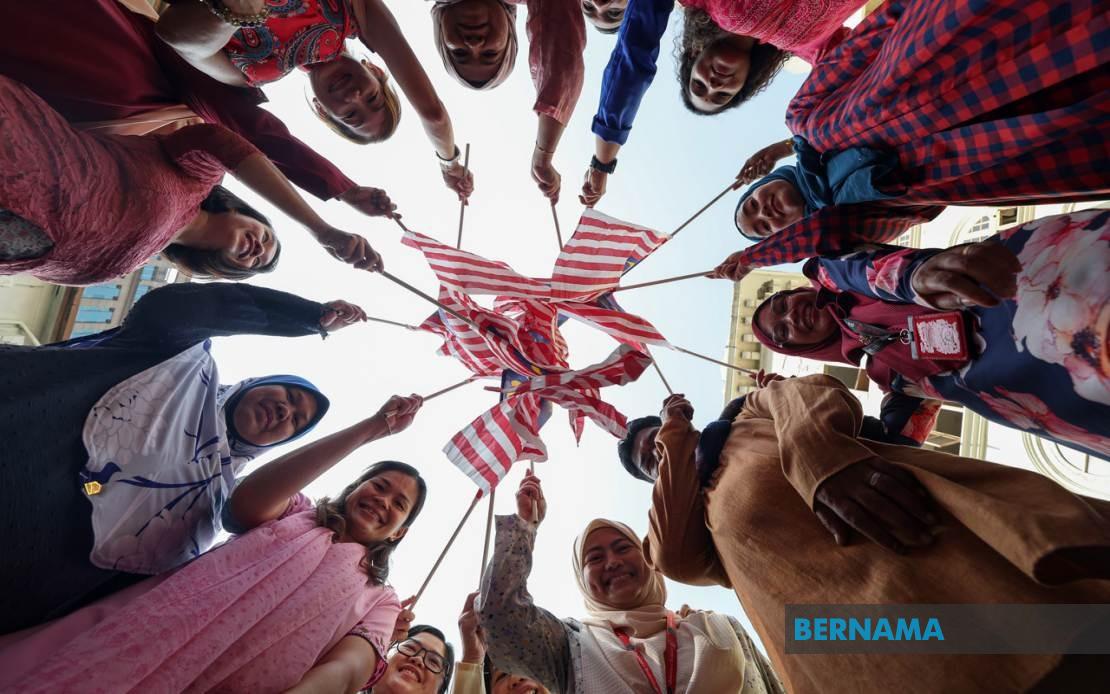
Prime Minister Datuk Seri Anwar Ibrahim has made an impassioned appeal to Malaysians to take responsibility for safeguarding their country while maintaining the inclusive spirit that has held the nation together since independence. Speaking through social media posts and a video message released on Friday, Anwar framed national cohesion as the bedrock upon which Malaysia's security and prosperity rest, positioning unity not as an abstract ideal but as a practical necessity for national survival and advancement.
Anwar's message comes at a significant moment, just before Malaysia's celebration of its 69th National Day tomorrow under the theme "Malaysia MADANI: Kesejahteraan Dinikmati." His emphasis on collective responsibility reflects a broader concern about maintaining social stability in a diverse, multi-ethnic democracy where tensions occasionally surface between different communities. By invoking the sacrifices of previous generations, the Prime Minister sought to establish a moral foundation for his appeal, suggesting that the freedoms and prosperity Malaysians enjoy today represent the culmination of struggles waged by those who came before.
The concept of independence, as articulated by Anwar, extends beyond the historical moment of 1957 when Malaysia gained freedom from colonial rule. He characterised true independence as the ability to determine one's own destiny with confidence, grounded in the recognition of national dignity and sovereignty. This reframing positions the continued defence of Malaysia's independence not as a relic of past struggles but as an ongoing requirement that demands courage and conviction from every generation.
Central to Anwar's message was an explicit acknowledgement of Malaysia's multi-ethnic composition and the essential role each community plays in national strength. He specifically named the Malay, Chinese, Indian, Iban, Kadazan, Murut, Bidayuh and Orang Ulu communities, underscoring that diversity is not a weakness to be managed but a source of collective power. This inclusive language carries particular significance in Malaysian politics, where communal sentiment can occasionally overshadow broader national interest. By listing communities with specificity, Anwar attempted to validate each group's contribution while reinforcing the principle that their strength lies in unified purpose.
A critical dimension of the Prime Minister's appeal concerned the primacy of national interest over narrower grievances. He explicitly stated that Malaysian interests must supersede ethnic and regional sentiments, a statement that addresses persistent tensions between community-focused politics and nation-building. This framing suggests that while communities and regions have legitimate concerns, these must be balanced against the overarching requirement to preserve the nation as a functional whole. For a country as heterogeneous as Malaysia, this balance remains perpetually contested and renegotiated.
Anwar also elevated the concept of justice as integral to national unity, declaring that Malaysia must be recognised as a nation guaranteeing justice for all its people, particularly those who experience marginalisation or feel sidelined. This emphasis on inclusive justice carries implications beyond mere rhetoric. It suggests that genuine national cohesion requires not only emotional appeals to unity but concrete commitments to ensure that all communities experience equitable treatment within state institutions and society. Without this foundation of fairness, unity risks becoming merely a demand that disadvantaged groups submit to existing arrangements.
The historical narrative embedded in Anwar's message merits examination, particularly his assertion that Malaysia's independence was achieved through "the collective strength of all Malaysians." This characterisation reflects the official historical narrative emphasizing cross-communal cooperation during decolonisation, though historians note that independence negotiations involved complex political calculations and that different communities experienced the transition differently. Nevertheless, this inclusive historical framing serves a contemporary purpose, suggesting that the formula which secured independence—namely, cooperation across communal lines—remains the appropriate model for addressing current challenges.
For Malaysian and regional observers, Anwar's National Day message represents an attempt to reset the tone of national discourse at a moment when political divisions and community tensions periodically threaten social stability. The timing and content suggest concern that Malaysia's social contract, the implicit agreement among diverse groups to coexist within a shared framework, requires periodic renewal and recommitment. This is not unique to Malaysia; all plural societies periodically reassert their founding principles when consensus appears threatened.
The strategic nature of the Prime Minister's appeal also reflects awareness that national unity cannot be taken as permanent or automatic in a country where history, religion, language and economic interests sometimes pull in different directions. By positioning himself as an advocate for all communities while simultaneously insisting on the priority of national interest, Anwar attempted to claim the centre ground of Malaysian politics—a position that successive prime ministers have sought to occupy, recognising that electoral and governing majorities depend on cross-communal support.
The "Malaysia MADANI" theme for this year's National Day celebration, emphasising shared prosperity, complements Anwar's message about unity. The concept of "MADANI," derived from the Islamic tradition of civilisational advancement, suggests a vision of development that transcends mere economic growth to encompass social cohesion and institutional improvement. In this framing, national defence and unity become not burdensome duties but pathways toward the shared prosperity that all communities desire.
For Malaysia's neighbours in Southeast Asia, watching a major regional power emphasise internal cohesion at a moment of global uncertainty has implications. A stable, unified Malaysia remains essential to regional security architecture and economic integration, particularly given Malaysia's strategic location and role in regional multilateral institutions. Anwar's repeated invocation of collective responsibility implicitly acknowledges that Malaysia's external relationships and international standing depend on domestic stability and the ability of government to mobilise societal consensus around core national objectives.
The broader context for Anwar's appeal includes ongoing debates about national identity, religious pluralism, and the proper balance between communal and national loyalties that periodically resurface in Malaysian politics. His message suggests a conscious effort to position these debates within a framework emphasising shared destiny rather than zero-sum competition. Whether this appeal succeeds in reshaping political discourse or merely reflects temporary positioning ahead of National Day celebrations will become apparent in the months ahead as Malaysia navigates contemporary challenges requiring genuine cross-communal cooperation.

