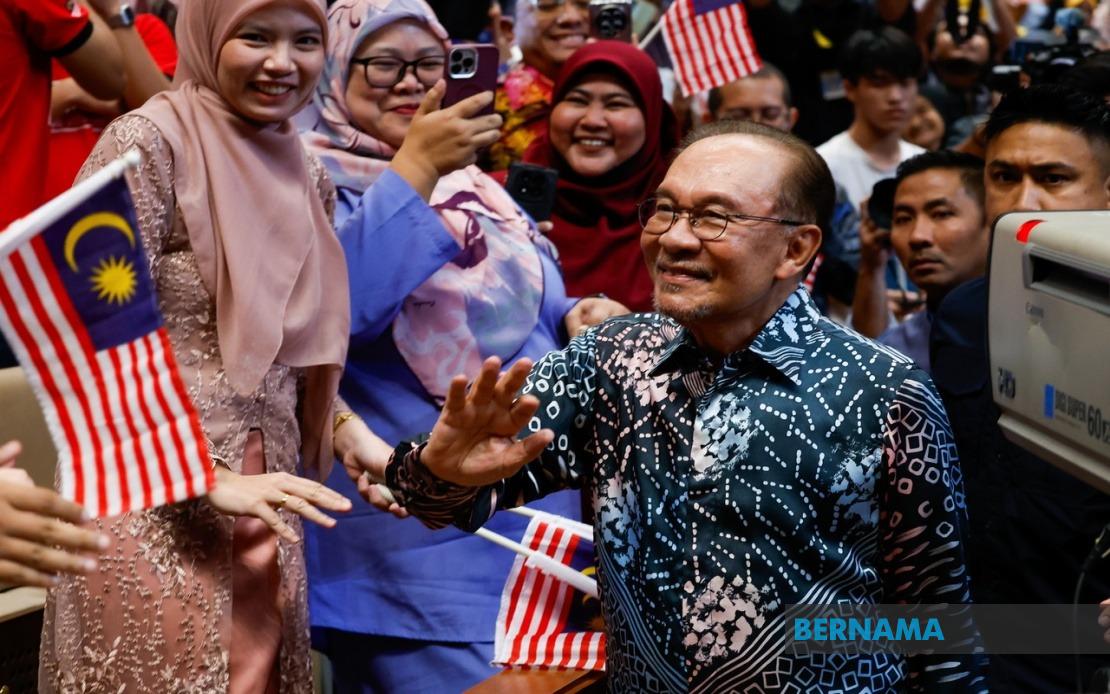
Prime Minister Datuk Seri Anwar Ibrahim has issued a forceful call for Malaysians to embed the spirit of independence within themselves, describing it as essential to the nation's future trajectory. Speaking at the Putrajaya International Convention Centre during the National Day address, Anwar stressed that independence extends far beyond constitutional arrangements or governmental frameworks—it represents a mindset and commitment that must permeate every citizen's consciousness.
Anwar's framing of independence as a psychological and spiritual condition rather than merely a legal or political status offers a distinctly introspective perspective on what the nation requires at this juncture. He articulated that the greatest obstacle facing Malaysia today lies not in external pressures or structural deficiencies, but in the collective failure to maintain and strengthen this independent consciousness. This diagnosis positions national renewal as contingent upon individual transformation and shared ideological commitment across society.
The Prime Minister's emphasis on unity carries particular weight given Malaysia's multicommunal composition and the recurring tensions that emerge across ethnic and regional lines. By invoking the vision of the nation's founders, Anwar reminded Malaysians that the independence compact was never predicated on homogeneity or the dominance of any single group. Instead, he portrayed the foundational agreement as requiring every generation to recommit to principles that transcend particularistic interests—whether defined by ethnicity, geography, or economic station.
Anwar explicitly articulated that national unity must embrace a broader conception than what he termed unification by race, district, or region. This formulation challenges narrow interpretations of solidarity and suggests that authentic national cohesion demands active participation from all communities in defending shared rights and advancing justice. The invocation of Malays and Bumiputera as the constitutional foundation while simultaneously demanding participation from all communities reflects the delicate balance Malaysia must maintain between constitutional provisions and inclusive governance.
The timing of this address carries significance in Malaysia's contemporary political context. Following periods of governance instability and polarization, the message functions as both exhortation and strategic repositioning. By grounding political legitimacy in philosophical ideals rather than partisan advantage, Anwar sought to elevate the discourse beyond factional competition toward principles that ostensibly command broader acceptance. This rhetorical strategy suggests recognition that sustainable governance requires mobilizing public commitment beyond institutional mechanisms.
The reference to rebuilding from ruins carries implicit acknowledgment of the challenges Malaysia has confronted in recent years. Economic headwinds, institutional credibility questions, and social fragmentation have tested the nation's institutional resilience. Anwar's invocation of this metaphor suggests his administration views restoration as requiring more than technical policy adjustments or administrative reforms. Rather, it necessitates rekindling foundational commitment to collective aspiration and shared responsibility for national direction.
The presence of Deputy Prime Minister Datuk Seri Dr Ahmad Zahid Hamidi, Communications Minister Datuk Seri Fahmi Fadzil, and Chief Secretary to the Government Tan Sri Shamsul Azri Abu Bakar underscored the governmental weight behind this messaging. The mobilization of senior leadership across multiple portfolios suggests the administration views this philosophical orientation as integral to broader governance objectives. The communications minister's attendance particularly signals intention to amplify this message through state and media apparatus.
For Malaysian readers, Anwar's address carries implications extending beyond ceremonial patriotism. The emphasis on independence as individual and collective consciousness speaks to ongoing questions about national identity and shared purpose. In an era when globalization, technological change, and transnational economic flows challenge traditional sources of national cohesion, Anwar's invocation of an internalized independence spirit attempts to locate resilience in ideological commitment rather than institutional structures alone.
The framework Anwar presented also addresses persistent questions about Malaysia's ability to maintain social harmony amid diversity. By insisting that unity requires all communities to play their part in defending rights and upholding justice, he articulated an aspirational vision of Malaysian citizenship that transcends ethnic categorization. However, translating this rhetoric into institutional practice remains contested terrain, particularly when constitutional provisions establish differential frameworks for different categories of citizens.
The broader Southeast Asian context adds layers of significance to this message. Regional peers confront analogous challenges of maintaining cohesion amid diversity, managing modernization pressures, and establishing legitimacy beyond institutional formality. Malaysia's specific constitutional architecture and diversity make this positioning particularly relevant for Malaysian audiences, yet the underlying themes resonate across the region as nations grapple with post-pandemic restoration and renewed questions about national purpose.
Anwar's address ultimately represents an attempt to reframe national politics around philosophical foundations and shared ideological commitment. Whether such appeals to independence consciousness can mobilize substantive behavioral change—whether in political participation, civic engagement, or interethnic relations—remains an open question. The gap between rhetorical assertion and institutional implementation has historically challenged Malaysian governance, suggesting that translation of this message into tangible outcomes will require sustained commitment beyond ceremonial occasions.

