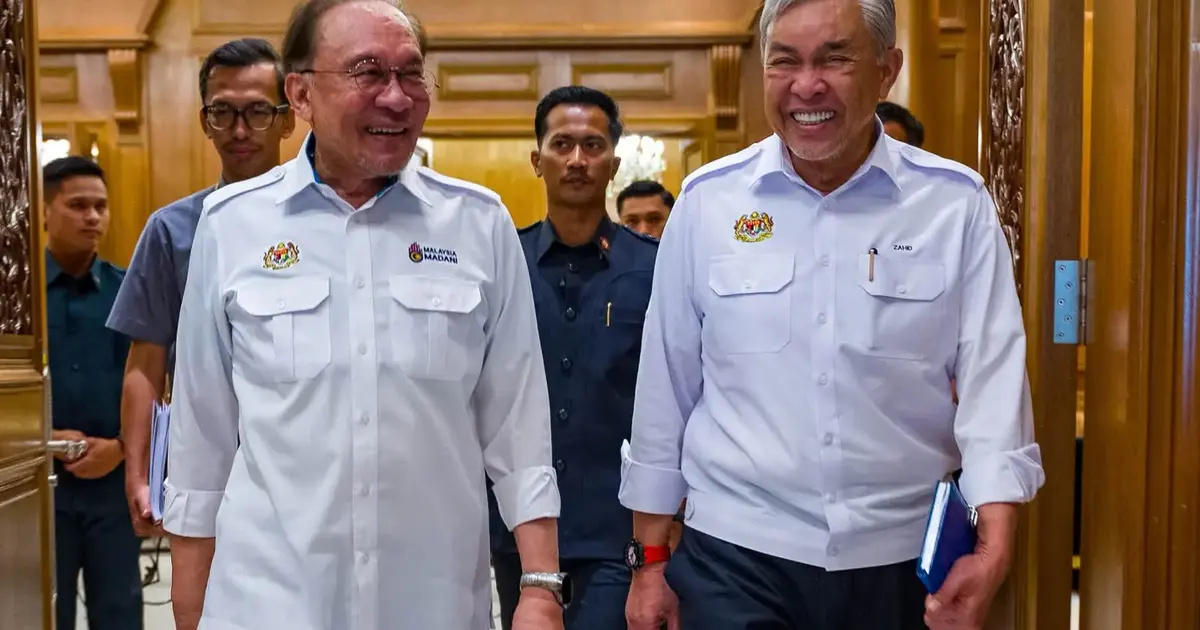
Prime Minister Anwar Ibrahim and Barisan Nasional chairman Ahmad Zahid Hamidi have moved swiftly to mend fences after a pointed public disagreement, presenting a carefully composed image of coalition harmony just hours after their dispute became public knowledge. The apparent friction, which centred on the status of eight BN ministers within the federal government, has been defused with both leaders appearing together in a conciliatory mood, signalling that underlying tensions within Malaysia's ruling coalition have been managed at least for now.
The dust-up emerged when Ahmad Zahid Hamidi issued what could be interpreted as a provocative statement, essentially inviting Prime Minister Anwar to remove the eight ministers from Barisan Nasional if he harboured dissatisfaction with their performance or loyalty. The remark carried an unmistakable edge—a public assertion of BN's political weight and a reminder that the bloc's continued support for the government carries significance. In the context of Malaysian coalition politics, where the balance of power between governing partners remains perpetually delicate, such statements rarely emerge without calculated intent.
The timing of Zahid's comment reflects ongoing dynamics within Malaysia's political structure, where the relationship between Pakatan Harapan-led government and its Barisan Nasional partners requires constant calibration. With Anwar's administration dependent on BN's parliamentary numbers to maintain its working majority, any hint of friction carries potential consequences for governmental stability. The Prime Minister's coalition lacks an independent super-majority, making the retention of BN goodwill operationally essential for advancing legislative agenda and avoiding embarrassing parliamentary defeats.
The public reconciliation that followed demonstrates how Malaysian political leaders manage disagreements—through rapid de-escalation and the projection of unity to avoid triggering market uncertainty, investor concerns, or opposition opportunities to exploit perceived weaknesses. When such tensions surface in Malaysian politics, the standard response involves swift damage control, which both leaders have clearly recognized as necessary. The almost theatrical display of camaraderie that followed suggests a return to the careful choreography that has characterized their working relationship.
This incident underscores the inherent fragility of Malaysia's current governing arrangement, cobbled together through necessity rather than ideological alignment or historical partnership. Anwar's administration represents a coalition of convenience, bringing together parties whose interests do not naturally converge. Barisan Nasional, historically Malaysia's dominant political force before its stunning 2018 defeat, has made strategic calculations about supporting the current government while maintaining leverage for future negotiations. The presence of BN ministers in cabinet positions represents both a symbol of unity and a potential pressure point.
The eight ministers in question occupy positions across the government's ministerial hierarchy, their presence reflecting BN's negotiated share of executive power. These appointments were part of the arrangement that enabled Anwar to form government in late 2022, a compromise that satisfied multiple political requirements simultaneously. However, the visibility of these ministers—and the periodic tensions over their roles—reflects the underlying reality that Malaysia's governing coalition remains one of tactical accommodation rather than organic political partnership.
Zahid's statement, while framed as a casual invitation for the Prime Minister to exercise authority, carried implicit messages about BN's continuing relevance and its capacity to withdraw support if treated disrespectfully. In Malaysian political culture, such remarks are rarely made without purpose; they serve simultaneously as assertion of status and subtle warning. The fact that it generated sufficient attention to require immediate presidential address indicates the statement resonated within political and media circles as more than mere rhetorical flourish.
The rapid resolution has restored surface-level equilibrium, but observers of Malaysian politics will recognize that such episodes typically indicate underlying pressures seeking expression. BN's decision to support the current government, while sensible from a realpolitik perspective given the party's weakness and the opposition's strength, creates ongoing tension between supporting governance and maintaining independent political identity. Senior BN figures must constantly balance loyalty to the coalition arrangement against positioning their party for eventual political recovery.
Looking forward, this incident demonstrates that Malaysia's ruling coalition will likely continue experiencing periodic friction as competing interests seek acknowledgment and accommodation. The government's legislative agenda depends substantially on maintaining BN cooperation, while BN must continually demonstrate to its base that coalition membership provides strategic advantage rather than representing capitulation to rivals. These competing pressures will generate similar public tensions requiring similar management going forward, suggesting that coalition harmony in Malaysian politics remains an ongoing project rather than a settled reality.

