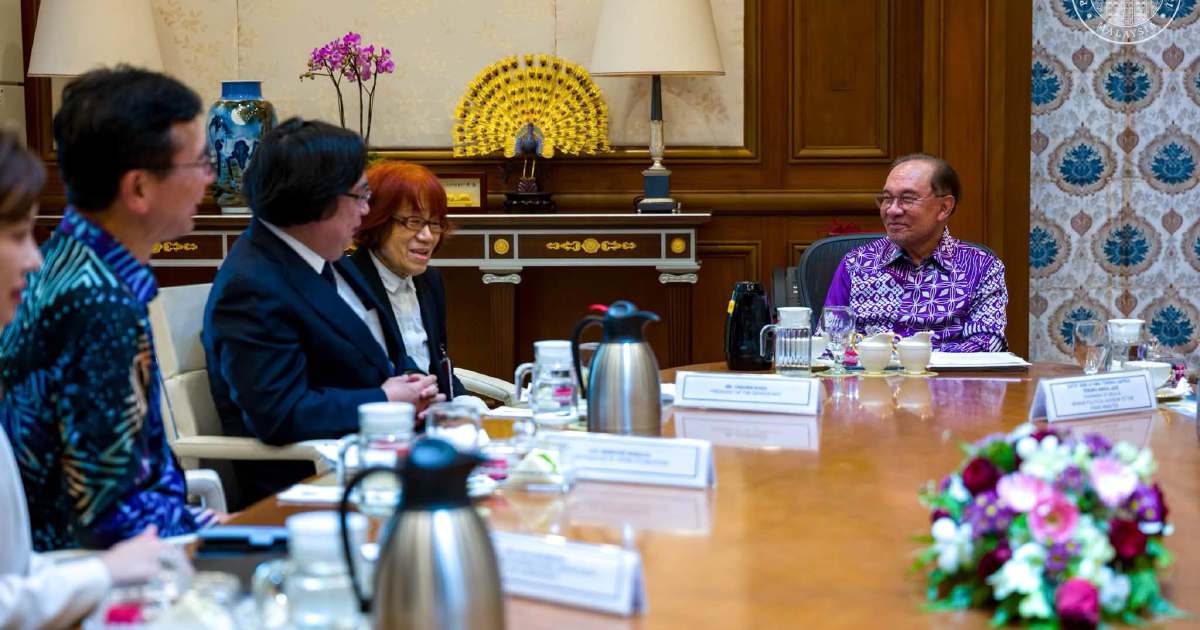
Prime Minister Datuk Seri Anwar Ibrahim has welcomed Genron NPO president Yasushi Kudo to the Malaysian capital in a courtesy call aimed at reinforcing the two nations' strategic engagement and bilateral relationship. The meeting brought together leadership from government and one of Japan's most influential policy research organizations, reflecting the importance both capitals place on sustained institutional dialogue beyond traditional diplomatic channels.
Genron NPO, formally established in Tokyo, functions as a non-profit organization focused on policy advocacy and strategic analysis for Japanese policymakers. The organization wields considerable sway in Japanese political circles, serving as a conduit between academic researchers, business leaders, and government officials. Kudo's visit to Kuala Lumpur signals Japan's commitment to engaging comprehensively with key Southeast Asian partners, recognizing Malaysia's pivotal role in regional geopolitics and its significance as both an economic partner and security stakeholder.
The discussions that took place during this engagement centred on broadening the mechanisms through which Malaysia and Japan pursue strategic dialogue. Such conversations are increasingly vital as both nations navigate complex regional dynamics, including evolving maritime security concerns, technology competition, and efforts to maintain open trade pathways in the Indo-Pacific. For Malaysia particularly, maintaining robust channels of communication with developed economies like Japan helps balance regional influence and ensures national interests are articulated effectively across multiple forums.
Malaysia and Japan have cultivated deep historical ties spanning decades, though their relationship has evolved considerably with changing geopolitical circumstances. Economic integration remains substantial, with Japanese corporations maintaining significant investments across Malaysian manufacturing, automotive, electronics, and services sectors. The bilateral relationship extends into defence and security cooperation, maritime safety initiatives, and cultural exchanges that have fostered genuine mutual understanding between the two societies.
The timing of this engagement carries particular significance given current regional tensions and the heightened focus on maintaining stability in Southeast Asia. Japan has increasingly invested diplomatic and strategic resources into deeper partnerships with ASEAN nations as it seeks to strengthen what some analysts term the "free and open Indo-Pacific" framework. Malaysia, as both an ASEAN member and a non-aligned nation maintaining diplomatic flexibility, occupies a unique position valued by major powers including Japan.
Kudo's visit represents the type of track-two diplomacy that often precedes or complements official government negotiations. Think-tanks and policy organizations frequently serve as testing grounds for new diplomatic initiatives, allowing governments to explore possibilities without the formality and constraints of official channels. Genron NPO's involvement suggests that the ideas discussed may inform future bilateral policy directions, making such engagements consequential despite their ostensibly informal nature.
For Malaysian policymakers, strengthening strategic dialogue with organizations like Genron NPO offers opportunities to influence Japanese policy perspectives on issues of importance to Kuala Lumpur. Malaysia's interests in South China Sea stability, regional economic architecture, and technology cooperation with established democracies can be effectively articulated through such platforms. The conversation likely touched upon how Malaysia and Japan can coordinate positions on issues of mutual concern within broader regional and multilateral frameworks.
The emphasis on strategic dialogue reflects recognition that bilateral relationships today require constant nourishment through multiple channels. Official state visits and ministerial meetings remain important, yet sustained engagement through academic institutions, policy organizations, and business forums creates the conditions for deeper mutual comprehension and alignment on shared objectives. This multi-layered approach to diplomacy has become standard practice among sophisticated governments seeking to build resilient partnerships.
Looking forward, strengthened Malaysia-Japan cooperation holds potential benefits for both economies and the broader region. Enhanced coordination on supply chain security, particularly in semiconductors and critical minerals where both nations have stakes, could yield mutual advantages. Collaboration on technology standards, digital economy frameworks, and talent development in emerging fields represents another frontier for partnership expansion. Additionally, coordinated responses to transnational challenges including climate change, pandemic preparedness, and maritime security could demonstrate how bilateral partnerships contribute to regional stability.
The visit also underscores Japan's broader strategy of engaging Southeast Asian nations at multiple diplomatic levels simultaneously. While official government relationships remain foundational, Japan recognizes that meaningful influence requires connecting with civil society, research communities, and business leaders. This comprehensive engagement approach reflects understanding that durable partnerships rest on foundations broader than governmental transactions alone.

