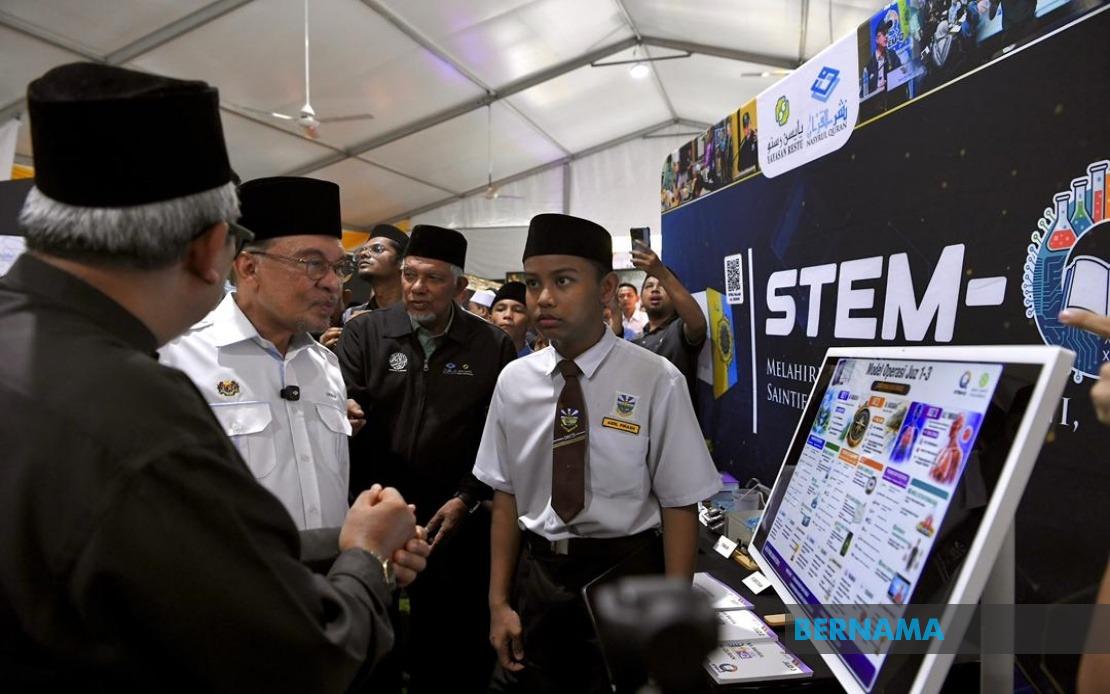
Prime Minister Datuk Seri Anwar Ibrahim has approved RM4.6 million in additional funding this financial year to upgrade basic infrastructure at 27 Islamic educational institutions across Penang, marking a significant expansion of the government's investment in religious education facilities. The announcement, made while addressing participants at the National Tadabbur Perdana and Maidah Wanita MADANI Permatang Pauh programmes at Masjid Muhajirin in Butterworth, reflects a doubling of support compared to the previous year's allocation of RM2.11 million, which had covered upgrading works at 11 institutions.
The scale of this year's initiative demonstrates a broadened focus by the Finance Ministry on enhancing religious education infrastructure across the northern state. Anwar, who holds both the Prime Minister and Finance Minister portfolios, outlined that the RM4.6 million would be deployed across multiple categories of improvement projects tailored to the varied needs of these establishments. The funding encompasses structural work such as wall and fence upgrades, renovations to madrasah facilities, enhancements to school buildings, construction of new kindergarten blocks, and development of tahfiz academies—institutions that specialise in memorisation of the Quran.
The expansion from 11 institutions supported last year to 27 this year underscores a policy shift toward more comprehensive coverage of Islamic educational facilities in Penang. Rather than concentrating resources on a smaller number of larger institutions, the government appears to be pursuing a more distributed approach that reaches smaller, community-based religious schools that may otherwise struggle to fund necessary infrastructure repairs and expansions. This strategy could particularly benefit institutions in less urbanised areas or those serving economically disadvantaged communities.
Beyond the immediate infrastructure improvements, Anwar emphasised the government's broader commitment to maintaining momentum in strengthening religious education as a cornerstone of national development. He articulated a vision in which Islamic educational institutions receive sustained and predictable funding, allowing them to plan long-term improvements and maintain facilities to adequate standards. This consistent investment signals confidence in the role these institutions play within Malaysia's educational ecosystem and religious landscape.
A notable dimension of Anwar's remarks addressed the integration of modern technology with traditional Islamic learning. He advocated for Islamic educational institutions to embrace technological advancement, particularly artificial intelligence applications in Quranic and Islamic studies. However, he coupled this forward-looking stance with a critical caveat: that technology must be deployed within a framework of strong ethical values and moral principles. Anwar cautioned against the adoption of AI purely for capability enhancement or pedagogical efficiency without ensuring that the underlying systems reflect Islamic values and moral teachings.
This perspective reflects a tension increasingly felt across the Islamic world regarding modernisation and tradition. Malaysia, as a Muslim-majority nation with sophisticated technological infrastructure, occupies a unique position in navigating this balance. The Prime Minister's comments suggest the government recognises that Islamic education cannot remain isolated from technological currents reshaping global education, yet it must do so in ways that preserve doctrinal integrity and ethical foundations. For Penang's institutions, this could translate into gradual adoption of AI-assisted Quranic learning tools, digital madrasah management systems, or online Islamic studies programmes—provided these are developed with religious scholars' input.
Anwar also called upon the broader public to take fuller advantage of the religious and civic freedoms available within Malaysia to organise Islamic programmes and educational initiatives. He specifically highlighted the value of regular Quran study circles (tadabbur sessions), Quranic recitation classes, and religious lectures as mechanisms for deepening popular understanding of Islamic teachings. This emphasis on grassroots religious engagement suggests the government views Islamic education as extending beyond formal institutions into community-led learning spaces.
The practical implications of this funding expansion for Penang are multifaceted. For the 27 beneficiary institutions, the allocation will permit necessary maintenance and expansion that might otherwise be deferred. For parents and students, improved facilities may enhance the learning environment and demonstrate state support for Islamic education. For religious authorities and community leaders, the predictable funding stream creates space for longer-term planning and programme development. The doubling of allocations year-on-year also signals to other states that religious education infrastructure deserves budgetary priority.
Within Malaysia's broader policy context, the announcement reflects how the government under Anwar is recalibrating approaches to Islamic institutions following political transitions. The previous administration's relationships with religious bodies and Islamic education were sometimes contentious; the current leadership appears intent on demonstrating responsiveness to the sector's material needs. Penang, governed by the opposition Democratic Action Party but home to a significant Muslim population and numerous Islamic institutions, becomes a testing ground for how federal-level religious funding can function across political divides.
For Southeast Asia more broadly, Malaysia's approach to modernising Islamic education while maintaining doctrinal grounding offers a model that other Muslim-majority nations monitor. The region contains populations navigating similar questions about technology, tradition, and religious education; Malaysia's experiments with AI-assisted Islamic learning or upgraded tahfiz facilities may influence policy discussions elsewhere in the region.
The allocation also carries implications for Islamic education workers and administrators in Penang. Improved facilities and infrastructure can reduce administrative burden, allowing educators to focus more intensively on pedagogical quality. Upgraded kindergarten buildings and tahfiz academies may attract more students and enable these institutions to expand their reach within their communities. The psychological signal that government values their work through material investment can also support morale in a sector that often operates with limited resources and public recognition.
Moving forward, the sustainability of this funding trajectory will depend on continued budgetary allocation and political commitment across administrations. The jump from RM2.11 million to RM4.6 million demonstrates current intent, but whether this represents a floor for ongoing investment or a temporary surge remains unclear. Religious institutions would benefit from clarity on whether future years will maintain this expanded funding level or whether they should plan for variations. Anwar's framing of this as part of sustained government focus suggests commitment to consistency, yet Malaysia's fluid political landscape means that budgetary priorities can shift.

