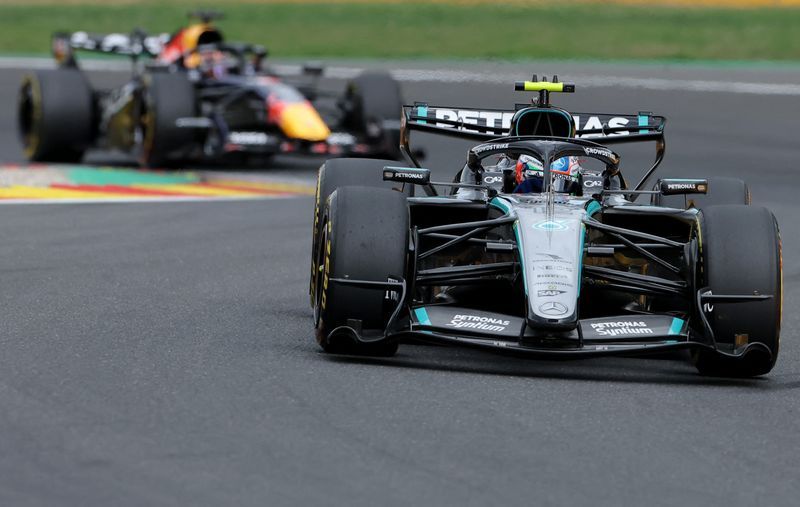
Kimi Antonelli's commanding performance at Spa-Francorchamps on Sunday delivered Mercedes yet another decisive blow in an increasingly dominant 2024 Formula One season, as the 19-year-old Italian driver stretched his championship advantage to 45 points ahead of Ferrari's Lewis Hamilton. The result underscored Mercedes' ascendancy in the current campaign whilst simultaneously exposing vulnerabilities within rival teams that have struggled to mount a sustained challenge.
The race unfolded dramatically from the opening lap, when George Russell—who had arrived in Belgium as Antonelli's closest title rival—encountered catastrophic difficulties that would reshape the championship landscape. Russell's attempt to recover ground lost during the initial dash to the first corner culminated in a collision with teammate Lewis Hamilton, sending the British driver into the gravel and out of the 44-lap contest. The incident eliminated a significant threat to Antonelli's title ambitions and demonstrated the pressure mounting within the Mercedes team as competition for victory intensifies.
Antonelli's tactical execution proved superior throughout the afternoon, particularly when navigating a virtual safety car period that disrupted race rhythm. Ferrari's Charles Leclerc capitalised on this interruption to assume the lead following his pit stop, temporarily threatening Mercedes' control. However, Antonelli methodically worked his way back to the front, demonstrating the consistency that has defined his season thus far. His ability to recover from tactical disadvantage and reassert dominance reflects both driving skill and the underlying pace advantage Mercedes has cultivated.
The victory marked Antonelli's sixth triumph in ten rounds, consolidating a remarkable record of success that contrasts sharply with earlier inconsistency. The Italian had endured a blank stretch across the previous three rounds, failing to score in two separate outings and raising questions about maintaining focus during challenging periods. Sunday's performance vindicated the narrative that Antonelli possesses sufficient resilience to overcome temporary setbacks, a crucial attribute required of championship contenders in the unforgiving Formula One environment.
Hamilton's fourth-place finish came accompanied by the immediate complication of a five-second penalty for his collision with Russell, a sanction that did not reflect the severity of the underlying incident. Beyond this punishment, the Ferrari driver faced ongoing investigation into an allegedly unsafe pit stop release, a technical breach that could trigger further grid penalty consequences. The prospect of additional penalties suggested Hamilton's championship credentials face mounting pressure, as his points deficit to Antonelli threatened to expand beyond the current 45-point margin.
Maximilian Verstappen's third-place completion contributed Red Bull's 300th Formula One podium finish, a statistical milestone that acknowledges the team's lengthy heritage in the sport. Yet this achievement arrived amidst a concerning pattern of inconsistent competitiveness that has allowed Mercedes and Ferrari to establish clear superiority. Red Bull's inability to challenge for victory at a circuit traditionally suiting their technical approach indicated deeper structural challenges requiring urgent resolution.
McLaren's continuing inconsistency manifested through Oscar Piastri's fifth-place result and reigning champion Lando Norris's seventh-place outcome. Norris's performance proved particularly disappointing given his grid penalty context; starting from 13th position following a ten-place sanction, his recovery to seventh represented modest progress against expectations. The constructors' championship aspirations appear increasingly untenable as Mercedes consolidates manufacturing supremacy and outpaces rivals in operational efficiency.
Australia's Gabriel Bortoleto secured points for Audi in eighth place, maintaining the manufacturer's incremental progress during what remains an early-stage homologation year. Racing Bulls' Arvid Lindblad and Franco Colapinto of Alpine rounded out the scoring positions, with Colapinto's tenth-place conclusion suggesting the Argentine driver continues adapting to Formula One machinery following his recent mid-season introduction.
Antonelli's pole position achievement extended Mercedes' remarkable qualifying dominance, which now encompasses every session throughout 2024. This unbroken qualifying supremacy provides decisive strategic advantages during race weekends, permitting tactical flexibility unavailable to competitors trapped in inferior grid positions. The qualifying advantage compounds throughout racing distance, creating compounding benefits that translate championship points into decisive leads.
The champion's measured assessment of Sunday's triumph acknowledged the fortunate circumstances surrounding the Russell-Hamilton collision, suggesting Antonelli recognises the championship would remain genuinely competitive absent such dramatic interventions. This analytical honesty contrasts with overconfident proclamations sometimes heard from drivers riding championship waves, indicating a maturity extending beyond his youthful years. The commentary regarding momentum and capitalising on opportunity reflected understanding that championship campaigns contain unpredictable elements requiring opportunism combined with consistency.
For Malaysian and Southeast Asian followers monitoring Formula One's evolution, Mercedes' sustained dominance raises questions about competitive balance and whether structural advantages prove insurmountable for challenging teams. The championship narrative has shifted from multi-team competition toward Mercedes' march toward decisive victory, with Antonelli positioned as the primary protagonist in a season that increasingly resembles a procession toward inevitable triumph. The remaining calendar presents limited opportunities for rivals to narrow the expanding points deficit.

