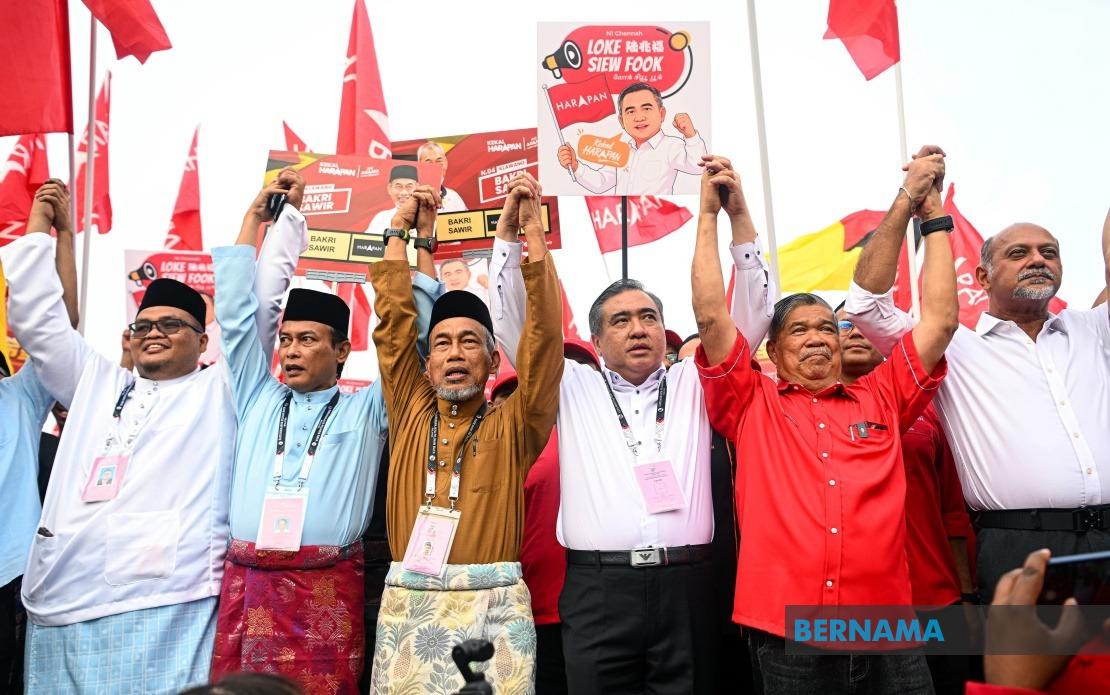
The 16th Negeri Sembilan state election has officially commenced with a closely watched contest emerging in the Chennah state seat, where DAP secretary-general Anthony Loke will defend his position against Barisan Nasional's Siow Kong Choon, the state MCA Youth chief. The nomination process, which concluded at the Dewan Besar Kuala Klawang in Jelebu on July 18, established what election officials describe as a straight two-way fight for the constituency, with Loke's nomination submitted at 9:05 am followed immediately by Siow at 9:09 am.
Loke's decision to seek re-election comes amid his dual responsibilities as both Seremban Member of Parliament and Malaysia's Transport Minister, a position that has kept him in the national spotlight throughout the DAP's recent political evolution. His decade-long tenure representing Chennah since 2013 has established significant grassroots support within the state seat, though the party faces renewed pressure from coalition rivals across the peninsula. The announcement by Jelebu Parliamentary returning officer Abdul Rahim A Aziz confirmed the bilateral nature of the contest, eliminating earlier uncertainty about potential multi-cornered fights that have characterised recent Malaysian electoral cycles.
Siow Kong Choon's candidacy represents BN's determined effort to recapture ground in Negeri Sembilan, where the coalition has struggled to maintain electoral momentum across urban and semi-urban constituencies. As state MCA Youth chief, Siow brings organisational credibility within the party's youth network and can potentially mobilise traditional Chinese business and professional communities that have historically supported BN's Malaysian Chinese Association component. The MCA's selection of Siow underscores the party's strategy to contest seats where demographic composition favours a direct appeal to the Chinese-majority electorate, a calculation that appears particularly relevant in Chennah's voter composition.
Loke's track record in this seat provides substantial context for the impending contest. During the 2023 Negeri Sembilan state election, he secured 5,888 votes, defeating Perikatan Nasional candidate Rosmadi Arif by a decisive margin of 2,200 votes. That victory, occurring in a political environment marked by PN's significant rural support and urban swing patterns, demonstrated Loke's ability to consolidate opposition votes while maintaining DAP's traditional urban base. The outcome suggested that Chennah voters had rejected PN's electoral challenge despite the coalition's broader momentum in several peninsular constituencies during that cycle.
The electoral timeline established by the Election Commission provides both camps with defined campaign periods. Early voting has been scheduled for July 28, allowing working professionals, security personnel, and other eligible voters to cast ballots before the main polling day. The official polling date of August 1 gives campaigns approximately two weeks for ground mobilisation, with the condensed timeframe characteristic of Malaysia's modern state election schedules. This compressed timeline typically advantages incumbents with established machinery and name recognition, potentially favouring Loke's retention prospects.
Negeri Sembilan's political significance within the broader Malaysian context cannot be overlooked. The state represents a crucial battleground where urban DAP support meets rural Malay-Muslim constituencies that remain contested terrain between BN and PN. Loke's transport portfolio and national profile have elevated Chennah's electoral importance beyond purely local considerations, as his retention or defeat would carry implications for DAP's standing within the Pakatan Rakyat coalition and broader opposition consolidation efforts. The constituency thus functions as a proxy indicator for opposition strength in mixed urban-rural demographics across the peninsula.
The BN machinery's capacity to mobilise support around Siow Kong Choon will largely determine the contest's competitive character. Traditional BN voter networks, particularly among older demographics and established merchant communities, retain significant organisational reach despite recent electoral setbacks. However, BN's recent poor performance in several state and parliamentary elections suggests potential voter fatigue with the coalition's long incumbency and governance record, a phenomenon that has benefited opposition parties in mixed constituencies similar to Chennah's demographics.
Loke's position as Transport Minister provides both electoral advantage and vulnerability. On one hand, his ministerial portfolio enables him to highlight infrastructure and transport-related initiatives potentially benefiting Negeri Sembilan voters, from road improvements to public transport enhancements. Conversely, any controversies or underperformance in his ministry could provide opposition ammunition, though BN's own governance record offers limited high ground for criticism on administrative competence. The Transport Ministry portfolio, relatively technical compared to portfolios like Defence or Home Affairs, typically attracts less electoral controversy unless major incidents or policy failures occur.
The broader Negeri Sembilan election context suggests multiple constituencies will remain genuinely competitive rather than predetermined outcomes. Unlike several Malaysian states where one coalition has achieved dominant positioning, Negeri Sembilan continues to feature mixed electoral patterns with genuine swings possible across different constituencies. Chennah's status as a metropolitan state seat makes it particularly susceptible to voter mood shifts, urban professional realignment, and demographic changes favouring either the opposition or BN depending on governance performance and campaign effectiveness during the two-week campaign window.
For Malaysian political observers, the Chennah contest represents a valuable indicator of DAP's electoral health in mixed urban-rural constituencies and the party's capacity to retain ministerial-level representation outside Penang and the Federal Territories. A Loke victory would suggest DAP's continued penetration into Negeri Sembilan's urban and semi-urban voter bases, while a defeat would signal either effective BN mobilisation or unexpected erosion of opposition support in constituencies that have recently favoured the coalition. The August 1 results will thus provide crucial data points for understanding Malaysia's evolving political configuration and voter preferences as the nation contemplates potential federal elections within the coming years.

