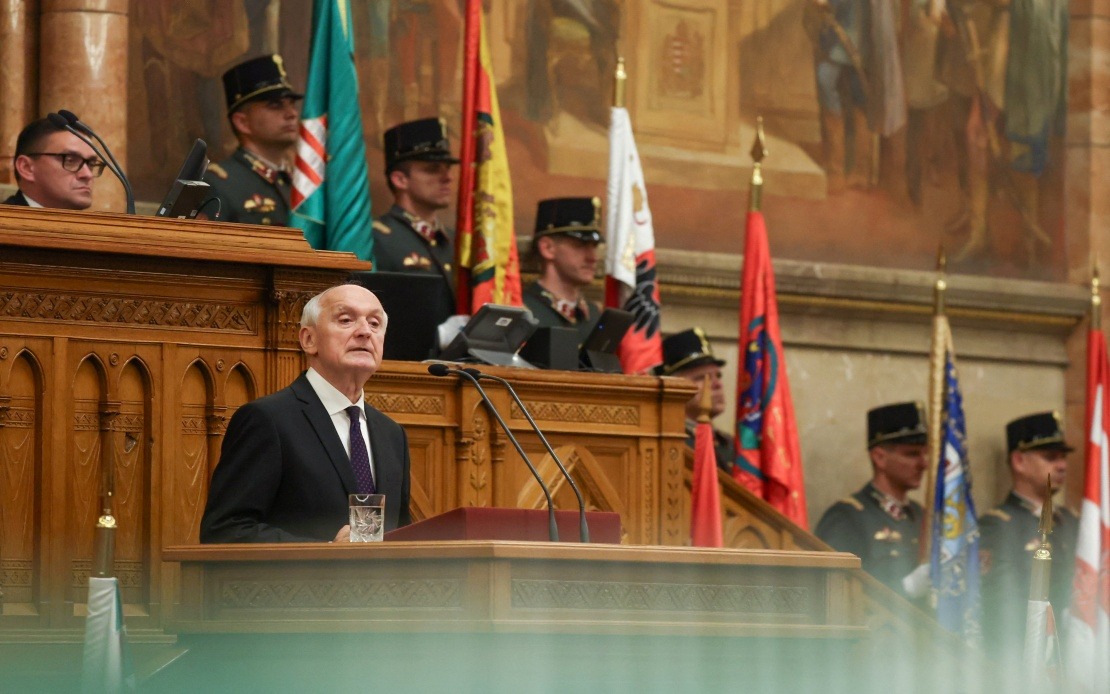
Andras Baka officially assumed the Hungarian presidency on August 19, 2026, marking a significant institutional shift in the Central European nation's political landscape. Prime Minister Peter Magyar confirmed the transition through social media, extending congratulations to the new president and expressing hopes for his tenure to be characterized by humanitarian principles and effective leadership. The transition represents one of Hungary's most contentious leadership changes in recent years, shadowed by deep parliamentary divisions and disputes over constitutional reform.
The Hungarian Parliament had elected Baka to the presidency during its August 11 session, selecting the former judicial authority to lead the country through a particularly turbulent political period. His elevation to the nation's highest office reflects a complex interplay between the ruling coalition and the judiciary, two institutions that have experienced considerable tension throughout the past decade. The appointment process itself underscores broader questions about institutional independence and democratic governance that have animated European debate about Hungary's constitutional trajectory.
Baka brings substantial judicial experience to the presidency, having served as president of Hungary's Supreme Court from 2009 to 2011 before departing amid disagreements over court restructuring initiated by Viktor Orban's government. His resignation from the Supreme Court reflected fundamental tensions over judicial reform, demonstrating Baka's willingness to take principled stands on institutional matters. Between his exit from the Supreme Court and his path to the presidency, Baka worked at the European Court of Human Rights in Strasbourg, where he gained exposure to international human rights jurisprudence and comparative constitutional practice across the European Union's member states.
Following the Supreme Court's restructuring, Baka led the Hungarian Curia from 2012 to 2020, serving as chairman of the reformed institution that replaced the previous judicial structure. This nine-year tenure positioned him as a central figure navigating Hungary's revised judicial architecture, managing the courts during a period when debates about independence and political influence remained acute. His experience leading the reformed Curia provided him with intimate knowledge of Hungary's judicial functioning and the practical challenges facing courts operating within contested institutional frameworks.
The presidential election proved contentious, with major opposition parties refusing to participate. Both Fidesz and the Christian Democratic People's Party boycotted the proceedings as a protest against the manner in which the previous president, Tamas Szujok, had been removed from office through constitutional amendments. This boycott represents a significant act of parliamentary resistance, signaling opposition objections to what they characterize as extrajudicial removal of a sitting head of state. The refusal to participate highlights the deep fractures within Hungarian politics and disputes about constitutional procedure and presidential authority.
The constitutional amendments enabling Szujok's removal represent a controversial escalation of institutional conflict within Hungary. Opposition parties viewed the process as circumventing normal democratic and constitutional safeguards, establishing a precedent for removing sitting presidents through legislative means rather than through elections or resignation. Their boycott of Baka's election protest this constitutional innovation, though the majority coalition's parliamentary dominance rendered such resistance largely symbolic in achieving immediate legislative outcomes.
The circumstances surrounding Baka's accession carry particular significance for Hungarian judicial independence and European constitutional governance. The international dimension looms large, as Hungary's relationship with European Union institutions has been strained by various reforms critics characterize as threatening judicial autonomy and rule-of-law standards. Baka's background at the European Court of Human Rights and his previous principled resignation over court reform create expectations that he may serve as a moderating force or institutional guardian, though the presidency's actual constitutional powers in Hungary's parliamentary system remain circumscribed compared to executive authority wielded by the prime minister.
For Malaysian and Southeast Asian observers, Hungary's institutional upheaval offers instructive parallels regarding constitutional governance, judicial independence, and the vulnerabilities of democratic systems when majority coalitions exercise extensive legislative power without proportional check or opposition voice. The boycott strategy employed by Hungarian opposition parties—refusing to legitimize proceedings they consider unconstitutional—reflects approaches visible across democracies facing institutional pressures, though such tactics carry limitations when majorities control parliamentary proceedings.
Baka's presidency under these fractious circumstances will likely witness continued scrutiny regarding the independence of Hungary's judiciary and whether the courts can function as meaningful institutional constraints on executive and legislative power. His previous resignation over judicial reform suggests potential willingness to defend institutional prerogatives, yet the presidency's formal powers and real-world capacity to influence judicial operations remain circumscribed within Hungary's governmental structure. International observers, including European Union authorities concerned with Hungarian governance, will closely monitor his tenure for signals about the trajectory of judicial autonomy and constitutional respect.
The transition also reflects generational and ideological shifts within Hungarian politics, with Baka representing a different era of judicial governance compared to the institutional evolution overseen under Orban's lengthy tenure. His appointment suggests potential opening toward international human rights standards and European judicial cooperation frameworks, contrasting with some characterizations of recent Hungarian judicial reforms as strengthening governmental control. Yet whether his presidency can meaningfully alter institutional trajectories or merely serve as ceremonial figurehead remains an open question dependent on how political actors, the parliamentary majority, and Baka himself interpret and exercise presidential authority within Hungary's constitutional framework.
The swearing-in concludes one political chapter while opening another characterized by deep institutional divisions and unresolved questions about constitutional legitimacy and democratic process. As Hungary navigates this period, its experience continues offering broader lessons about the vulnerabilities of democratic systems, the challenges of maintaining institutional equilibrium under concentrated parliamentary power, and the limitations of procedural legitimacy when substantial portions of the political community question the constitutional validity of governmental transitions.

