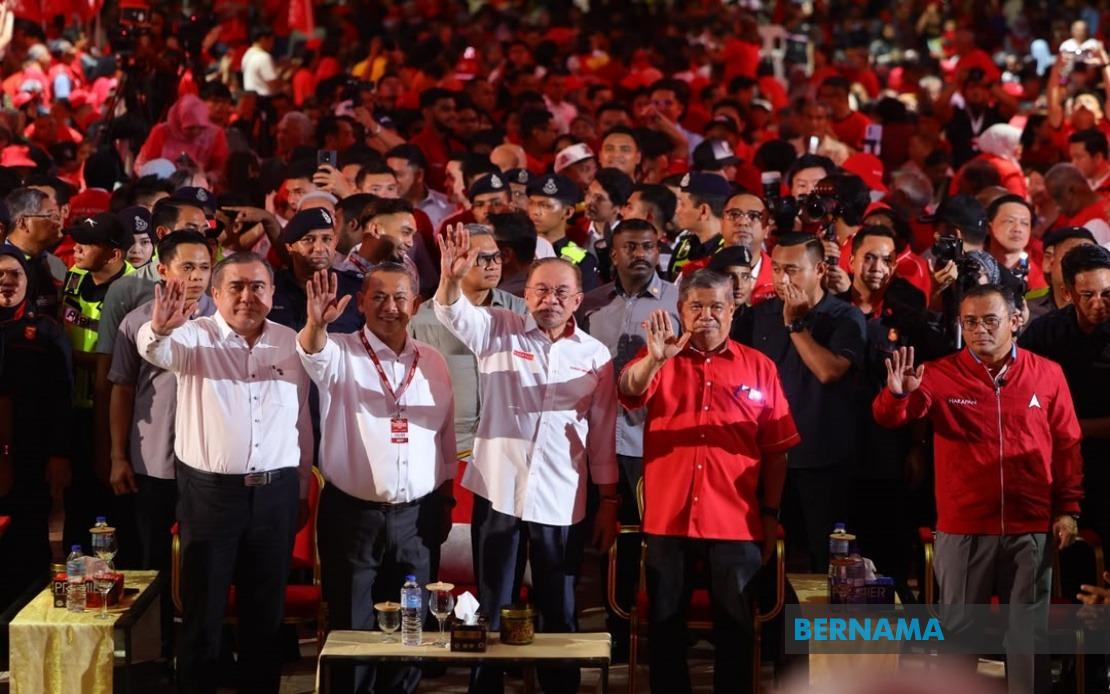
Datuk Seri Aminuddin Harun, chairman of Pakatan Harapan in Negeri Sembilan, is urging constituents across the state to deliver the coalition a renewed mandate at the ballot box during the 16th state election. Speaking at the coalition's candidate announcement ceremony in Kuala Pilah, Aminuddin framed the election as a critical opportunity to sustain the political stability and investor confidence that he argues have underpinned Negeri Sembilan's development trajectory over recent years.
The stability of state governance, according to Aminuddin, directly influences the sustainability of government programmes and economic initiatives that benefit residents. A government with a clear electoral mandate, he contended, can pursue long-term strategies without disruption, whereas political uncertainty creates hesitation among investors and undermines the implementation of welfare schemes. This argument reflects a broader positioning by PH that governmental continuity, rather than change, should be the primary consideration for voters weighing their electoral choices.
Since PH's victory in 2018, the coalition has pursued various developmental and welfare initiatives across Negeri Sembilan. These include educational assistance programmes, the distribution of free tablets to students, and enhanced cooperation mechanisms with the Federal Government. Aminuddin emphasised that these programmes depend on political stability and would face potential disruption under a different administration. His invocation of specific welfare measures seeks to translate abstract promises of stability into concrete benefits that voters have already experienced or anticipated.
A notable dimension of PH's campaign messaging in Negeri Sembilan involves the state's economic performance. The coalition has attracted RM19.1 billion in investments during its tenure, a figure Aminuddin highlighted as evidence of investor confidence in the state's governance. This economic narrative is particularly significant for a state seeking to position itself as an attractive destination for manufacturing and commercial activity within Malaysia's industrial landscape. The investment figure serves as a quantifiable marker of PH's administrative competence and appeal to the business community.
Another achievement Aminuddin pointed to is the substantial increase in zakat collection, which has grown from approximately RM80 million to nearly RM200 million since his tenure began. This expansion in Islamic charitable funding enables greater assistance to economically vulnerable populations, addressing social welfare through religious institutional channels. The figure demonstrates both increased prosperity within the state and more effective collection mechanisms, both of which reflect positively on the incumbent government's management of state affairs.
However, PH's position in Negeri Sembilan must be understood against the backdrop of recent electoral setbacks. The coalition's performance in the Johor state election fell short of expectations, a result that has prompted strategic recalibration ahead of the Negeri Sembilan contest. DAP secretary-general Anthony Loke characterised the upcoming election as PH's "second round," suggesting a determination to recover momentum after the Johor disappointment. This framing transforms the Negeri Sembilan election into a critical test of whether PH can stabilise its support base or whether its declining trajectory will continue.
Loke's remarks revealed an awareness among PH leadership that the Johor result demands substantive response rather than rhetorical dismissal. Rather than minimising the loss, he acknowledged it directly whilst simultaneously pivoting toward the immediate challenge in Negeri Sembilan. This approach attempts to demonstrate resilience and learning capacity to voters who may harbour doubts about PH's electoral viability. The coalition's strategy involves leveraging Negeri Sembilan as "home ground" where PH's organisational advantages should theoretically be strongest, creating a platform from which to rebuild broader momentum.
The composition of the delegation present at the announcement ceremony reflected PH's multi-component coalition structure. DAP secretary-general Anthony Loke, Amanah president Datuk Seri Mohamad Sabu, and senior communications figures demonstrated the coalition's presentation of unified leadership. Aminuddin's retention as the coalition's Menteri Besar candidate and election "commander" underscores PH's commitment to continuity in state leadership, a positioning that aligns with the broader message about stability and investor confidence.
Loke's emphasis on campaign conduct and respect for Negeri Sembilan's royal institutions and constitutional framework suggests PH's awareness of sensitivities surrounding non-Malay led coalitions in states with significant Malay-Muslim populations. His explicit reaffirmations of loyalty to Yang Dipertuan Besar and respect for constitutional monarchy and Rukun Negara principles attempt to preempt narratives questioning DAP's commitment to these institutions. This defensive positioning reflects PH's need to navigate complex cultural and political terrain in Negeri Sembilan, where perceptions of respect toward royal and Islamic institutions carry electoral weight.
The campaign period ahead will test whether PH's economic performance metrics and welfare programme achievements sufficiently outweigh broader concerns about the coalition's national trajectory and recent electoral performance. Aminuddin's appeal for voter support rests fundamentally on the argument that continuity produces superior outcomes compared to uncertainty. This claim will require validation through systematic engagement with constituencies across Negeri Sembilan, particularly in rural and semi-urban areas where PH faces competitive challenges from alternative political formations.
For Malaysian observers monitoring state-level politics, the Negeri Sembilan election represents a barometer of PH's capacity to maintain control of territories it currently governs. The coalition's performance here will provide indicators about whether the Johor result represents a broader realignment of voter preferences or a state-specific anomaly. Should PH succeed in retaining Negeri Sembilan comfortably, it would suggest residual organisational strength in its traditional strongholds. Conversely, a narrow victory or defeat would signal deeper structural challenges requiring fundamental strategic reassessment within the coalition.

