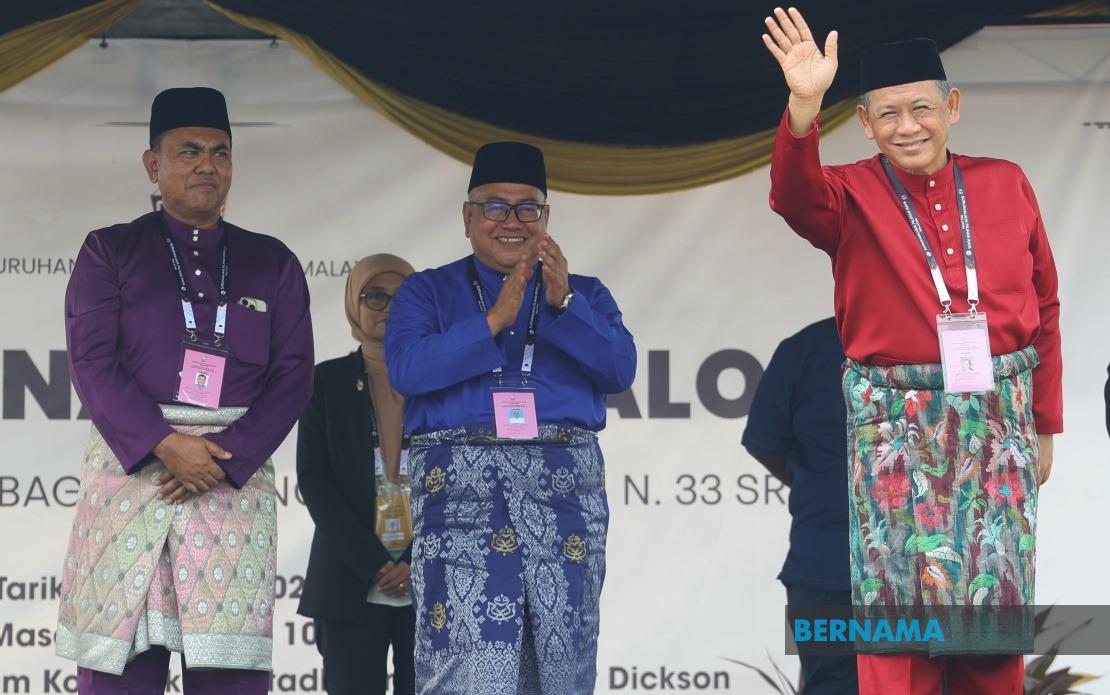
Negeri Sembilan's political landscape is set for a keenly contested battle on August 1, with Menteri Besar Datuk Seri Aminuddin Harun entering a three-cornered fight to retain the Linggi seat. The Pakatan Harapan leader must contend with strong opposition from both Barisan Nasional incumbent Datuk Mohd Faizal Ramli and Bersatu candidate Datuk Zamri Md Said, according to nominations that closed on July 18 in Port Dickson.
The contest reflects the increasingly fragmented nature of Malaysian state politics, where traditional two-way battles between government and opposition have given way to multi-party competition across multiple constituencies. For Aminuddin, who assumed the Menteri Besar position in a state that has historically tilted towards the political centre, defending his seat against a divided opposition represents both a challenge and an opportunity. Barisan Nasional's presence in the contest signals the coalition's determination to reclaim ground in Negeri Sembilan, while Bersatu's participation underscores the party's strategy to contest state elections independently rather than as part of broader coalitions.
Beyond the headliner race in Linggi, competition across Negeri Sembilan's state assembly seats reveals similarly complex dynamics. In Sri Tanjung, Pakatan Harapan's incumbent Dr G. Rajassekaran will defend his position against two challengers: Barisan Nasional's A. Achutan and Bersatu newcomer Leevineshwaraan Murugan. The Lukut constituency presents another triangular contest, with Pakatan incumbent Choo Ken Hwa squaring off against Perikatan Nasional's Sathes Kumar Nilameham and independent candidate Teo Seng Lee, indicating that the election landscape extends beyond the major coalitions to encompass independent voices as well.
The situation in Bagan Pinang illustrates the internal restructuring of electoral coalitions at state level. There, Pas incumbent Abd Fatah Zakaria faces off against Nasir Raman representing Pakatan Harapan and Sheikh Junaidy Jamaludin of Bersatu. This lineup demonstrates how Pas, traditionally associated with Perikatan Nasional, continues to retain strength in certain constituencies despite broader coalition realignments. The contest becomes particularly significant given that Pas holds the seat against a government coalition that includes Pakatan parties, suggesting the party's local organizational networks remain formidable even amid national political flux.
In contrast, the Chuah seat presents a simpler dynamic, featuring a direct contest between incumbent Yew Boon Lye of Pakatan Harapan and Pau Jeou Ching of Barisan Nasional. This bilateral competition, though less common in this election cycle, may indicate either weaker third-party presence or strategic decisions by smaller parties to concentrate resources elsewhere. For voters in Chuah, the contest remains straightforward, though even this seat reflects the broader regional pattern of competitive politics across Negeri Sembilan.
The Election Commission's announcement that August 1 will serve as polling day provides the state's electorate with a clear timeline for this significant political exercise. Early voting has been scheduled for July 28, accommodating those unable to cast ballots on the main election day. This scheduling demonstrates electoral management efforts to ensure maximum voter participation across a state with diverse working patterns and constituencies spanning urban Port Dickson and more rural areas.
The eligible voting population demonstrates the substantial scale of democratic participation expected in this state election. The Commission confirmed that 889,490 voters are registered to participate, comprising 867,151 ordinary registered voters alongside 16,884 military personnel and their family members and 5,455 police officers and their spouses. This breakdown reveals how electoral participation in Negeri Sembilan extends beyond civilian voters to encompass uniformed personnel, reflecting the substantial security force presence across the state.
For Pakatan Harapan, which governs Negeri Sembilan through Aminuddin's administration, this election represents a test of support since the coalition took charge at state level. The presence of three-cornered contests across multiple constituencies means that vote splits could dramatically alter the outcome in ways that simple two-party calculations cannot predict. Barisan Nasional's re-engagement in Negeri Sembilan politics, after a period of reduced prominence, signals a strategic push to recover ground, particularly in constituencies where Pakatan's support may not be uniformly consolidated.
Bersatu's independent electoral participation in Negeri Sembilan, rather than fighting as part of Perikatan Nasional or another coalition, suggests the party believes it can secure representation through separate candidacies. This approach creates uncertainty about post-election coalition possibilities, as Bersatu's elected representatives could potentially align with multiple governing combinations depending on final seat tallies. Such fluidity in coalition mathematics has become characteristic of Malaysian state politics since the 2018 federal election disrupted traditional voting patterns.
The competitive intensity across constituencies also reflects deeper shifts in voter behaviour at state level. Rather than accepting predetermined alignments dictated by national coalition leadership, voters in specific constituencies appear willing to consider multiple options, including local candidates from different parties or independent contenders. This trend suggests that while national politics continues to shape state elections, local factors increasingly influence how constituencies ultimately vote, requiring parties to invest in ground organisation and community engagement rather than relying solely on national brand recognition.
For Malaysian observers and regional analysts, the Negeri Sembilan election provides valuable indicators of broader political sentiment beyond the federal sphere. State elections often serve as barometers for voter satisfaction with ruling coalitions before major national electoral contests. The outcome of contests like Aminuddin's in Linggi could influence calculations about coalition viability heading toward future parliamentary elections, making this August date significant for Malaysia's political trajectory more broadly.

