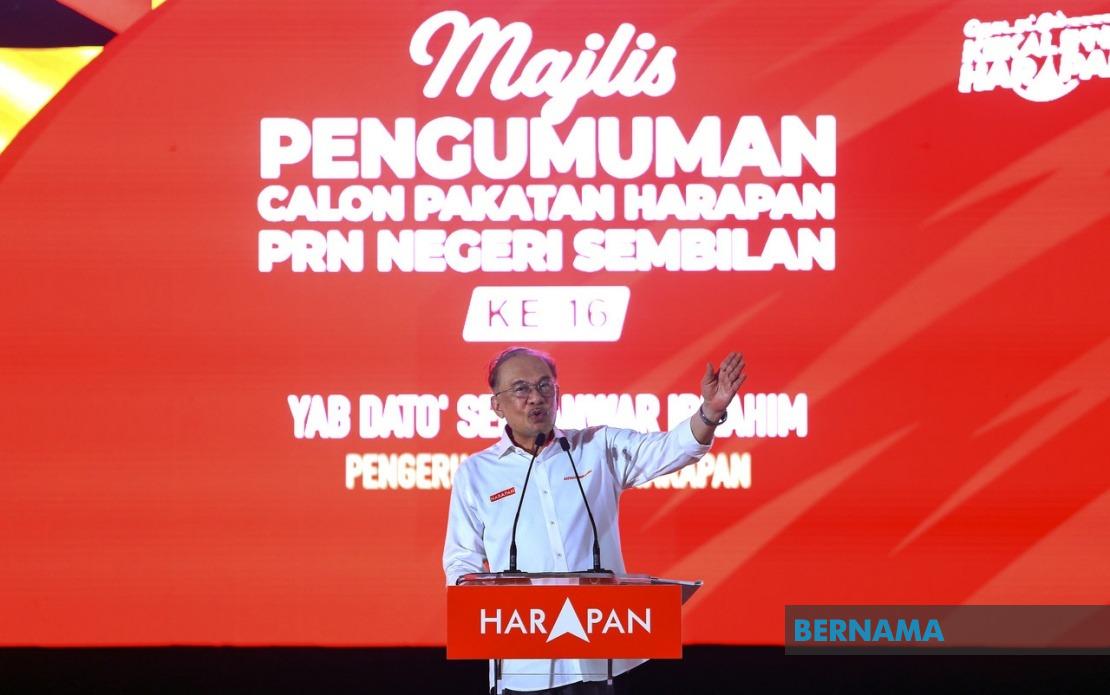
Pakatan Harapan has formally unveiled its candidacy strategy for the 16th Negeri Sembilan State Election, with Prime Minister Datuk Seri Anwar Ibrahim announcing two significant political moves at a coalition rally in Kuala Pilah on July 14. The centrepiece of the announcement is Negeri Sembilan Menteri Besar Datuk Seri Aminuddin Harun's transition to the Linggi constituency, signalling a tactical reshuffling ahead of what analysts expect to be a closely contested state-level contest in one of Malaysia's more politically volatile regions.
Aminuddin's shift to Linggi represents a notable change in the political landscape of Negeri Sembilan. The Menteri Besar, who simultaneously serves as chairman of PH's state chapter, has maintained a commanding grip on the Sikamat seat since 2008, securing it across four consecutive electoral cycles. His repositioning to Linggi—a constituency with its own electoral dynamics—suggests PH's confidence in consolidating its hold on the state while strategically broadening its geographical influence within Negeri Sembilan's legislature.
The coalition's decision to retain DAP secretary-general Anthony Loke in the Chennah seat demonstrates faith in an established performer. Loke, one of DAP's most prominent figures nationally and a senior voice in PH's top councils, has represented Chennah since 2013 and is well-positioned to maintain his legislative foothold. His dual role as a state representative and national party secretary-general underscores the significance PH places on retaining this seat and the symbolic weight Loke carries within the broader coalition framework.
The public unveiling took place at a gathering that drew substantial grassroots support, with thousands of PH sympathisers witnessing the formal candidacy announcement. The presence of senior coalition figures—including Amanah president Datuk Seri Mohamad Sabu, communications director Datuk Seri Fahmi Fadzil, and election director Datuk Seri Amirudin Shari—underscored the strategic importance attached to the Negeri Sembilan contest. The calibre of leadership present signalled that PH views this state election as integral to its broader political consolidation efforts across Malaysia.
For Malaysian political observers, the Negeri Sembilan election carries weight beyond the state's immediate boundaries. The state, historically a bellwether for electoral sentiment, has experienced significant political volatility in recent years. A strong PH performance would reinforce the coalition's recovery narrative following the 2022 general election and strengthen its position heading into potential future national polls. Conversely, a weak showing would provide ammunition to opposition forces questioning PH's electoral viability and internal cohesion.
Aminuddin's track record in Sikamat provides a foundation for optimism about his prospects in Linggi. Winning the same seat four times consecutively reflects substantial personal popularity and organisational strength, though contesting a different constituency always carries inherent uncertainties. The Menteri Besar's ability to translate his executive position and accumulated political capital into victory in an unfamiliar electoral terrain will be closely watched by PH strategists assessing party fortunes across Malaysian constituencies.
Loke's retention in Chennah also reflects DAP's strategic calculations regarding state representation. As a component party within PH, DAP's performance in state elections carries implications for the broader coalition's internal balance and credibility with voters. Loke's experience and national profile can serve as a stabilising force in what may be a contested electoral environment, particularly if opposition parties mount coordinated campaigns to wrest state seats from PH's control.
The timing of this candidacy announcement reflects standard election preparation protocols in Malaysia, where coalitions typically unveil candidates several months before polling day. This advance notice allows nominated candidates to begin ground-level engagement, assess local sentiment, and mobilise party machinery in their respective constituencies. For Aminuddin and Loke, the coming months will involve intensive constituency work to secure voter backing and maintain the organisational momentum PH has built within Negeri Sembilan.
Regionally, the Negeri Sembilan election holds relevance for Southeast Asian political analysts monitoring Malaysia's democratic processes and coalition stability. A successful campaign by PH would further legitimise Anwar's administration's mandate and demonstrate the coalition's capacity to sustain electoral support in state-level contests. The mechanics of this election—encompassing candidate selection, campaign strategy, and voter engagement—offer insights into how Malaysian political coalitions navigate internal decision-making and electoral positioning in the contemporary political climate.
The announcement also carries implications for understanding factional dynamics within PH's state structure. The deliberate positioning of Aminuddin in a new constituency while maintaining Loke's existing seat suggests careful negotiation among coalition partners regarding candidate allocation and seat distribution. Such decisions frequently reflect deeper party discussions about resource allocation, demographic representation, and competitive capacity across different legislative districts within the state.

