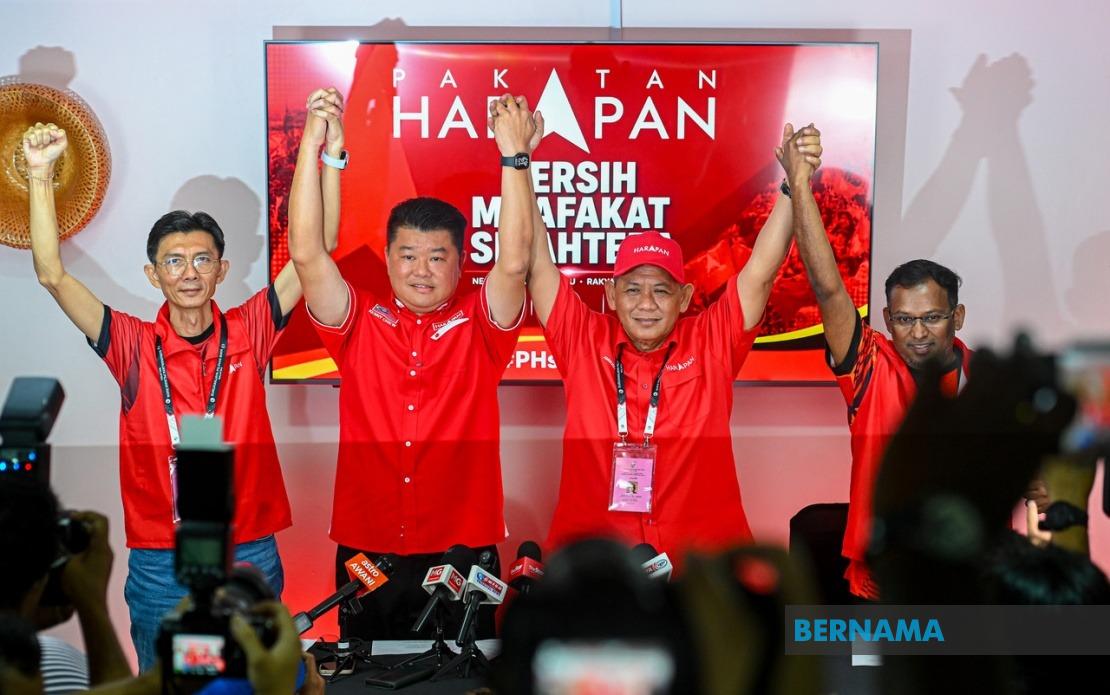
Negeri Sembilan's Pakatan Harapan leadership moved swiftly to quash rumours of internal discord on Saturday, with State chairman Datuk Seri Aminuddin Harun asserting that the coalition's campaign machinery is functioning cohesively across the five constituencies that comprise the Port Dickson parliamentary seat. Speaking at a press conference in Port Dickson, the menteri besar and State PKR chairman rejected suggestions that factional tensions existed among senior coalition figures or that party machinery had fractured ahead of the imminent state election.
Among the five constituencies where Pakatan Harapan is campaigning—Chuah, Lukut, Sri Tanjung, Bagan Pinang, and Linggi—Aminuddin expressed confidence that coordinated efforts would deliver electoral victories for all coalition candidates. He characterised the campaign coordination as robust and well-organised, dismissing what he framed as deliberate attempts by opposition or hostile actors to sow discord and undermine public confidence in the coalition's capacity to govern.
A significant point of contention that had circulated on social media centred on the re-nomination of Chuah's incumbent representative, Datuk Yew Boon Lye. This development had sparked comment particularly from Port Dickson PKR's deputy division chief, Datuk Kenny Chiew Chi Kin, who had reportedly expressed disappointment at not being selected as a candidate himself. Aminuddin confirmed that discussions addressing these concerns had taken place internally within the party structure, and he disclosed that Chiew had subsequently committed to supporting all Pakatan Harapan candidates contesting in the election.
Aminuddin's remarks regarding Chiew reflected an attempt to reframe the deputy division chief's role within the broader coalition narrative. Rather than characterising him as a dissenting voice, Aminuddin praised Chiew's contributions to strengthening the Port Dickson PKR division and acknowledged the personal sacrifice involved in party activism without securing a candidacy. This framing sought to convert a potential liability—internal disappointment over candidate selection—into a narrative of party loyalty and collective commitment to electoral success.
The menteri besar explicitly stated that Chiew's pledge of full support for all coalition-endorsed candidates represented a resolution of the underlying tension. Aminuddin thanked Chiew publicly for his continued commitment to ensuring that Pakatan Harapan would secure all five state seats within the Port Dickson parliamentary constituency, thereby normalising the deputy division chief's position within party machinery and signalling unity to external observers and party members alike.
Among the constituencies, the Chuah seat represents a particular focus, given that Yew had successfully defended it during the 2023 state election against Perikatan Nasional's Tang Jay Son with a majority of 6,298 votes. In the upcoming contest, Yew will confront a different challenger in Barisan Nasional's Pau Jeou Ching, marking a shift in the opposition lineup and potentially altering the electoral dynamics in what has historically been a competitive seat. The transition from facing Perikatan Nasional to confronting Barisan Nasional also reflects broader coalitional shifts within Malaysian politics, where the Perikatan alliance's influence in state-level contests has fluctuated.
Aminduddin's insistence that speculation about internal divisions had been deliberately manufactured illuminates the sensitivity surrounding coalition cohesion during election cycles. Political coalitions in Malaysia frequently face scrutiny regarding their internal stability, particularly when multiple parties with distinct organisational structures and interests must coordinate campaign strategies and candidate selection processes. Public perception of unity or division can materially affect voter confidence and turnout, making management of such narratives a crucial component of campaign strategy.
The timing of Aminuddin's intervention—roughly two weeks before polling day—reflects standard campaign management practice in consolidating messaging and preempting negative narratives. By publicly acknowledging the issue while simultaneously resolving it, the coalition leadership attempted to prevent the story from dominating media coverage during the critical final weeks before voters went to the polls. This proactive stance contrasts with allowing such tensions to simmer and potentially metastasize into more significant fractures.
For Malaysian observers and those tracking Negeri Sembilan politics, the episode illustrated how candidate selection processes—ostensibly technical party matters—can generate ripples affecting broader perceptions of coalition stability. The relative swiftness with which internal mechanisms resolved the Chiew matter and secured his public support suggests that coordination structures within Pakatan Harapan's Negeri Sembilan operations remained functional, though the fact that such tensions surfaced publicly on social media indicated that dissatisfaction could not be entirely contained within party channels.
Election day is scheduled for August 1, with early voting occurring on July 28. The outcome of the Port Dickson constituencies, particularly Chuah where Yew faced new opposition, would provide concrete indicators of whether Pakatan Harapan's claimed unity translated into electoral performance, or whether underlying organisational tensions had affected campaign effectiveness and voter mobilisation.

