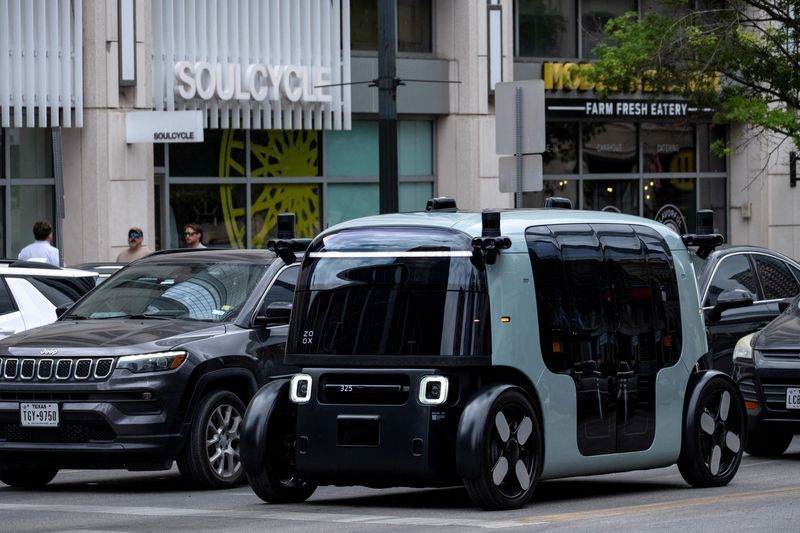
Amazon's autonomous vehicle subsidiary Zoox commenced charging passengers for robotaxi rides in Las Vegas this week, marking a significant milestone in the commercialisation of fully driverless transportation. The launch follows regulatory clearance from the U.S. National Highway Traffic Safety Administration, which granted Zoox an exemption from federal rules mandating human controls—a distinction that positions the company ahead of competitors still operating modified conventional vehicles.
Zoox's distinctive electric vehicle, characterised by its carriage-style design with two rows of passenger seats facing inward, has undergone extensive real-world testing across four major American cities. Prior to entering the paid phase, the company accumulated substantial operational data by offering complimentary rides to passengers in Las Vegas, San Francisco, Austin, and Miami. This gradual approach to commercialisation reflects the capital-intensive and cautious nature of autonomous vehicle development, where safety validation and public acceptance remain paramount concerns for regulators and operators alike.
The Las Vegas rollout represents a critical inflection point in the robotaxi sector, where multiple technology giants are racing to establish market dominance. Alphabet's Waymo has already established paid driverless services across several metropolitan areas, while Tesla has begun introducing its autonomous offering to consumers. Zoox's commercial entry intensifies this competitive landscape, forcing each operator to balance rapid scaling with stringent safety standards and regulatory compliance.
Zoox has positioned its Las Vegas service at pricing levels comparable to premium ride-hailing tiers, typically commanding fares 20 to 40 percent above conventional ride-sharing options. This premium pricing strategy aligns with the vehicle's distinctive design and operational characteristics, allowing the company to offset higher operational costs while establishing brand positioning around quality and comfort. The company has committed to transparent fare structures, with pricing based on base fares plus time and distance calculations routed optimally, and any supplementary charges for specific destinations disclosed in advance to riders.
The NHTSA exemption granted to Zoox carries substantial significance for the autonomous vehicle industry, as it represents the first formal approval for commercial deployment of a purpose-built driverless vehicle. However, this clearance comes with notable constraints, limiting Zoox to deploying no more than 2,500 vehicles annually across each of the next two years. These restrictions reflect regulators' cautious approach, allowing commercial operation whilst maintaining oversight mechanisms and containing potential risks.
Regulatory approval, though groundbreaking, does not eliminate safety scrutiny or operational challenges. The NHTSA determined that Zoox's vehicle meets safety standards equivalent to conventionally controlled vehicles, yet imposed additional reporting obligations regarding incidents such as collisions and inappropriate road stops. These requirements acknowledge that fully autonomous systems operate in fundamentally different ways than human-driven vehicles, necessitating novel oversight approaches that capture data regulators have not traditionally collected.
The robotaxi sector continues facing considerable challenges centred on vehicle behaviour in complex driving scenarios. Emergency response situations represent a particularly acute concern, where autonomous systems must navigate unclear rules of engagement, interact appropriately with first responders, and make real-time decisions under uncertainty. Zoox has publicly disclosed multiple software updates addressing detected deficiencies, including a notable July recall following an incident where one vehicle failed to identify heavy smoke at an emergency scene—a scenario that underscores the technical hurdles remaining before autonomous systems can reliably match human driver judgment.
For Southeast Asian observers, the Las Vegas commercial launch carries implications for regional autonomous vehicle development timelines. Malaysia and neighbouring countries, which are gradually establishing frameworks for autonomous vehicle testing and deployment, can examine Zoox's regulatory journey and operational approach. The company's staged rollout strategy, combining extended testing phases with clearly bounded commercial deployment, offers a template that regional regulators and investors might consider when designing their own autonomous vehicle governance structures.
Zoox did not announce timelines for expanding paid services beyond Las Vegas, leaving substantial uncertainty about the company's broader commercialisation strategy. This measured expansion approach contrasts with Waymo's broader geographic presence, suggesting Zoox prioritises operational perfection and safety accumulation in specific markets before pursuing wider deployment. The strategic decision to concentrate initial commercial efforts reflects lessons learned from previous autonomous vehicle ventures and acknowledgement that premature scaling can undermine long-term viability.
The autonomous ride-hailing sector's evolution toward commercial viability remains heavily dependent on demonstrating sustained safe operation across diverse conditions and extensive vehicle fleets. Zoox's Las Vegas entry represents progress toward this objective, yet the path toward mainstream adoption remains lengthy and uncertain. Regulatory frameworks continue developing, public acceptance varies significantly across demographics, and technical challenges—particularly in edge cases and emergency situations—require ongoing refinement. As Zoox scales its paid operations, the company will generate increasingly valuable data regarding real-world autonomous vehicle performance, contributing to the broader industry's understanding of what full commercialisation ultimately requires.

