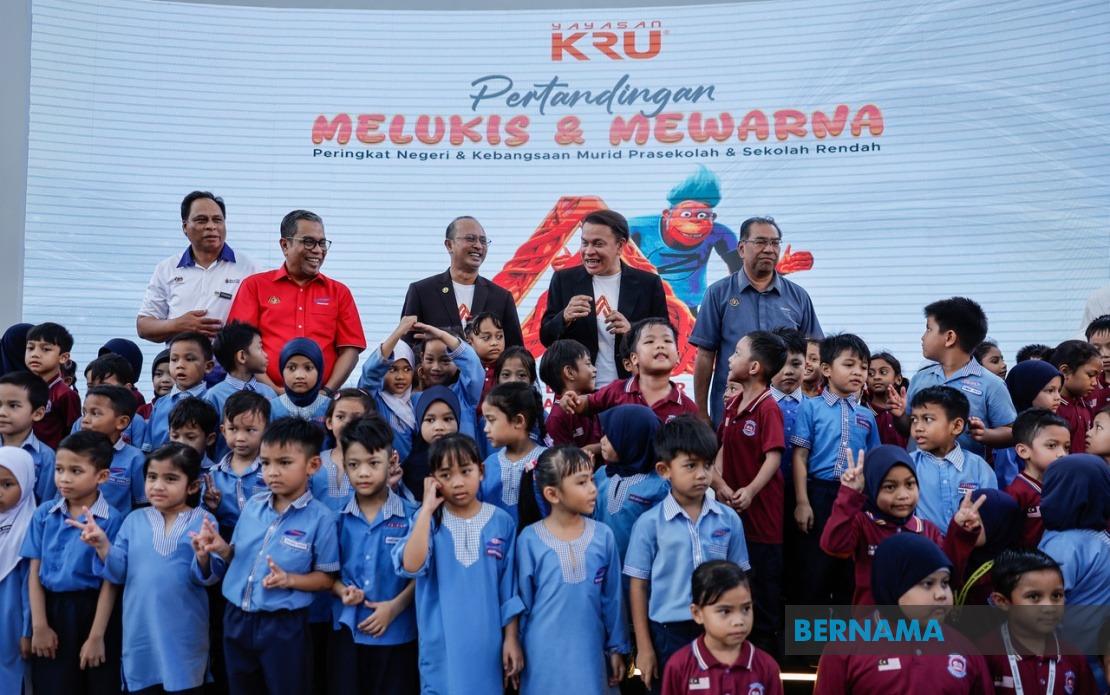
A creative competition targeting preschool children has etched its name into Malaysia's record books, drawing an unprecedented 153,000 participants from kindergartens nationwide. The 2026 Kreatif Aspirasi Reka (AKAR) Awards, orchestrated by Yayasan KRU, secured recognition from the Malaysia Book of Records (MBOR) for hosting the country's largest nationwide colouring competition involving young learners. The simultaneous rollout across the nation represented a logistical achievement that underscored the growing appetite for structured creative activities among Malaysia's youngest demographic.
Yayasan KRU Board of Trustees president Datuk Norman Abdul Halim described the milestone as historic, emphasising that the success stemmed from collaborative efforts involving multiple government bodies and educational institutions. Speaking after the official launch in Shah Alam, he highlighted how the initiative extended beyond mere artistic expression, integrating environmental stewardship into its core messaging. The programme emerged from a carefully coordinated partnership spanning the National Higher Education Fund Corporation (PTPTN), the Education Ministry (MOE), the Community Development Department (KEMAS), and the Department of National Unity and National Integration (JPNIN).
The competitive structure incentivised participation at multiple levels, with cumulative prize money reaching approximately RM100,000 distributed across state and national rounds. Top performers from individual states earned advancement to the national finals scheduled for August 29 in Putrajaya, where they would contend for the highest awards. Winners at all tiers would receive prizes credited directly into their National Education Savings Scheme (SSPN) accounts, a mechanism that combined immediate recognition with long-term financial benefit for participating families.
The environmental dimension constituted a significant component of AKAR 2026's narrative architecture. Through the "I Love Orangutans" campaign, organisers wove conservation messaging into the artistic activity, exposing preschool-aged children to ecological concerns during formative developmental stages. This integration reflected broader global trends toward embedding sustainability education into early childhood programmes, positioning Malaysia alongside international best practices in holistic child development.
KEMAS director-general Datuk Mohd Hanafiah Man contextualised the initiative within contemporary workforce demands, arguing that creativity represented an essential competency for future economic participation. His remarks underscored official recognition that traditional pedagogical approaches required augmentation with creative problem-solving capabilities. The involvement of KEMAS facilities—which serve as primary educational touchpoints for many Malaysian families—ensured geographically inclusive access, particularly benefiting communities in less developed regions.
The scale of participation raised questions about resource allocation and capacity building within preschool institutions. Managing 153,000 simultaneous submissions demanded substantial coordination infrastructure, from collection mechanisms to judging procedures to record-keeping. The successful execution suggested maturation in Malaysia's institutional capacity for managing large-scale youth programmes, a capability increasingly relevant as digital-era initiatives scale to national proportions.
Financial incentivisation through SSPN accounts represented a nuanced policy approach, linking artistic achievement to educational savings mechanisms. Rather than awarding cash prizes directly—which might prove ephemeral—crediting accounts created lasting value while reinforcing the connection between creativity and education. This structure aligned with broader government initiatives promoting long-term financial discipline among young Malaysians.
The involvement of JPNIN in the competition's governance reflected official prioritisation of national unity objectives during early childhood stages. Educational initiatives engaging diverse demographic groups simultaneously contributed toward social cohesion, particularly when framed around shared creative endeavours rather than divisive themes. The department's participation signalled recognition that cultural and linguistic unity building could occur through aesthetic experiences alongside more traditional mechanisms.
Regional implications warranted consideration, as AKAR 2026's achievement established benchmarks other Southeast Asian nations might reference when designing comparable programmes. Malaysia's competitive landscape increasingly centred on positioning itself as a regional innovation and creativity hub, and youth-oriented initiatives provided tangible evidence of such positioning. The MBOR recognition translated into international-calibre validation of local achievements.
The programme's structure across KEMAS and Unity kindergartens ensured representation from both government-subsidised and private early education sectors, reflecting Malaysia's mixed educational ecosystem. This dual-sector engagement demonstrated that large-scale national initiatives could function across institutional boundaries when proper coordination frameworks existed, a lesson applicable to future cross-sector collaborative efforts.
For Malaysian parents and educators, AKAR 2026 illustrated growing official recognition that preschool years deserved investment beyond basic childcare functions. The competition signalled that creative development warranted the same institutional attention as literacy and numeracy, potentially influencing parental expectations regarding educational quality and enrichment opportunities. The MBOR recognition provided tangible validation that Malaysian preschool experiences could achieve world-class standards.
Looking forward, the competition's success established precedent for larger creative initiatives targeting other age groups or demographic segments. The mechanisms developed for managing 153,000 participants provided transferable models for future programmes, whether environmental conservation, cultural heritage, or digital literacy campaigns. The documented achievement would likely serve as template for scaling similar initiatives nationally and potentially regionally, contributing to Malaysia's reputation as a capable administrator of youth-oriented programmes.

