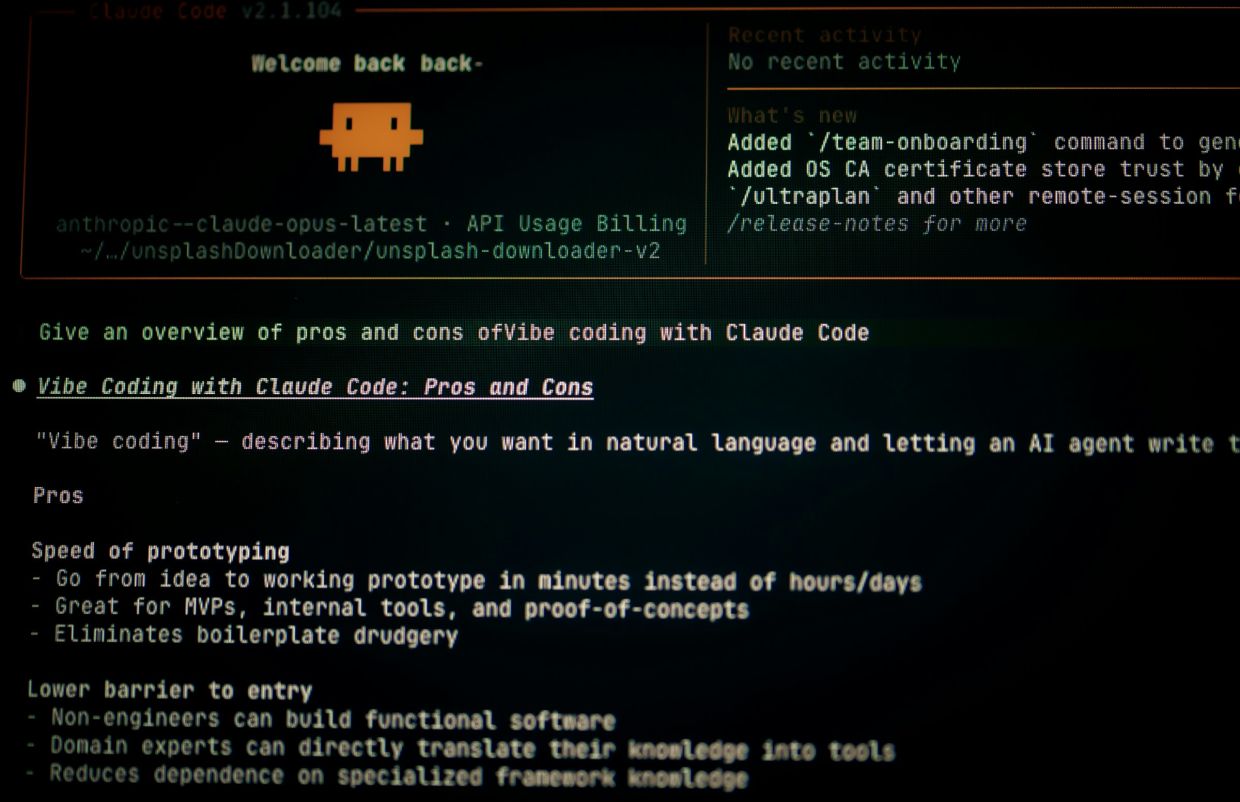
The technology sector is undergoing a fundamental restructuring of its workforce as artificial intelligence coding assistants fundamentally alter how software gets built and who gets hired to build it. Rather than recruiting large teams of junior developers to handle routine coding tasks, startups increasingly prefer experienced architects who can leverage AI tools to amplify their output—a shift that is quietly erasing the entry-level opportunities that have long served as the gateway into programming careers across the industry.
Companies deploying advanced coding platforms such as Anthropic's Claude Code and OpenAI's Codex are discovering that a handful of skilled developers armed with AI assistance can accomplish what previously required substantially larger workforces. This transformation fundamentally redefines the programming profession itself, converting developers from individuals who manually write and debug code line by line into project managers and architects who use natural language prompts to generate, test, and refine entire software systems instantaneously. The economic incentive to adopt this approach is overwhelming—premium AI subscriptions cost roughly US$200 per month, a trivial expense compared to the US$100,000 annual salary of a mid-level developer.
The adoption curve is accelerating with striking speed across the startup ecosystem. According to Jared Friedman, Managing Partner at Y Combinator, a quarter of startups in the Winter 2025 batch were constructed using code that was 95 percent AI-generated, signalling a wholesale transformation of development practices within the world's most influential startup accelerator. Beyond Y Combinator, founders across the sector report similar experiences, with experienced engineers deliberately choosing to expand the capabilities of existing team members rather than hiring new ones. Haitham Mengad, co-founder of Stems Labs, exemplified this philosophy by deliberately keeping his engineering team lean and enhancing their productivity through AI rather than pursuing traditional growth through headcount expansion.
The financial implications are staggering for company balance sheets. Lindsay Euller, vice president of customer success at software company Espresa, stated her organization is realizing millions of dollars in annual savings through AI-driven development efficiencies. This cost structure is creating powerful psychological and financial pressure on hiring decisions throughout the sector. Euller noted that future requests for additional headcount will increasingly be challenged with demands to justify why AI optimization could not achieve the required outcomes, fundamentally inverting the burden of proof in hiring conversations and making it substantially harder for teams to justify adding personnel.
Yet beneath these efficiency gains lies a troubling employment crisis for early-career programmers. Research from Stanford's Digital Economy Lab examining payroll records across millions of United States workers reveals that employment among 22- to 25-year-olds in AI-exposed occupations, particularly software development, has contracted nearly 20 percent from its late 2022 peak. A parallel study conducted by Harvard researchers analyzing resume and job posting data spanning 62 million workers across 285,000 firms found that junior employment at companies that have adopted generative AI dropped approximately nine percent relative to firms that have not adopted these technologies, all within a span of six quarters. Simultaneously, senior-level employment at AI-adopting firms continued rising, creating a bifurcated market where experienced developers thrive while beginners struggle to secure initial positions.
The psychological impact extends beyond mere statistics. Ian Amit, CEO of cybersecurity startup Gomboc AI, reported widespread hiring paralysis across the sector as companies interview multiple candidates but hesitate to make actual employment commitments. This hesitation reflects fundamental uncertainty about workforce requirements in an AI-augmented development environment, leaving countless junior programmers suspended in an elongated recruitment process without clear outcomes or timelines.
Not all industry leaders accept this trajectory as inevitable or desirable. Matt Garman, CEO of Amazon Web Services, has publicly characterized the strategy of replacing junior developers with AI as fundamentally misguided, arguing that such an approach undermines the industry's capacity to develop future leaders and innovators. Garman's concerns carry particular weight given AWS's position at the infrastructure foundation of the cloud computing sector, suggesting that even major technology establishment figures recognize risks in the current trajectory.
Educational institutions are already responding to these market signals. Computer science enrollments have begun declining across the country, dropping six percent within the University of California system alone and falling across two-thirds of computing programs nationwide according to the Computing Research Association. This decline suggests that prospective students are recognizing diminished entry-level opportunities and choosing alternative career paths, creating a potential supply-side constraint that could eventually moderate the rush to eliminate junior positions.
For Southeast Asian technology communities, these trends carry particular significance. Malaysia, Singapore, and other regional tech hubs have increasingly positioned themselves as alternatives to higher-cost Silicon Valley and established development centers. However, the AI-driven consolidation of engineering talent toward experienced architects threatens the region's strategy of competing on cost while building technical expertise. If multinational companies can operate with skeleton crews augmented by AI, the comparative advantage of lower Southeast Asian salaries diminishes substantially, potentially redirecting investment and opportunity flows away from the region's emerging technology sectors.
The underlying economic logic driving this transformation appears structurally resilient and unlikely to reverse. Startups operating in hypergrowth mode face constant trade-offs between deploying capital toward product development and people-intensive expansion. With AI tools demonstrating concrete efficiency improvements measured in millions of dollars annually, the financial incentive to prioritize technology over human headcount remains overwhelming. Lauer, articulating the mindset of contemporary founders, framed this as an ongoing calculation rather than a settled decision, but the economic weight consistently tilts toward smaller, more efficient teams.
The technology sector's embrace of AI-powered development represents a genuine productivity revolution, enabling smaller organizations to execute more ambitious projects than previously possible. However, this efficiency comes coupled with a generational opportunity deficit that threatens the traditional pathway through which young programmers have entered and advanced within their profession. As the sector continues optimizing away entry-level positions, the industry risks creating a talent pipeline crisis that could eventually constrain long-term innovation and growth—consequences that may take years to fully materialize even as hiring patterns shift dramatically in real-time.

