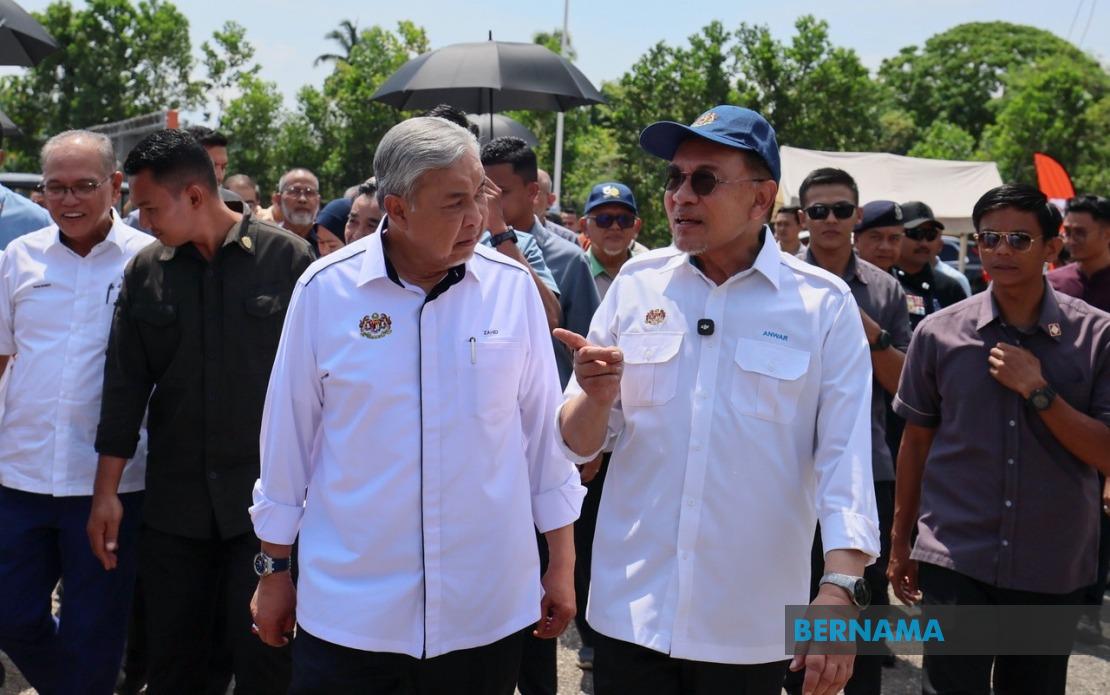
Deputy Prime Minister Datuk Seri Dr. Ahmad Zahid Hamidi has put forward a proposal to return segments of land currently under FGV Holdings Berhad to the Federal Land Development Authority, marking a significant shift in how Malaysia manages one of its oldest and largest agricultural institutions. Speaking at FELDA's 70th anniversary celebration in Maran, Ahmad Zahid outlined the reasoning behind the restructuring idea, suggesting that placing plantation management directly back into FELDA's hands could unlock financial benefits that have eluded the organisation under the existing arrangement.
As Minister of Rural and Regional Development, Ahmad Zahid framed the initiative within a broader strategy to fortify FELDA's deteriorating financial foundations. He articulated a straightforward logic: if FELDA regains direct operational control of its plantations rather than relying on FGV as an intermediary manager, the organisation could streamline decision-making, reduce administrative overhead, and channel more revenue toward the primary objective of settler welfare. The proposal reflects mounting pressure on the government to address longstanding complaints from FELDA settlers whose incomes have stagnated despite Malaysia's economic growth, particularly as oil palm prices have fluctuated and global sustainability pressures have mounted on the sector.
The financial scale of FELDA's challenges has become increasingly difficult to ignore. Prime Minister Datuk Seri Anwar Ibrahim disclosed that the Federal Government currently allocates nearly RM1 billion annually to support FELDA operations and settler welfare, a burden that underscores the severity of the organisation's structural difficulties. According to government projections outlined by Anwar, FELDA would require at least nine years of sustained federal assistance to restore itself to financial health—a timeline that highlights the depth of mismanagement from earlier decades. Ahmad Zahid's endorsement of this timeframe suggests broad agreement within the cabinet that reversing FELDA's decline will demand patience and substantial ongoing investment.
The proposal carries particular significance because it acknowledges that the FGV arrangement, established with intentions to modernise FELDA's operations, has not delivered the promised benefits to grassroots settlers. FGV, originally structured as a corporate vehicle to manage FELDA's assets more efficiently, has instead created an additional layer of administration that critics argue extracts value away from those it was meant to serve. By suggesting a return to direct FELDA management, Ahmad Zahid is implicitly admitting that this corporatisation strategy fell short, though he framed the move constructively as an efficiency improvement rather than a reversal of failed policy.
The welfare of three generations of FELDA settlers—original scheme participants, their children, and grandchildren—has become a political flashpoint, particularly as rural constituencies have grown more vocal about agricultural stagnation. Ahmad Zahid emphasised that government priority must encompass all three generations, acknowledging that FELDA settlements have become multigenerational communities with distinct economic needs. Original settlers approaching retirement require assured income protection, while younger generations often pursue education and off-farm employment, creating expectations that FELDA provide either competitive agricultural incomes or transition support.
Parallel to the plantation restructuring proposal, Ahmad Zahid outlined efforts to address immediate liquidity crises affecting FELDA members through its cooperative arm, Koperasi Permodalan FELDA. The cooperative faces mounting redemption requests from members whose KPF share values have eroded due to declining dividend yields driven by weakness in stock and property markets. Approximately RM350 million is required to satisfy pending redemptions from members who purchased shares expecting returns that never materialised. Many KPF members had borrowed against their properties or liquidated assets to acquire these shares, viewing them as secure investments backed by FELDA's land holdings.
The government's decision to restructure KPF assets and facilitate share redemptions by year-end reflects recognition that cooperative members represent politically sensitive constituencies who feel betrayed by weak returns. Ahmad Zahid presented the restructuring effort as a social safety measure targeting vulnerable members who made financially consequential decisions based on expectations that were not met. This acknowledgement of responsibility suggests the government views KPF's underperformance not merely as a market outcome but as a policy failure requiring corrective intervention.
The FGV proposal must be understood within Malaysia's broader struggle to maintain viability of agricultural schemes established in the 1950s and 1960s when land distribution and rural development were central to post-independence nation-building. As global palm oil markets have matured, prices have become more volatile, and environmental regulations have tightened, smallholder schemes like FELDA have faced unprecedented pressure. The original model—providing land, basic infrastructure, and management support to rural families—assumes relatively stable commodity prices and modest regulatory requirements, conditions that no longer exist.
Regional context adds weight to FELDA's predicament. Across Southeast Asia, state-sponsored agricultural settlements face similar challenges of aging populations, declining youth interest in farming, and pressure to modernise governance structures. Indonesia's transmigration schemes, Thailand's agricultural cooperatives, and the Philippines' land reform programs all grapple with analogous tensions between maintaining social safety nets for original beneficiaries and creating commercially viable enterprises. Malaysia's willingness to contemplate restructuring suggests acknowledgment that incremental reforms are insufficient.
The proposal also intersects with Malaysia's climate and sustainability commitments. As international buyers increasingly demand verified sustainable palm oil and environmental accountability, large integrated operations like FELDA-managed plantations face scrutiny that individual smallholders might avoid. Direct FELDA management could theoretically enable more systematic implementation of sustainability standards that enhance market access and premium pricing, though execution would depend on technical capacity and investment in certification systems.
From an economic standpoint, the land return proposal raises questions about how asset allocation would actually function. FGV presumably holds valuable plantation properties under management contracts; transferring these back to FELDA would require negotiated agreements addressing compensation, liability transfers, and operational continuity. The logistics and political economy of such transfers remain unspecified, suggesting the proposal is currently at a conceptual stage rather than an advanced policy framework.
The timing of these announcements—during FELDA's anniversary celebration with Prime Minister Anwar present—signals top-level commitment to addressing what successive governments have recognised as a chronic drain on national resources. However, the gap between acknowledging FELDA's problems and implementing sustainable solutions remains substantial. Ahmad Zahid's proposal addresses symptoms of financial distress rather than systemic questions about whether commodity-dependent smallholder schemes can remain viable in modern markets without continuous subsidy.
Looking forward, these proposals will be tested against implementation realities. Whether returning FGV-managed land to FELDA can genuinely accelerate debt settlement depends on whether direct management actually reduces costs and increases yields—outcomes not guaranteed by organisational restructuring alone. Similarly, KPF asset restructuring can resolve immediate redemption pressures but addresses neither the fundamental dividend problem nor the question of why cooperative members continue purchasing shares in underperforming entities. The government's nine-year recovery timeline acknowledges that FELDA's restoration requires sustained commitment, making these policy choices enduring rather than temporary interventions in Malaysian rural development strategy.

