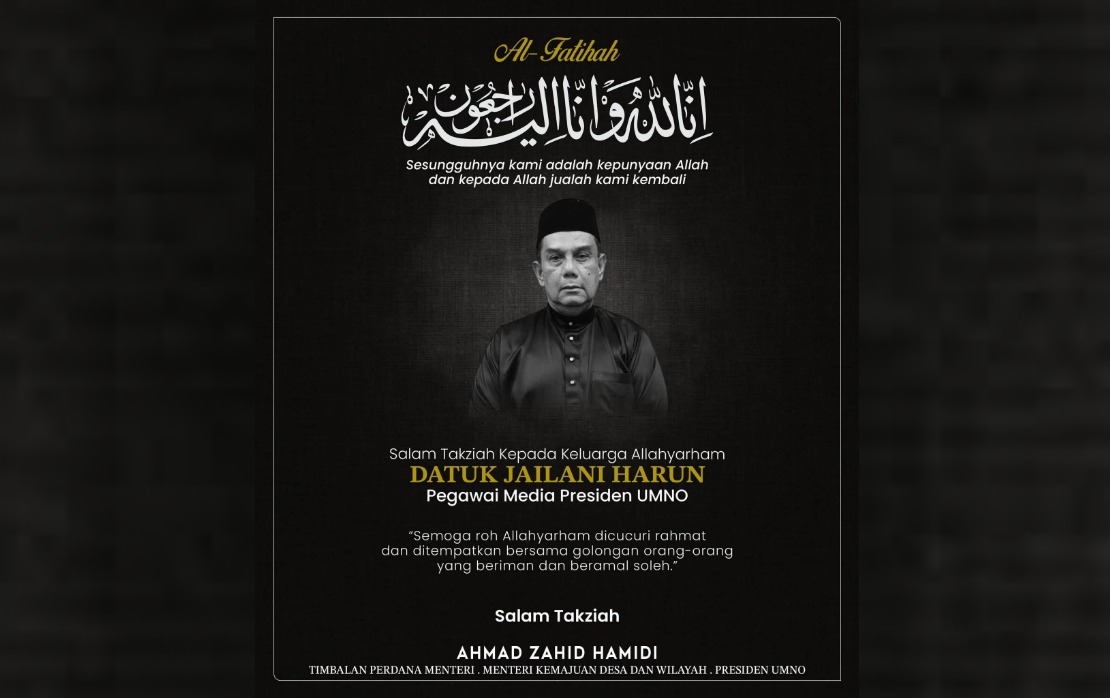
Deputy Prime Minister Datuk Seri Dr Ahmad Zahid Hamidi has extended his sympathies to the bereaved family of Datuk Jailani Harun, a prominent figure in Malaysian journalism and communications who died on July 7. The UMNO president, in a statement posted on social media, reflected on his personal connection to the deceased and acknowledged the significant loss to his immediate family and the wider political establishment.
Ahmad Zahid revealed that he had made an early morning visit to Jailani at Serdang Hospital, where the veteran media professional was receiving treatment before his death at 11.34 am. During that final encounter, the Deputy Prime Minister observed the gravity of Jailani's condition and described the experience as emotionally difficult, noting that he had held onto hope for a recovery that ultimately did not materialise.
The Deputy PM's tribute characterised Jailani as an individual distinguished by personal integrity and humility. These qualities, combined with his professional expertise accumulated over decades in the journalism sector, had earned him considerable respect among colleagues and peers within political and media circles. Ahmad Zahid's choice to publicly acknowledge these attributes underscored the esteem in which Jailani was held at senior levels of the UMNO hierarchy, where he had served as a media officer attached to the party president's office.
Jailani's career trajectory embodied a significant chapter in Malaysia's evolving media landscape. Having worked as a journalist before transitioning into formal communications roles, he represented a bridge between the newsroom and political institutions—a position that requires both credibility in reporting and institutional loyalty. Such individuals play crucial roles in shaping the interface between government communications and public understanding of political developments.
In his condolence message, Ahmad Zahid invoked Islamic prayers for the deceased, seeking divine forgiveness for Jailani's transgressions and expressing hope that he would be counted among the righteous in the afterlife. This spiritual dimension reflected the cultural and religious context in which Malaysian political figures typically express grief and acknowledge mortality.
Jailani was 66 years old at the time of his passing, suggesting he had reached the latter stages of a lengthy professional career. His age and health circumstances, while not detailed in the available information, indicate he was among the generation of Malaysian communicators who had witnessed and participated in the country's political transformations over several decades.
The funeral arrangements proceeded with traditional Islamic rites, with the burial scheduled to take place at Alam Damai Muslim cemetery in Cheras following asar prayers. This location, situated in the Kuala Lumpur metropolitan area, would have been accessible to colleagues, family members, and associates wishing to pay their final respects during the funeral service.
Jailani's passing represents another milestone in the generational transition occurring within UMNO and Malaysia's political establishment more broadly. Media officers and communications professionals occupying positions within the upper echelons of political parties often accumulate institutional knowledge and personal networks that extend across multiple political cycles and administrations. The loss of such figures can create gaps in organisational memory and practical communications capacity.
The timing of Ahmad Zahid's public acknowledgment of Jailani's death, delivered through contemporary social media channels rather than traditional press statements alone, reflects how Malaysian political communications have evolved. Such expressions of condolence now typically reach audiences instantaneously and generate their own commentary and sharing across digital platforms, amplifying the reach of tributes beyond traditional news cycles.
For Malaysian readers observing political institutions and personalities, Jailani's death underscores the human dimensions beneath institutional structures. The Deputy Prime Minister's personal visit to the hospital and his emotional reflection on that encounter humanise the often formal and procedural nature of political life at senior levels. These personal touches in political communications, when conveyed authentically, can influence public perceptions of leadership character and values.
The loss also prompts reflection on the importance of institutional continuity and succession planning within political parties. Media and communications officers serve as custodians of party narratives, historical records, and established relationships with media outlets. Their retirement or, as in this case, unexpected passing, necessitates deliberate efforts to transfer knowledge and maintain organisational effectiveness in political communications.
As Malaysian politics continues to navigate complex domestic and regional challenges, the passing of experienced communicators like Jailani Harun serves as a reminder of the diverse expertise required to manage modern political institutions. From managing media relations to crafting public messages, these professionals contribute substantially to the functioning of political organisations, even when their work often occurs behind public view.

