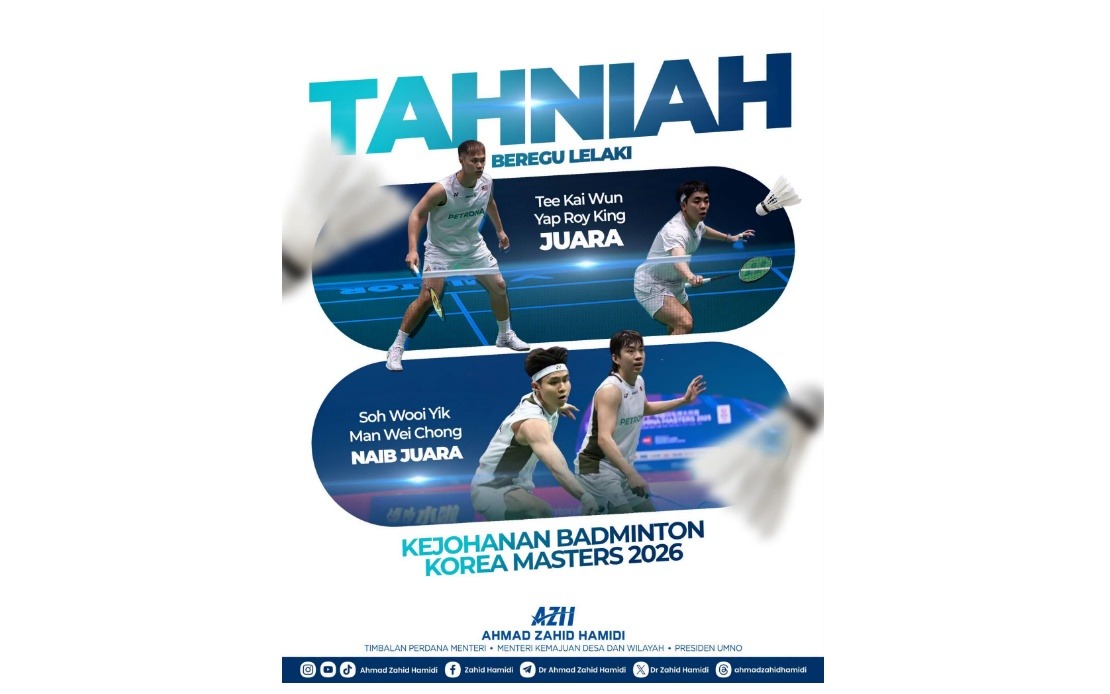
Deputy Prime Minister Datuk Seri Dr Ahmad Zahid Hamidi has expressed his congratulations to two Malaysian men's doubles badminton partnerships following their remarkable showing at the 2026 Korea Masters Badminton Championships, which concluded at the Yi Sun-sin Gymnasium in Asan. The achievement marks a significant moment for Malaysian badminton on the international circuit, with both domestic pairings reaching the final stages of the tournament and showcasing the depth of talent within the country's doubles contingent.
Tee Kai Wun and Yap Roy King emerged triumphant in their Korea Masters debut, securing the championship title with a decisive victory over fellow Malaysians Soh Wooi Yik and Man Wei Chong. The champions recorded a commanding performance that lasted just 31 minutes, claiming the crown with a scoreline of 21-13, 21-18. This result demonstrated not only the calibre of Malaysian doubles play but also the competitive intensity that exists within the national programme, where top pairings are pushing each other to elite levels of performance.
The runners-up finish by Wooi Yik and Wei Chong, whilst not capturing the title, represents an exceptional outcome that underscores Malaysia's current strength in men's doubles badminton. The pairing's progression to the final stages of a prestigious international tournament provides valuable competition experience and exposure on the global stage. Their performance also reflects the strategic development of fresh partnerships within the national badminton ecosystem, ensuring continuity and sustainability of Malaysia's competitiveness in this discipline.
Ahmad Zahid has framed these achievements as encouraging indicators for Malaysian badminton's trajectory on the world stage. In his statement released through social media, he emphasised that such triumphs serve as motivation for the players to maintain their upward momentum and continue delivering success for the nation. The deputy prime minister's public acknowledgement underscores the government's recognition of badminton as a significant contributor to Malaysia's international sporting reputation.
The Korea Masters victory for Kai Wun and Roy King carries particular significance given that it represents their inaugural appearance at this prestigious tournament. Emerging as champions in their debut demonstrates the tactical maturity and technical proficiency of this newly formed pairing. Such immediate success at the elite level suggests that the partnership has already reached a competitive standard matching established international combinations, boding well for their future prospects in world badminton rankings and major tournaments.
Malaysia's historical record at the Korea Masters also adds context to these latest achievements. The nation has previously captured the men's doubles title at this championship, with Soh Wooi Yik partnering Aaron Chia to claim the crown in 2024. The back-to-back success, separated by just two years, reinforces Malaysia's established position as a powerhouse in doubles badminton. This trajectory suggests that Malaysian badminton authorities have developed systematic approaches to talent identification, partnership formation, and competitive preparation that yield consistent results at prestigious international venues.
The significance of having two Malaysian pairs contested in the Korea Masters final carries implications beyond the immediate medals won. It demonstrates that the national badminton system has not relied upon single dominant partnerships but instead cultivated multiple capable combinations capable of performing at the highest level. This depth provides strategic flexibility for selection to major tournaments and ensures that Malaysia maintains competitive capacity across different partnership combinations, reducing vulnerability to injury or loss of form of any individual pairing.
From a Southeast Asian perspective, Malaysia's dominance in men's doubles badminton at international tournaments reinforces the region's badminton heritage. The success of Malaysian pairings serves to elevate the profile of badminton across Southeast Asia and maintains the region's competitive standing against established powerhouses from East Asia and Europe. These achievements attract international attention and investment in the sport within the region.
Ahmad Zahid's public commendation also reflects broader government priorities regarding sports excellence and athlete development. By highlighting the achievements of these badminton partnerships, the deputy prime minister signals the administration's commitment to supporting sports programmes that deliver international success. Such political backing often translates into continued resource allocation and institutional support for badminton development, benefiting the entire ecosystem of coaching, infrastructure, and athlete welfare.
Looking forward, the momentum generated by these Korea Masters successes provides a platform for Malaysian badminton to build towards major tournaments on the international calendar. The confidence and match experience gained by both pairings, particularly the triumphant Kai Wun-Roy King combination, will inform their preparation for other significant championships. These victories also serve to attract attention from young emerging players aspiring to develop doubles combinations capable of competing at world-class levels.
The psychological impact of achieving success at a tournament of Korea Masters' calibre should not be underestimated. International badminton competitions at this level test not merely technical and physical attributes but also mental resilience and tactical decision-making under pressure. The fact that Malaysian pairings have performed successfully in these demanding circumstances indicates readiness for continued competition at prestigious venues and suggests that Malaysian badminton has strengthened its competitive foundations.

