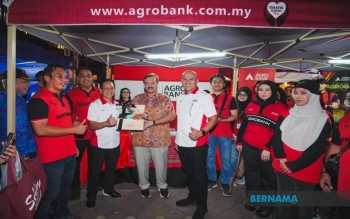
Agrobank's direct outreach to small traders is gaining traction, with the agricultural development bank reporting financing applications exceeding RM8 million through its series of engagement sessions with hawkers and micro-entrepreneurs. The initiative represents a deliberate shift toward bringing financial services to where traders operate, rather than requiring them to navigate traditional banking channels. This approach resonates strongly with the government's broader agenda of democratising access to capital for Malaysia's informal and semi-formal economy, a sector that has historically faced barriers in securing working capital and expansion funding.
The bank recently expanded its ground-level engagement strategy beyond the Klang Valley into Sabah, conducting sessions at two key commercial hubs: the Api-Api Night Market on Jalan Gaya in Kota Kinabalu and the Papar Tamu Farmers' Market. The selection of these venues underscores a deliberate strategy to embed financial advisory directly into economic spaces where small traders already congregate. Night markets and farmers' markets function as vital arteries of local commerce across Malaysia, particularly in tier-two cities and towns where formal financial infrastructure may feel distant or intimidating to small business operators.
The Api-Api Night Market session alone engaged 153 hawkers and entrepreneurs, whilst the Papar meeting drew 95 traders. These numbers suggest substantial participation, indicating that traders recognise the value of tailored financial conversations. The sessions specifically zeroed in on identifying working capital needs and financing options to support business expansion—the two most immediate constraints typically facing micro-enterprises trying to scale operations or smooth seasonal cash flow challenges.
Datak Tengku Ahmad Badli Shah Raja Hussin, Agrobank's Group president and chief executive officer, framed the Sabah expansion as a recognition that small business ecosystems differ markedly across Malaysia's geography and demographics. This insight carries weight in a Malaysian context where entrepreneurship in Peninsular Malaysia differs substantially from Sabah and Sarawak in terms of commodity focus, supply chain dynamics, and market access. By embedding staff into local trading communities, Agrobank signals that it understands these particularities rather than imposing a one-size-fits-all lending framework.
The on-the-ground methodology represents a departure from conventional retail banking, which typically operates through static branch locations and standardised application processes. For traders accustomed to informal credit arrangements or informal savings groups, the prospect of sitting across a desk from a loan officer at a bank branch can appear unnecessarily formal and administratively burdensome. Agrobank's approach of conducting sessions at night markets and farmers' markets lowers psychological barriers to engagement, allowing traders to ask questions in a familiar environment where many of their peers are present.
Finance Minister II Datuk Seri Amir Hamzah Azizan's presence at the Api-Api Night Market session underscores the political dimension of this initiative. The government has committed to accelerating the disbursement of RM5 billion in financing to small traders, a target that demands not only policy frameworks but active institutional execution. Agrobank's engagement sessions serve as a mechanism to convert that policy intention into actual credit flowing to micro-entrepreneurs. The minister's attendance signals that the federal government views Agrobank's outreach as aligned with its economic priorities.
The timing of the Sabah expansion also reflects post-pandemic realities in Malaysian small commerce. Many hawkers and traders depended on emergency government relief during 2020 and 2021, but that temporary support has now ended. As cash reserves accumulated through pandemic assistance dwindle, traders face renewed pressure to secure conventional financing to sustain operations and invest in growth. Agrobank's expanded presence in Sabah addresses this pressure point by offering accessible pathways to structured credit.
Beyond pure financing, Agrobank emphasises the provision of non-financial support—financial advisory, business structuring guidance, and sustainability-focused management practices. This bundled approach acknowledges that capital alone does not guarantee business success; traders frequently lack formal business training, bookkeeping discipline, and strategic planning frameworks. By coupling financing with advisory, Agrobank positions itself not merely as a lender but as a business development partner, an important distinction that could enhance repayment rates and borrower satisfaction.
The RM8 million in accumulated applications represents a significant pipeline for the bank, though the ultimate impact will depend on conversion rates from application to approved and disbursed funding. The figure demonstrates demand but does not yet confirm that Agrobank will approve and deploy all applications submitted. Nevertheless, the volume of interest validates the premise that traders are willing to engage with formal financing when presented with accessible, low-friction entry points.
For Malaysian policymakers, Agrobank's experience offers a replicable template for other development institutions and commercial banks seeking to improve financial inclusion among small traders. The model proves that geographic proximity and contextual sensitivity outweigh the cost efficiencies of centralised processing. As Malaysia navigates post-pandemic economic recovery and grapples with the aspirations of its small business community, initiatives like Agrobank's engagement sessions exemplify a pragmatic approach to translating policy rhetoric into tangible capital access. The question now is whether this model can be scaled sufficiently across Malaysia's diverse economic landscape to move the dial meaningfully on small business financing gaps.

