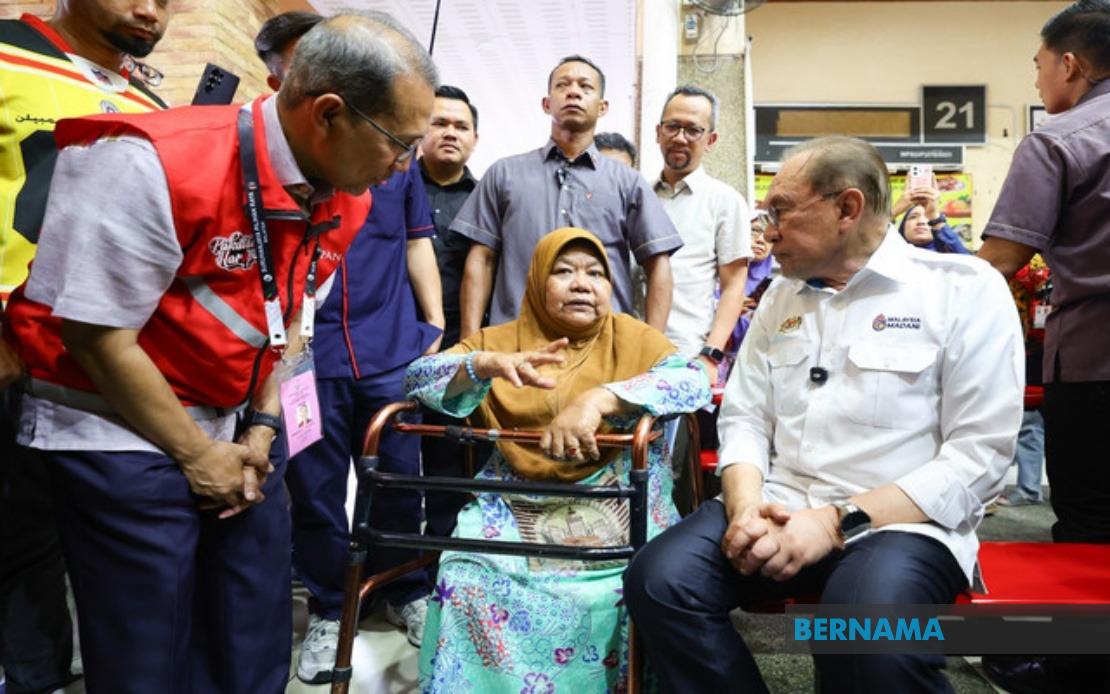
Determination and hope overcame physical hardship when 68-year-old Jumaah Mohd Alif navigated her three-wheeled motorcycle through drizzling rain from Kampung Gedung Lalang to Benteng Ampangan in Seremban, driven by a singular ambition: to meet Prime Minister Datuk Seri Anwar Ibrahim face-to-face. The encounter, which took place on July 22, represented far more than a casual political interaction—it was the realisation of a long-cherished personal dream for someone who has lived with significant physical constraints for three and a half decades.
Jumaah's resilience is particularly striking given her circumstances. Having lost her left leg in an accident 35 years ago, she has navigated life as a person with disabilities (PwD) through decades marked by societal barriers and accessibility challenges. Despite these realities, she seized the opportunity when word spread through her village that the Prime Minister would be campaigning in the area. Without hesitation, she prepared her three-wheeled motorcycle and set out, undeterred by the wet weather conditions that might have deterred others in better physical health. Her willingness to brave the elements underscores both her determination and the profound significance she attached to this moment.
In an interview with Bernama, Jumaah described how village neighbours had informed her of Anwar's impending arrival, prompting her to make the journey. She expressed genuine amazement that the opportunity had materialised, having previously encountered the Prime Minister only through television screens or from considerable distances. The personal meeting transformed what might have remained a distant aspiration into concrete reality, a validation of her persistence and hope that political leaders would acknowledge citizens like her. For individuals with disabilities in Malaysia, access to high-level political engagement remains relatively uncommon, making such encounters particularly significant within community contexts.
The Negeri Sembilan campaign visit occurred as part of broader efforts by the Pakatan Harapan (PH) coalition, of which Anwar serves as chairman, to consolidate momentum ahead of the state election. The timing of his presence in Ampangan aligned perfectly with Jumaah's opportunity, though neither she nor the electoral machinery could have anticipated that her quiet determination would resonate as a human-interest narrative during the political season. Such spontaneous encounters between ordinary citizens and national leadership often reveal the genuine concerns and aspirations of the electorate beyond formal campaign structures.
Jumaah's explicit hope, voiced during her meeting with the Prime Minister, centred on continued government prioritisation of welfare provisions for vulnerable populations, particularly elderly citizens and persons with disabilities. This advocacy reflects a broader concern within Malaysia's PwD community regarding adequate social support systems, healthcare access, and economic assistance. Her statement carries particular weight as it emerges from lived experience rather than abstract policy discussion, grounding concerns about disability inclusion in personal testimony. For policymakers monitoring public sentiment during election periods, such direct feedback from constituents provides invaluable perspective on which issues demand urgent attention.
The accessibility and dignity dimensions of Jumaah's journey warrant consideration within Malaysia's ongoing disability rights discourse. That a woman with significant physical limitations felt motivated to undertake such effort to meet her country's leader suggests both deep civic engagement and, potentially, a sense that conventional channels for expressing concerns may feel distant or ineffective. Her choice to use a three-wheeled motorcycle—likely her primary mode of independent mobility—demonstrates resourcefulness and adaptation, qualities essential for many Malaysians living with disabilities who navigate infrastructure and services not always designed with their needs in mind.
The Negeri Sembilan state election campaign, which designated July 28 for early voting and August 1 as polling day, provided the electoral context for this encounter. State elections offer particularly significant opportunities for direct engagement between voters and leadership, as campaigns tend to be more locally focused than national contests. Anwar's presence in Ampangan reflected the coalition's strategic focus on Negeri Sembilan during the critical phase before voting commenced. For candidates and campaign machinery, voter engagement such as Jumaah's encounter illustrates the importance of community presence and accessibility during electoral periods.
Jumaah's narrative also raises questions about representation and visibility within Malaysian political discourse. Senior citizens and persons with disabilities collectively represent substantial voting constituencies, yet their specific policy concerns often receive secondary emphasis in mainstream campaign messaging. Individual stories like Jumaah's can serve as catalysts for broader public conversation about whether existing welfare frameworks adequately serve these populations, and whether political parties are genuinely addressing their priorities or merely making symbolic gestures during election cycles. Her directness in expressing hope for continued governmental support suggests she expects accountability.
The weather conditions Jumaah encountered—drizzle that might ordinarily discourage travel—took on symbolic resonance given her determination to proceed regardless. In Malaysian contexts where monsoon seasons and tropical rainfall are regular phenomena, the willingness to venture out in poor weather reflects significant motivation. For individuals with mobility challenges, managing weather-related complications adds another layer of complexity to routine journeys, making Jumaah's decision to travel through drizzle even more demonstrative of her commitment to this particular objective.
Beyond the immediate personal satisfaction Jumaah derived from meeting Anwar, her journey illuminates broader themes about civic participation, accessibility, and political engagement among marginalised communities in Malaysia. Whether the encounter translates into concrete policy developments or enhanced support mechanisms remains to be seen, but the symbolic importance of a person with disabilities actively seeking engagement with national leadership establishes a precedent worth noting. Her determination challenges assumptions about whose voices matter in political discourse and whose aspirations deserve attention from policymakers.
The encounter between Jumaah and Prime Minister Anwar concluded a campaign visit that, for her, represented the culmination of long-held personal aspiration. As Malaysia's electoral landscape continues evolving and new state elections approach, stories like hers serve as reminders that meaningful political engagement encompasses far more than voting percentages and campaign rhetoric. They encompass the hopes, concerns, and determination of individual citizens who, despite significant barriers, remain actively invested in their country's direction and in being heard by those who lead it.

