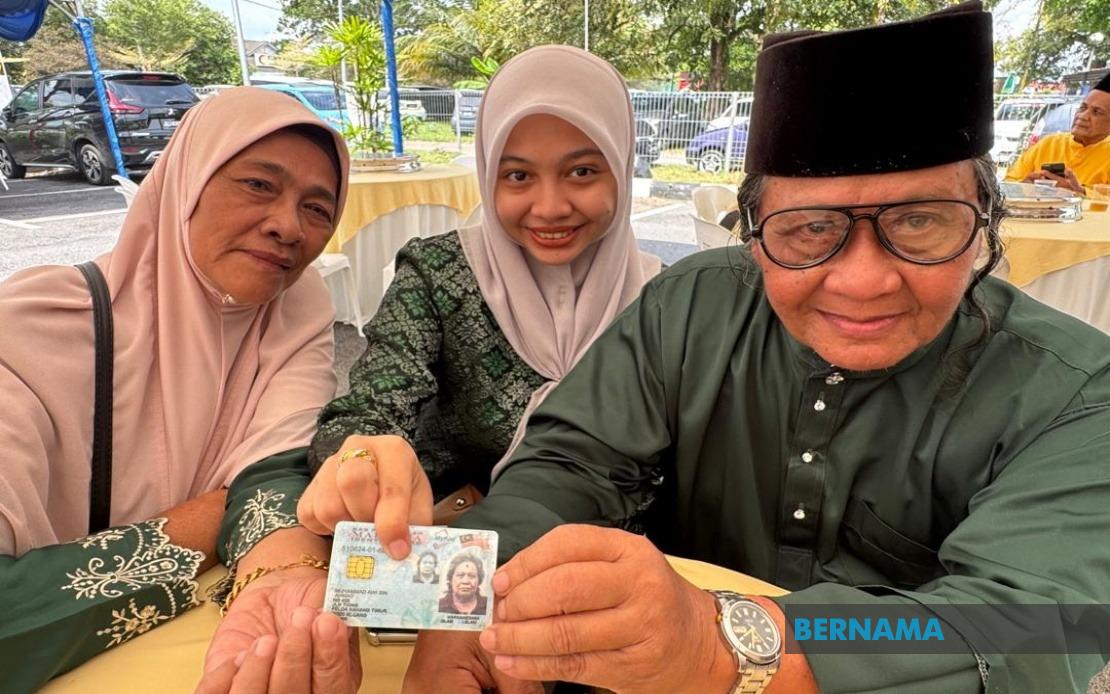
A 75-year-old Felda settler in Kluang marked his birthday yesterday with the realisation of a lifelong ambition: receiving the official ownership title to his 4.2-hectare plantation and residence. Muhammad Awi Ahmad's perseverance across three applications spanning three decades exemplifies the broader struggle that has confronted thousands of Federal Land Development Authority settlers seeking to formalise land rights in Johor. Yesterday's handover ceremony distributed titles to 210 recipients across Kluang, Kota Tinggi and Mersing, representing a watershed moment for a community that has long felt uncertain about its legal standing on land worked for generations.
The pathway to ownership has been fraught with bureaucratic complexity. Muhammad Awi first applied in 1990, then again in 2000, both times receiving rejection. It took a third application to finally succeed under the current Johor administration led by Menteri Besar Datuk Onn Hafiz Ghazi, which processed his case in approximately one year. For Muhammad Awi, the timing carried personal poignancy—receiving confirmation on his 75th birthday that decades of cultivation have legally translated into ownership. His experience reflects a systemic delay that has affected thousands across the state, though the recent acceleration suggests administrative reform is taking effect.
The generational dimension adds particular urgency to this issue. Muhammad Awi's daughter Norliyani, representing the second generation of Felda families, articulated a concern that extends beyond her father's situation. Where the first generation maintains cultural and practical ties to their ancestral villages, younger settlers regard their Felda allocations as permanent homes with no fallback option. Without formalised ownership, property could theoretically pass to others despite families' decades of labour. This intergenerational vulnerability has driven younger settlers to advocate actively for title resolution, understanding that inheritance and family security depend on securing legal documentation before elder family members pass away.
Mohd Farhan Mohamad's journey illustrates how applications can span generations within single families. He submitted his first title application in 2006, motivated by his father Mohamad Masek's desire to secure the land cultivated since the 1980s. Almost two decades elapsed before approval came through this year, during which both father and son experienced prolonged uncertainty. Farhan's modest expectation—he did not anticipate approval when reapplying last year—reveals how normalised rejection had become within the settler community, making success almost surprising rather than routine.
The administrative breakthrough appears quantifiable. Official figures show that 27,639 of 27,642 Felda settlers in Johor who submitted applications have now received ownership titles, representing 99.9 per cent approval. This near-universal resolution suggests that initial rejections stemmed from administrative or documentary issues rather than policy resistance. The dramatic improvement under the current state government indicates that streamlined procedures and political commitment can rapidly address longstanding problems, even where bureaucratic inertia previously prevailed. For Malaysian policymakers monitoring service delivery, the Johor model demonstrates how institutional reform at state level can resolve issues affecting thousands.
The economic implications extend beyond individual family security. Formalised land titles enable settlers to access credit markets, as banks require documented ownership for mortgage lending. With 27,600 newly titled properties, Felda communities now theoretically possess collateral for agricultural expansion, equipment purchases, or diversification into higher-value crops. This could gradually transform Felda settlements from subsistence-oriented to commercially competitive, though much depends on complementary policies regarding agricultural extension and market access. The land title resolution thus potentially unlocks economic productivity that has remained constrained by property uncertainty.
For younger Felda residents, secure ownership addresses inheritance concerns that could otherwise fragment family farms. Malaysian succession law requires clear title documentation to adjudicate estate distribution, and without titles, disputes among heirs could paralyse agricultural operations for months during probate. By securing titles while settler founders remain alive, families can engage in formal succession planning, establish wills with clear property descriptions, and ensure smooth transitions to next-generation operators. This institutional consolidation strengthens agricultural continuity, which benefits both family economics and national food security.
The resolution also carries symbolic weight within Malaysian federalism. Felda settlements represent a distinctive model of rural development pursued across multiple states, yet property rights administration has operated unevenly. Johor's near-complete resolution sets a benchmark that other state governments may face pressure to match. Settlers in comparable Felda communities in Pahang, Terengganu, or other states may petition their governments for equivalent title programmes, creating potential momentum for broader institutional reform. This horizontal policy diffusion—where one state's success prompts replication elsewhere—represents an underappreciated mechanism for governance improvement in Malaysia's federal system.
The remaining 0.1 per cent of unsettled applications warrant monitoring. Three settlers among 27,642 still lack approved titles, though the reasons remain unspecified. These outliers could reflect exceptional circumstances—disputed boundaries, inheritance complications, or documentation defects—rather than systematic rejection. Johor authorities should publicly clarify the status of these three cases and establish a transparent process for resolution, preventing them from becoming symbolic reminders that the programme remains incomplete. Complete closure would require addressing whatever obstacles these final cases present.
Looking forward, the title resolution represents necessary but incomplete reform. Settlers now possess ownership documentation, yet agricultural profitability depends on complementary support: improved road infrastructure accessing markets, technical training in sustainable farming, access to affordable credit, and premium price mechanisms for quality produce. Title security alone cannot guarantee economic viability if farming conditions remain structurally disadvantaged. State and federal authorities should integrate the land title programme with comprehensive agricultural modernisation initiatives, ensuring that Felda communities can convert ownership rights into genuine prosperity. The ceremonial handover yesterday was politically significant, but the settlers' long-term wellbeing will ultimately depend on what follows in subsequent months and years.

