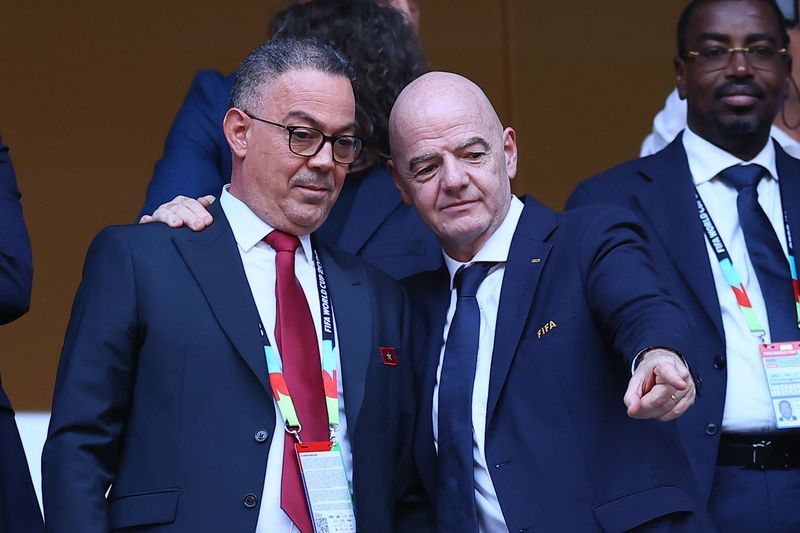
Embattled FIFA President Gianni Infantino has secured backing from influential African football administrators in his struggle to retain his position, a crucial advantage as he prepares for a presidential election scheduled for March. The show of support from the continent's leadership comes at a particularly vulnerable moment, with Infantino facing widespread criticism over his failed attempt to monetize future World Cup broadcasting rights. The endorsements from senior figures within the Confederation of African Football suggest that the bloc's substantial voting power could prove decisive in Infantino's effort to secure another term at the helm of world football's governing body.
The African football establishment has demonstrated notably different positioning compared to other continental confederations. While football administrators from Asia, Europe, and CONCACAF—the governing body for North and Central America and the Caribbean—publicly declared a loss of confidence in Infantino's leadership over the weekend, the African confederation has maintained a measured stance that preserves its negotiating position. This strategic silence contrasts sharply with the swift condemnation from other regions and reflects the complex calculus of African football politics, where financial considerations and historical relationships often outweigh concerns about governance.
Prominently among Infantino's supporters are CAF Vice President Fouzi Lekjaa of Morocco and FIFA Council members including Hany Abo Rida from Egypt, Hamidou Djibrilla from Niger, and Ahmed Yhaya from Mauritania. Their public statements, while welcoming Infantino's decision to abandon the controversial revenue-sharing scheme known as the FIFA Forward Enterprise initiative, went further in reaffirming their personal confidence in his leadership. Additional backing has come from Veron Mosengo-Omba, the newly elected president of the Democratic Republic of Congo's football federation and former CAF general secretary, who shares a personal connection with Infantino from their university days in Switzerland.
The failed initiative that triggered the current crisis centered on creating a new commercial entity designed to raise approximately $4.2 billion by selling stakes in World Cup broadcasting revenues. The proposal faced immediate and intense opposition across multiple confederations, forcing Infantino to abandon the plan on Friday despite its presence on the agenda for the Confederation of African Football's executive committee meeting. The swift capitulation to external pressure revealed the limits of Infantino's political capital in certain regions, yet paradoxically may have strengthened his position within African circles by demonstrating responsiveness to concerns about how future revenues would be distributed.
The financial dimension underlying African support for Infantino cannot be overstated. Since his election in 2016, Infantino has exponentially expanded the distribution of FIFA money to member associations, building on a model initially conceived by his predecessor Sepp Blatter. The baseline funding now guarantees each of FIFA's 211 member associations $8 million over a four-year cycle, a figure that has proven transformative for developing football nations with limited domestic revenue sources. The Confederation of African Football has supplemented this with its own annual grants to members, creating a financial ecosystem upon which many struggling associations have become dependent.
For many African nations, the flow of FIFA money represents one of the few reliable funding streams available to their football federations. Fleetwood Haiya, president of the Football Association of Malawi, articulated this reality starkly when describing how his association struggles to secure basic necessities. The government of Malawi must prioritize medical supplies in hospitals and other essential services, leaving little room for investment in football infrastructure, stadiums, or player development. Saïd Ali Athouman, heading the Comoros Football Federation, similarly emphasized how the reliance on international funding stems from the absence of domestic sponsorship and the competitive disadvantage this creates against wealthy European nations with abundant resources for training facilities and equipment.
This dependency creates an asymmetry of power that works decidedly in Infantino's favor. The African member associations have benefited substantially from his tenure and face genuine uncertainty about whether a successor would maintain or expand the financial generosity that has characterized his approach. The precedent Infantino set by increasing development funding far beyond what his predecessors offered has effectively locked many African football bodies into supporting his continuance in office. Any candidate challenging him would face immediate questions about whether they would preserve these financial commitments, a concern that naturally pushes African federations toward backing the proven incumbent.
The contrast between Infantino's original election in 2016 and his current predicament reveals the enduring importance of African support in FIFA politics. Infantino's first victory came substantially on the back of endorsements from African member associations, who had never before received systematic financial assistance from world football's governing body. When Sepp Blatter ran for election against UEFA president Lennart Johansson in 1998, he similarly secured African backing through promises of financial support, despite CAF's formal endorsement of his opponent. This historical pattern demonstrates that African football administrations have consistently recognized financial development as their primary interest and have voted accordingly.
Infantino's rebranding of Blatter's Goal Project as FIFA Forward, coupled with a significant expansion in funding levels, has deepened this relationship further. The African football establishment views Infantino not merely as a competent administrator but as someone who has demonstrated concrete loyalty to the continent's football development. Patrice Motsepe, who was effusive in his praise of Infantino days before the World Cup revenue scandal emerged, articulated this sentiment by characterizing Infantino as a loyal friend to Africa, someone whose support for African football transcends transactional politics.
The upcoming CAF executive committee meeting will provide the first formal opportunity for the confederation to articulate its collective position on Infantino's future. While individual members have issued statements of support, the confederation has not yet taken an official stance that could formally commit its bloc of voters. Nevertheless, the pattern of individual endorsements from influential figures suggests that any formal CAF statement would likely prove favorable to Infantino. The agenda item addressing the abandoned FIFA Forward Enterprise initiative will provide the ostensible framework for discussion, though the real negotiations will involve assurances about future funding and financial commitments.
For Malaysian observers and Southeast Asian stakeholders, the African football bloc's positioning carries implications for the broader geopolitical dynamics within FIFA. The Asian confederation's declaration of lost confidence in Infantino, alongside European and CONCACAF statements, might appear to presage his political isolation. However, the demonstrated strength of African support suggests that Infantino retains a viable path to reelection through strategic coalition-building centered on member associations whose primary concern remains financial support rather than governance reforms. The March presidential election will test whether financial incentives and personal relationships can overcome the governance concerns raised by wealthier and more institutionally developed confederations.
The current situation underscores fundamental tensions within FIFA's governance structure, where voting power remains distributed equally among member associations regardless of economic capacity or football development level. This structure gives disproportionate influence to the African confederation and other developing regions whose votes can be influenced through financial commitments. Infantino's strategy of substantially increasing development funding appears designed precisely to leverage this structural reality, creating a coalition of financially dependent members whose votes he can count on during contested elections. Whether this approach will prove sufficient to overcome the opposition from wealthier confederations will become apparent over the coming months as the March election approaches.

